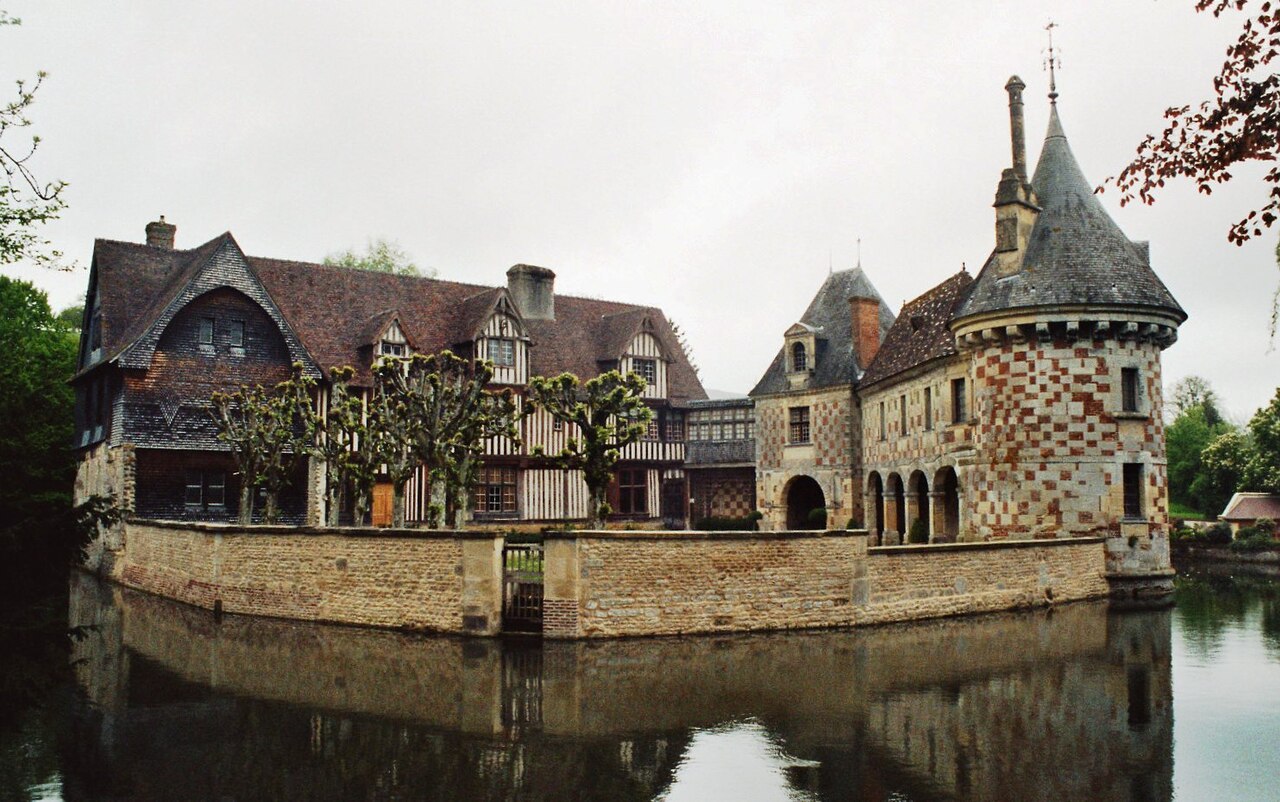
Château de Fauguernon
The Château de Fauguernon is a notable medieval fortress located in the municipality of Fauguernon within the Hauts-de-France region of northern France. This hill castle occupies a strategic ridge overlooking the surrounding landscape, including the valley of the Touques River and the Lieuvin plateau, which provided natural defensive advantages. Constructed and developed over several centuries, its architecture and history reflect the turbulent medieval period shaped by the Normans and later French noble families.
The origins of the estate trace back to the early 11th century, when the fief was held by Toustain de Bastebourg. The castle itself was gradually built and expanded from the 12th through the 16th centuries, evolving from a simple fortification into a complex defensive stronghold. In 1147, the castle was the site of a significant siege lasting three months, during which Robert Bertran valiantly defended the fortress before it fell to Geoffrey Plantagenet, Count of Anjou. Following its capture, the castle was ordered to be destroyed, yet the Bertran family managed to retain control over the surrounding lands and multiple lordships, continuing their influence into the late 12th and early 13th centuries. Members of the Bertran family also participated in crusading efforts, underscoring their prominence in regional affairs.
Medieval ownership and military history
By the mid-14th century, ownership of the castle shifted through marriage alliances to the Garancières and later the Montenay families. The castle endured the upheavals of the Hundred Years’ War, a protracted conflict between England and France. In 1417, English forces occupied the fortress, exploiting its strategic location. However, the castle was reclaimed by French troops in 1449, restoring French control. The Montenay family maintained possession until 1493, after which the estate was acquired by Christophe de Cerisay, chamberlain to King Charles VIII. Subsequently, the property passed by marriage to the Brézé family, a distinguished noble house with significant influence in the region.
The death of Louis de Brézé in 1589 precipitated the division of the estate among his cousins. The following year, during the religious conflicts known as the French Wars of Religion, the castle again became a focal point of military action. In 1590, the fortress was seized by the Duke of Montpensier, the governor of Normandy and a leading figure in the Catholic League. Due to its role as a refuge for League members, the castle was subjected to a decisive siege and was dismantled by cannon fire, marking the end of its military significance.
Architectural features and castle layout
The Château de Fauguernon was designed with robust defensive works characteristic of medieval military architecture. It features a double enceinte, consisting of two layers of enclosing walls, which provided formidable protection against attackers. Between these walls, deep moats were excavated, some of which remain visible today as water-filled ditches, illustrating the castle’s strategic use of natural and artificial defenses.
The outer enclosure contained a lower courtyard primarily used for agricultural activities. Within this area stood a farmstead whose surviving buildings preserve architectural elements dating back to the 16th century. This adaptation highlights the castle’s transition from a purely military fortress to a residence with economic functions. Access from the lower courtyard to the castle’s inner defenses was controlled by a drawbridge, a movable bridge that could be raised or lowered to regulate entry and enhance security.
The inner enclosure was laid out on an approximately square plan, fortified by exceptionally thick walls measuring close to two meters in width. This stronghold was protected by seven towers, strategically positioned to defend against assaults from all directions. Among these towers stood a donjon or keep, which served as the central tower and last refuge during attacks. The donjon also symbolized the lordly authority of the castle’s owners. Although the castle was dismantled during its 1590 siege, many of these defensive features remain visible as ruins, offering valuable insight into medieval fortification techniques.
Post-medieval history and preservation
Following its dismantling, the estate was sold in the early 17th century to Nicolas de Mire and eventually came into the possession of the Le Conte de Nonant family. They maintained the property through the 18th century, carrying noble titles associated with Fauguernon until the upheavals of the French Revolution significantly altered the social and political landscape of France.
Today, the Château de Fauguernon stands as a protected historic monument, having been officially recognized and safeguarded since October 16, 1930. Its ruins offer a tangible connection to the medieval past and serve as an important archaeological and cultural heritage site. Visitors can explore the remains of its defensive walls, towers, and moats, gaining insight into the evolution of castle architecture and the region’s complex history.
Strategic location and natural surroundings
Perched atop a ridge, the castle’s location provided commanding views over the village of Fauguernon and the surrounding countryside. This vantage point was crucial for early warning against invaders and controlling the nearby valley of the Touques River. The proximity to the Lieuvin plateau further enhanced its strategic importance, allowing the castle’s occupants to monitor movements across a broad area. The natural topography was skillfully integrated into the castle’s defensive design, maximizing its resilience against siege warfare.
Cultural significance and legacy
The Château de Fauguernon embodies the historical narrative of northern France’s medieval and early modern periods. It reflects the shifting power dynamics among noble families, the impact of major conflicts such as the Hundred Years’ War and the French Wars of Religion, and the architectural responses to evolving military technologies. As a heritage site, it offers scholars and visitors alike an opportunity to study the complexities of feudal society, military strategy, and architectural innovation.
Efforts to preserve the ruins underscore the importance of maintaining such sites for educational and cultural enrichment. The castle’s remains continue to inspire interest in medieval history and serve as a testament to the resilience and adaptability of fortress design over centuries.
Frequently asked questions (FAQ)
- What is the historical significance of Château de Fauguernon?
- Château de Fauguernon is significant for its role in medieval conflicts such as the Hundred Years’ War and the French Wars of Religion, reflecting the turbulent history of northern France.
- Can visitors explore the ruins of Château de Fauguernon?
- Yes, visitors can explore the ruins, including the defensive walls, towers, and moats, which provide insight into medieval military architecture.
- When was Château de Fauguernon built?
- The castle was constructed and expanded over several centuries, primarily from the 11th to the 16th centuries.
- Why was Château de Fauguernon dismantled?
- It was dismantled in 1590 after being seized by the Duke of Montpensier during the French Wars of Religion due to its use as a refuge for Catholic League members.
- What defensive features did Château de Fauguernon have?
- The castle featured a double enceinte with two layers of walls, deep moats, seven defensive towers, and a central donjon or keep.
Information
Loading map...
Visitor reviews
No reviews yet. Been here? Write the first review and help other travelers!
Write the first reviewVisited this castle? Share your experience
Your review helps other travelers and adds first-hand knowledge to our encyclopedia.