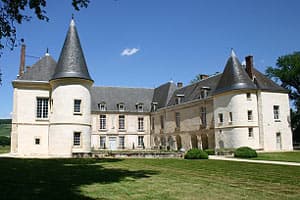
Château de Condé
The Château de Condé stands as a remarkable testament to centuries of French history, architecture, and art. Located in Condé-en-Brie within the Hauts-de-France region, this hill castle occupies a strategic site where the Dhuis and Surmelin rivers converge. Its name, derived from the Gaulish "Condate," reflects this geographical significance. The site has been continuously important since ancient times, originally hosting a Gallo-Roman villa that laid the foundation for the castle's enduring legacy.
The castle's history is deeply intertwined with the medieval period, beginning with the early 13th-century fortress constructed by Enguerrand III de Coucy. This original fortress featured formidable two-meter-thick stone walls and broad arrow slits designed for defense, parts of which remain visible today. Over the centuries, the castle passed through the hands of several noble families, including the Counts of Bar, the House of Luxembourg, and ultimately the House of Bourbon, reflecting its importance in French noble lineage.
Medieval origins and strategic importance
The earliest known lord associated with the estate was Jean de Montmirail. By the year 1200, his son-in-law, Enguerrand III de Coucy, established the stone fortress that formed the core of the castle. The fortress was strategically positioned to control the confluence of two rivers, enhancing its defensive capabilities. The thick walls and arrow slits were characteristic of early medieval military architecture, designed to withstand sieges and attacks.
During the early medieval period, the area was contested by local tribes such as the Senones and Condruses, underscoring the site's ongoing strategic value. The castle's location on a hill provided a commanding view of the surrounding landscape, which was crucial for monitoring movements and defending the territory.
Renaissance transformation and artistic enrichment
In the early 16th century, the castle underwent a significant transformation under Louis, Cardinal of Bourbon-Vendôme. He converted the medieval fortress into an expansive Renaissance hunting lodge, reshaping much of the structure while retaining about two-thirds of the original footprint. Cardinal Louis's heraldic symbols, including his coat of arms and cardinal's hat, remain visible on architectural elements such as door pediments and fireplaces, symbolizing his influence.
This period marked a shift from purely defensive architecture to a residence reflecting status, comfort, and leisure. The castle's interiors began to incorporate artistic and decorative elements that aligned with Renaissance tastes, emphasizing elegance and refinement.
Ownership by the house of condé and subsequent history
The estate became closely associated with the House of Condé when Louis, the cardinal's nephew, inherited it in 1556. Known as "Monsieur le Prince" or Prince of Condé, he and his wife, Éléonore de Roye, made the castle their family home. After Louis's assassination in 1569, the property remained with the Bourbon family until 1624, when it passed to the House of Savoy through marriage.
Under the reign of Louis XIV in 1711, the French properties of the House of Savoy, including Château de Condé, were confiscated and placed under military occupation. This period saw the castle's condition decline significantly due to neglect and the impacts of military use.
18th-century restoration and artistic patronage
The castle's fortunes revived when Jean-François Leriget de La Faye, a prominent financier, writer, and diplomat, acquired the estate in the 18th century. He commissioned the architect Servandoni to redesign the château, imparting much of its current appearance. Servandoni's work included reconstructing roofs, modifying the courtyard layout by removing one wing to enhance sunlight, and applying trompe-l'œil techniques to maintain symmetrical façades despite the thickness of medieval walls.
De La Faye also engaged leading artists of the time to enrich the interiors. Notable contributors included Jean-Antoine Watteau and his students Lancret, Pater, and Bonaventure de Bar, as well as Jean-Baptiste Oudry and François Boucher. These artists created frescoes, canvases, and decorative schemes that celebrate themes of mythology, hunting, and leisure, reflecting the cultural refinement of the French aristocracy during the Enlightenment.
Architectural features and interior highlights
The château's layout centers around a cour d’honneur, originally enclosed by four wings. The medieval gatehouse (porterie) and the capitainerie with its prison facilities remain significant features. The prison door, with its heavy locks, stands as a testament to the castle's defensive and judicial functions in earlier centuries.
Underground passages beneath the castle and adjacent buildings hint at a complex network likely used for secure communication or escape routes. Some of these tunnels remain accessible, underscoring the castle's strategic design.
The interior boasts a grand ceremonial staircase from the 18th century, replacing the original Renaissance stone staircase. This staircase not only serves practical purposes but also symbolizes the social status and aesthetic values of the period.
Distinctive rooms include the Richelieu chamber, Oudry salon, Servandoni-decorated room, Olympe Mancini chamber, and the Watteau wing, where recently uncovered frescoes have added to the château's artistic heritage. The musician’s chamber further reflects the cultural life nurtured within the castle.
Damage, restoration, and cultural significance in modern times
The château suffered considerable damage during both World Wars due to bombardments and looting, threatening its valuable artworks. Fortunately, many pieces were preserved or restored through dedicated conservation efforts after 1946. The de Sade family undertook extensive restoration in three phases, focusing on structural stability, interior refurbishment, and art preservation.
In 1979, the château was officially classified as a historic monument, recognizing its architectural and cultural significance. Since 1983, under the ownership of Alain Pasté de Rochefort and subsequently his family, restoration and maintenance have continued, ensuring the château's preservation for future generations.
Today, the Château de Condé is not only a heritage site but also a vibrant cultural venue hosting concerts, film productions, car rallies, ballooning challenges, and art exhibitions. This ongoing use highlights the château's role as a living monument that bridges history, art, and contemporary culture.
Photo gallery

Information
Sources & official resources
Verify the information above using these authoritative references.
Loading map...
Visitor reviews
No reviews yet. Been here? Write the first review and help other travelers!
Write the first reviewVisited this castle? Share your experience
Your review helps other travelers and adds first-hand knowledge to our encyclopedia.



