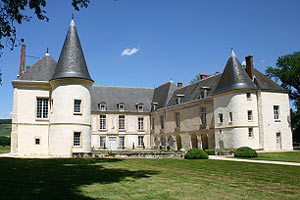
Château-Thierry Castle
Château-Thierry Castle, also known locally as Château de Château-Thierry, is a significant medieval fortress situated on a prominent hill in the town of Château-Thierry, within the Aisne department of northern France. This castle holds a rich history dating back to the early Middle Ages and stands as a remarkable example of military architecture evolving through centuries of conflict and adaptation.
The origins of the site trace back to the early 8th century when the Frankish ruler Charles Martel established a fortification around 720 AD. This early stronghold served as a residence for the young Merovingian king Theuderic IV (also known as Thierry IV), who was under Charles Martel's control. The name of the town itself, Château-Thierry, is derived from this period, originally known as Castrum Theodorici, meaning "Castle of Theuderic," which eventually evolved into its modern French form.
Early medieval origins and foundation
In the 10th century, the castle was the home of Herbert le-Vieux, Count of Omois from the House of Vermandois and Soissons, marking its importance as a noble residence. By 1060, significant modifications were undertaken by Hughes Lambert, who leveled the top of the hill to prepare the site for a more formidable fortress.
The present-day ruins primarily date from the 12th century when the castle was established by the powerful Counts of Champagne. This period corresponds to the High Medieval era, a time when castle-building flourished across France as feudal lords sought to assert control over their territories through imposing stone fortifications.
Architectural evolution and medieval significance
Between 1220 and 1230, the castle underwent a major reconstruction under Theobald IV, Count of Champagne. This phase introduced robust defensive features characteristic of the early 13th century, including a large enclosure surrounded by a curtain wall fortified with eight circular towers on the north side. These towers were equipped with arrow slits, designed for archers to defend the castle effectively against attackers.
The south side of the enclosure was later adapted to the changing demands of warfare during the 15th and 16th centuries. The walls here were reinforced with rectangular towers featuring breeches for guns, reflecting the introduction of firearms and artillery in castle defense. One of these towers contains a staircase leading to the gardens, indicating the castle's dual role as both a military stronghold and a noble residence.
Additional remnants include parts of the main gate, a Romanesque keep, and the foundations of several other buildings within the large enclosure. The sheer size of the castle's footprint suggests it was a formidable fortress commanding the surrounding landscape.
Historical ownership and military events
After its initial construction and rebuilding, Château-Thierry Castle fell under the control of the Lords of Coucy until 1285. Following this, it became part of the royal domain of France, reflecting its strategic importance. In the early 15th century, it was granted to Louis I, Duke of Orléans, but after his assassination in 1407, the castle reverted once again to royal ownership.
The castle and town were significant in the turbulent conflicts of the Hundred Years' War. In 1421, the English captured Château-Thierry, underscoring its military value. Later, in 1544, the fortress was seized by Charles V, Holy Roman Emperor, during his campaigns in France.
Eventually, the castle became part of the holdings of the Bouillon family, who neglected its upkeep. This lack of maintenance led to the castle's gradual decline into ruin, a fate common to many medieval fortresses rendered obsolete by advances in military technology and changing political circumstances.
Architectural features and current state
Today, visitors to Château-Thierry Castle can explore the extensive ruins that reveal much about medieval military architecture. The northern curtain wall with its eight circular towers remains a highlight, showcasing early 13th-century defensive design with arrow slits for archers. In contrast, the southern wall's rectangular towers demonstrate adaptations for gunpowder weaponry, marking the castle's evolution through the late medieval period.
The Romanesque keep stands as a testament to the castle's origins, while the remains of the gatehouse and other structures provide insight into the castle's layout and function. The large scale of the enclosure emphasizes its role as a major defensive and administrative center in the region.
Château-Thierry Castle is freely accessible to the public during daylight hours, allowing visitors to appreciate its historical significance and architectural grandeur amidst the scenic backdrop of the Aisne countryside.
Cultural and historical legacy
The castle's name and foundation are deeply intertwined with early medieval Frankish history and the Merovingian dynasty, linking it to notable figures such as Charles Martel and Theuderic IV. Its strategic position and successive ownership by powerful noble families and the French crown reflect the shifting political landscape of medieval France.
Despite its current ruined state, Château-Thierry Castle remains a vital cultural landmark. It offers valuable insights into the evolution of castle architecture from the early medieval period through the High and Late Medieval eras, illustrating the transition from traditional fortifications to adaptations for gunpowder warfare.
Visitors and historians alike value the site for its extensive remains and the stories encapsulated within its walls, making Château-Thierry Castle a significant monument in the heritage of northern France.
Frequently asked questions (FAQ)
- How do I visit Château-Thierry Castle?
- Château-Thierry Castle is open to visitors freely during daylight hours. There is no entrance fee, and visitors can explore the ruins at their own pace.
- What is the historical significance of Château-Thierry Castle?
- The castle dates back to the early 8th century and played a key role in medieval French history, including ownership by the Counts of Champagne and involvement in the Hundred Years' War.
- What architectural styles are visible at Château-Thierry Castle?
- The castle features Romanesque elements in its keep and early 13th-century defensive structures, with later adaptations for firearms including rectangular gun towers.
- Is Château-Thierry Castle accessible for people with mobility issues?
- As the castle consists mainly of ruins on a hill, accessibility may be limited for visitors with mobility challenges due to uneven terrain and lack of modern facilities.
- When was Château-Thierry Castle built?
- The current castle ruins primarily date from the 12th century, with significant rebuilding in the early 13th century under Theobald IV, Count of Champagne.
Information
Opening hours
Daylight hours
Ticket prices
Free
Address
Allée Victor Gardeur, Château-Thierry, France
Loading map...
Visitor reviews
No reviews yet. Been here? Write the first review and help other travelers!
Write the first reviewVisited this castle? Share your experience
Your review helps other travelers and adds first-hand knowledge to our encyclopedia.