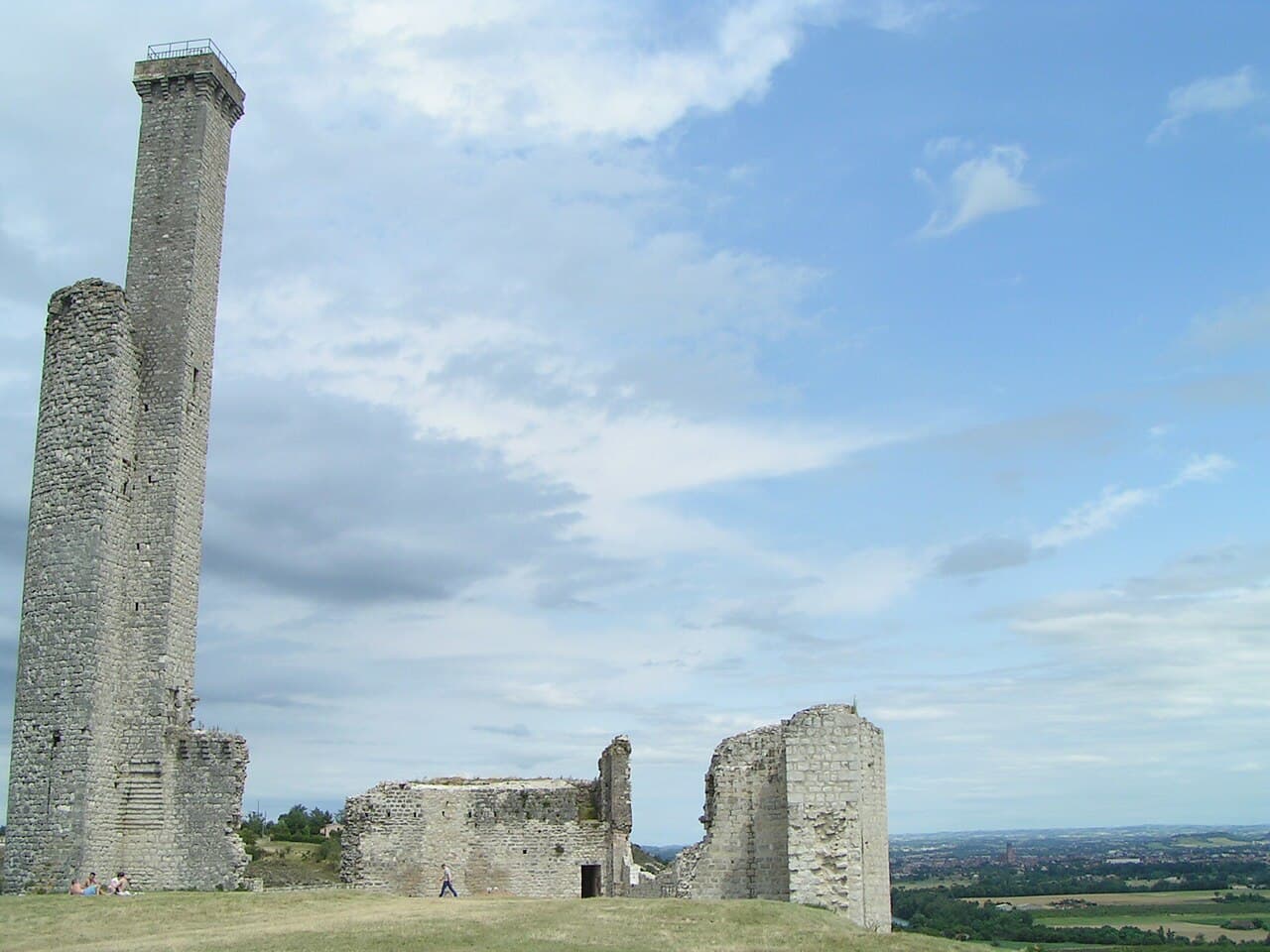
Château de Castelnau-de-Lévis
The Château de Castelnau-de-Lévis is a striking example of a high medieval hill castle strategically perched on the rocky summit of the puy de Bonnafous, commanding expansive views over the Tarn valley and the historic city of Albi in southern France. Constructed in the early 13th century by Sicard Alaman, a prominent noble aligned with Raymond VII, Count of Toulouse, the castle was originally known as Castelnau-de-Bonnafous. Its foundation was part of a broader defensive strategy to secure the northern frontier of Toulouse across the Tarn River during a period marked by regional conflicts and shifting allegiances.
The castle’s location on a steep hill provided natural defensive advantages, which were enhanced by the castle’s robust stone walls and towers that closely follow the contours of the terrain. This integration with the landscape exemplifies typical high medieval military architecture, designed to maximize visibility and defensibility. The fortress also gave rise to a small village at its base, which developed alongside the castle and contributed to the local economy and governance.
Historical development and ownership
Throughout its history, the Château de Castelnau-de-Lévis underwent significant transformations reflecting the changing needs and fortunes of its owners. In the 15th century, the castle passed into the hands of the Lévis family, who undertook extensive rebuilding efforts. These included the construction of a tower-logis, a residential tower that combined defensive features with domestic comfort, illustrating the period’s architectural evolution from purely military fortifications to fortified noble residences.
Later in the same century, the seigneurie was acquired by Hugues d’Amboise, baron d’Aubijoux. His descendants retained possession of the castle until the 17th century. Notably, Louis d’Amboise, comte d’Aubijoux, carried out restoration works and chose the castle as his residence, signaling its continued importance as a noble seat well into the early modern period.
Architectural features and surviving structures
The watchtower and defensive elements
One of the most prominent surviving features of the castle is the narrow square watchtower (tour de guet), which rises approximately 40 meters above the hilltop. This tower is a composite structure, with a 14th-century semicircular tower adjoined to an earlier 13th-century square staircase tower. Inside, the watchtower contains three vaulted floors with evidence of wooden flooring that once created additional levels, indicating a complex internal arrangement designed for surveillance and defense.
The tower-logis and residential quarters
The 15th-century tower-logis built by the Lévis family reflects a shift towards integrating domestic comfort within fortified structures. This tower overlooks the Tarn valley and the city of Albi, serving both as a lookout and a noble residence. Its architecture balances defensive needs with the requirements of a comfortable living space, a characteristic feature of late medieval castle evolution.
Enceinte and fortifications
Only one fortified gate remains from the castle’s lower enceinte, or outer defensive wall. Portions of the upper enceinte walls have been identified and partially restored, revealing the castle’s once extensive defensive network. The triangular layout of the castle follows the natural shape of the rocky hill, optimizing its defensive capabilities by minimizing blind spots and allowing defenders to cover all approaches effectively.
Decline, preservation, and current status
The castle’s decline began in the 19th century when it was increasingly used as a source of building stone, leading to significant structural losses. Despite this, the historical and architectural significance of the Château de Castelnau-de-Lévis was recognized early on, resulting in its designation as a French historic monument on 22 November 1909.
In the late 20th century, particularly during the early 1980s, conservation efforts focused on stabilizing the remaining structures, especially the upper defensive walls, to prevent further deterioration. Today, the castle remains privately owned, and while much of the original complex lies in ruins, the surviving watchtower and restored sections provide valuable insights into medieval military architecture and noble life in the region.
Significance in regional history and architecture
The Château de Castelnau-de-Lévis is a notable example of a hill castle that played a critical role in the defense of the Toulouse region during the high medieval period. Its architectural features illustrate the transition from purely military fortifications to fortified noble residences, reflecting broader social and political changes in medieval France.
The castle’s commanding position overlooking the Tarn valley and Albi made it a strategic stronghold controlling important routes and territory. Its history is intertwined with prominent regional families such as the Lévis and d’Amboise, whose influence extended over several centuries.
Today, the Château de Castelnau-de-Lévis stands as a testament to medieval fortification techniques adapted to the natural landscape, and its ruins continue to attract historians, architects, and visitors interested in the rich heritage of southern France.
Frequently asked questions (FAQ)
- When was Château de Castelnau-de-Lévis built and by whom?
- The Château de Castelnau-de-Lévis was built in the early 13th century by Sicard Alaman, a noble allied with Raymond VII, Count of Toulouse.
- What architectural features remain visible at Château de Castelnau-de-Lévis?
- The most prominent surviving feature is the 40-meter tall watchtower, along with remnants of the 15th-century tower-logis and portions of the defensive walls.
- Is Château de Castelnau-de-Lévis open to the public?
- The castle is privately owned and not generally open to the public, but its exterior and views can be appreciated from nearby areas.
- What is the historical significance of the castle's location?
- Situated on the puy de Bonnafous, the castle’s elevated position provided strategic control over the Tarn valley and the city of Albi, important for regional defense.
- What conservation efforts have been made to preserve the castle?
- Restoration and stabilization efforts began in the early 1980s, focusing on the upper defensive walls to prevent further deterioration.
Photo gallery

Information
Current owner
Private owner
Loading map...
Visitor reviews
No reviews yet. Been here? Write the first review and help other travelers!
Write the first reviewVisited this castle? Share your experience
Your review helps other travelers and adds first-hand knowledge to our encyclopedia.



