Château d’Aulteribe
The Château d’Aulteribe stands as a remarkable example of a medieval hill castle in the heart of the Auvergne region of central France. Located in Sermentizon within the Puy-de-Dôme department, this castle has a rich history that spans from its origins in the late 13th century through significant transformations in the 15th, 17th, and 19th centuries. Its strategic position near the ancient Roman Via Agrippa highlights its historical importance in controlling regional routes connecting major cities such as Lyon, Clermont-Ferrand, and Limoges.
The castle’s initial construction dates to the late 13th century, with the earliest recorded noble associated with the estate being Odinet Cholet, a young nobleman or "damoiseau". By around 1400, the estate had established a hereditary lordship under Pierre Cholet. The castle’s fortifications were significantly enhanced in 1467 by Charles Motier de La Fayette, who added arrow slits and cannon openings to adapt to evolving military technology during the turbulent late Middle Ages. Ownership passed through the Montboissier family and later the Montagu family, reflecting the shifting noble alliances and inheritance practices characteristic of the period.
Architectural evolution and defensive features
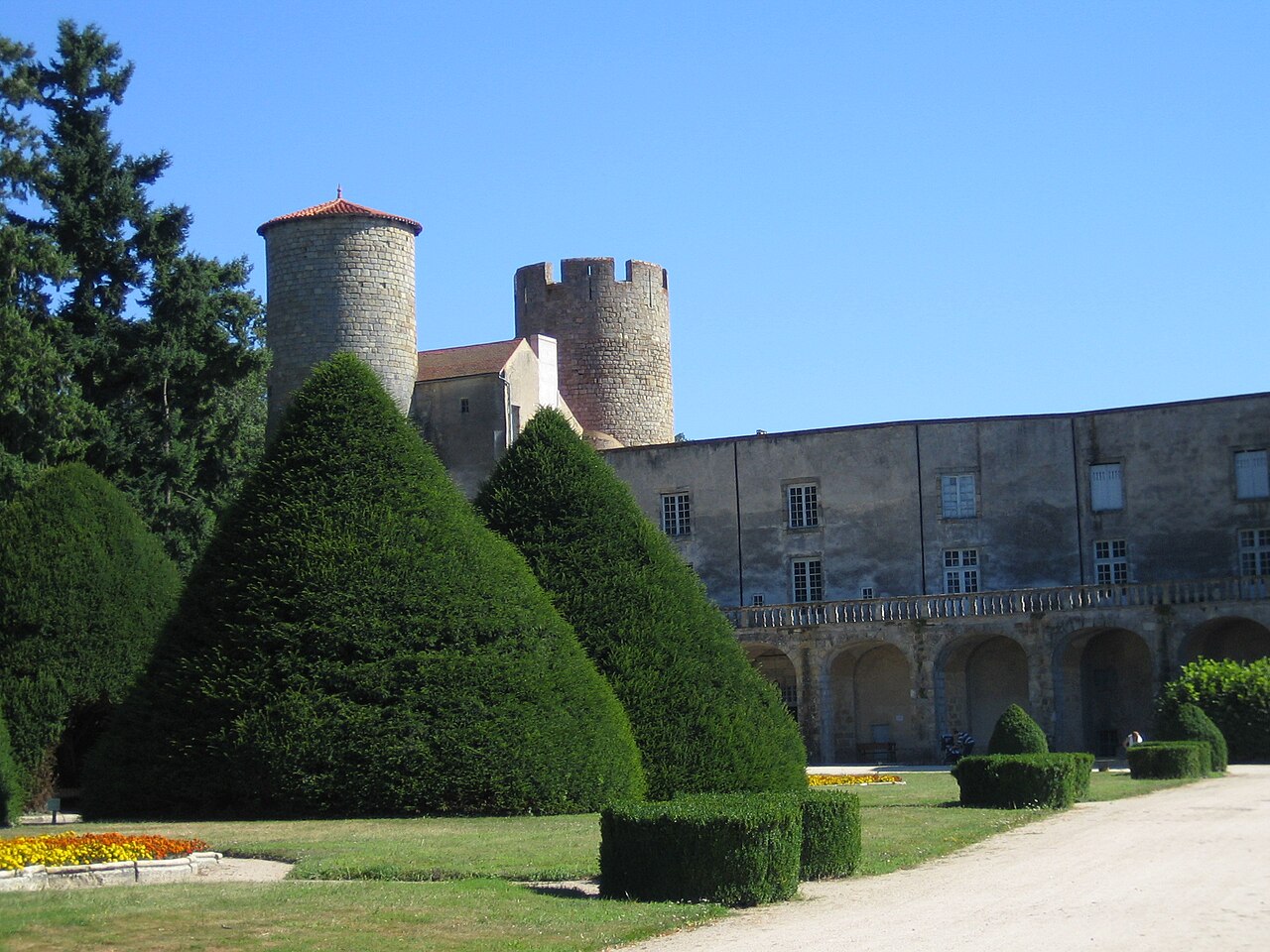
The Château d’Aulteribe is built on a polygonal plan featuring rooms arranged around a small interior courtyard. Originally, the castle had a square plan with four corner towers and was naturally defended by ravines on three sides. The southern side included an enclosure with towers, a gatehouse, and a drawbridge, emphasizing its defensive role. These fortifications were typical of late medieval hill castles designed to withstand sieges and control the surrounding territory.
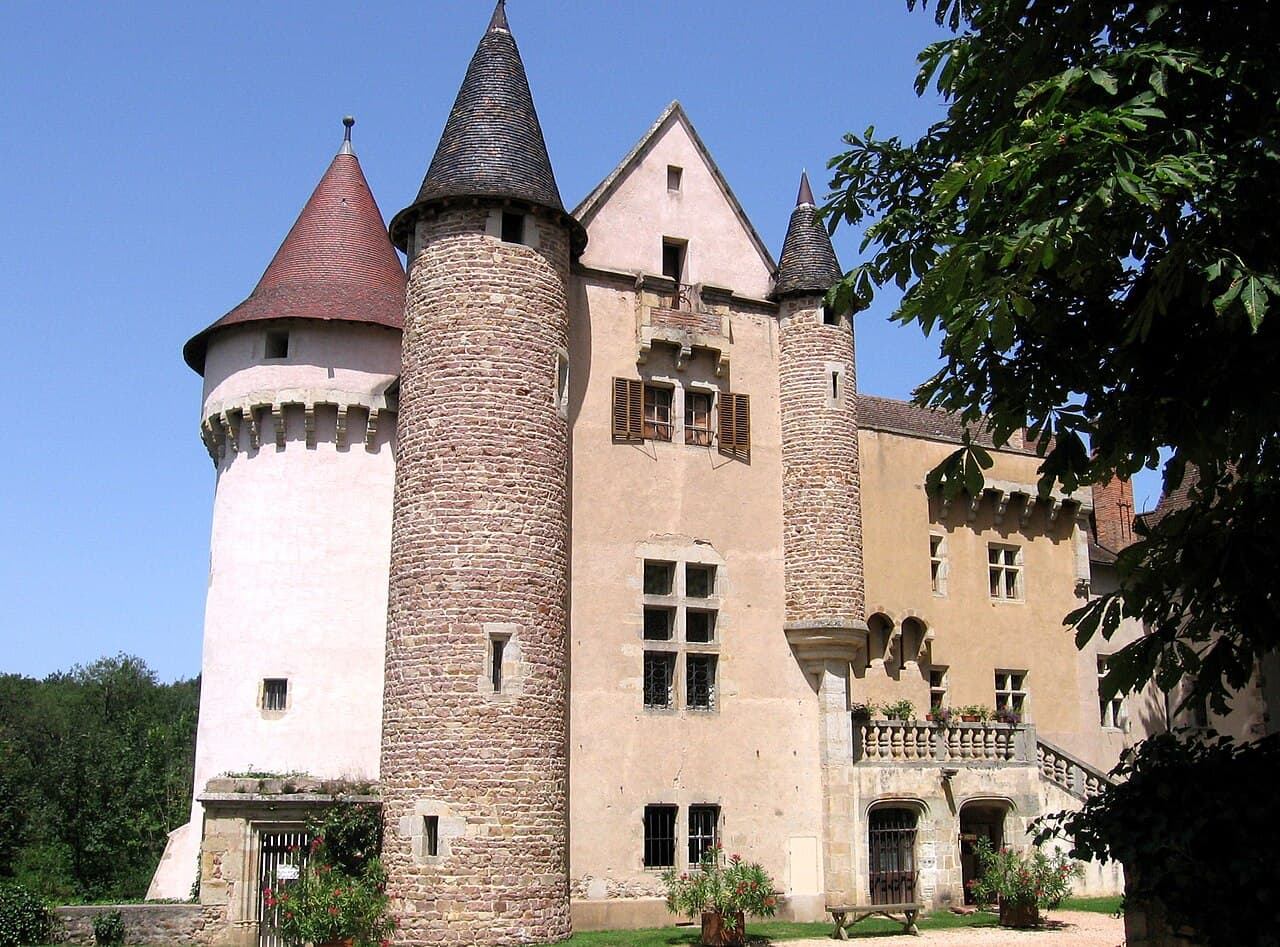
The south façade is notable for its asymmetrical design facing an outer courtyard. This façade features a central two-story section topped with machicolations—openings in the parapet used to defend the castle by dropping projectiles on attackers—and a small projecting gallery known as a bretèche. The windows incorporate mullions and transoms, vertical and horizontal stone bars dividing the glass panes, which were characteristic of late medieval and early Renaissance architecture.
The main staircase connects a square tower on one side with a pavilion featuring a turret and a distinctive pepperpot-shaped tower made of pink stone on the other. The first floor preserves a medieval pointed arch at the family entrance, while a depressed arch door below the porch leads to the interior courtyard and kitchens. The south façade blends neo-Renaissance and picturesque elements, reflecting the 19th-century romantic restoration style.
The west façade is distinguished by large windows opening onto a granite-console balcony, which illuminates the great hall historically used by the lords. The façades facing the ravine rise two stories and feature regularly arranged mullioned and transomed windows, enhancing both the castle’s defensive posture and aesthetic appeal.
The neo-Romanesque chapel and artistic details
A small neo-Romanesque chapel stands before the castle, inspired by the Romanesque art of the Auvergne region. It has a simple layout with an apse and two small apsidioles—side chapels—flanking a short nave. The exterior decoration features colorful effects created by alternating brick and stone, along with sculpted anthropomorphic modillions, carved supports shaped like human figures, adding a rich visual texture to the chapel’s façade.
Interior furnishings and collections
The castle’s interior showcases a furnishing collection spanning several centuries, from the 15th to the 19th century. This includes Breton furniture, Renaissance chests, 18th-century chairs, and 19th-century kitchen stoves. The rooms are further enriched by Flemish and Aubusson tapestries, as well as Chinese and Japanese porcelain, reflecting the diverse tastes and collecting interests of the castle’s owners over time.
Paintings by notable artists such as Philippe de Champaigne, Hyacinthe Rigaud, and Jean-Baptiste Martin decorate the interiors, adding artistic prestige. A wood-carved fireplace in the Fontainebleau style and a monumental chimney bearing the de Pierre family crest are among the castle’s most striking features. Some rooms display portraits, orientalist objects, and musical instruments associated with the composer George Onslow, highlighting the cultural richness preserved within the castle.
The arrangement of the castle’s collections and decorative elements evokes the atmosphere of a collector’s residence from the early 20th century, preserving both the historical architecture and the accumulated art and furnishings. This makes Château d’Aulteribe not only a monument of medieval military architecture but also a vibrant repository of cultural heritage.
Historical significance and preservation
The Château d’Aulteribe’s history reflects the broader socio-political changes in France from the Middle Ages through the 19th century. Its fortifications illustrate the evolution of defensive architecture responding to the advent of artillery, while its later romantic restoration embodies the 19th-century fascination with medieval heritage and aesthetics.
Classified as a historic monument in 1949, with its entire furniture collection protected since 1953, the castle has been managed by the Centre des monuments nationaux since 1965. It is open to the public, offering visitors a chance to explore its well-preserved medieval and neo-Renaissance architecture, extensive collections, and beautifully maintained grounds.
Since 1999, Château d’Aulteribe has also hosted a specialized two-year furniture restoration training program, utilizing its rich collections for practical education. This initiative underscores the castle’s ongoing role in heritage preservation and cultural education.
Frequently asked questions (FAQ)
- What is the best time to visit Château d’Aulteribe?
- The castle is open daily from 10:00 to 18:00, making spring and summer ideal for visiting due to favorable weather and extended daylight hours.
- How do I get to Château d’Aulteribe?
- Château d’Aulteribe is located in Sermentizon, Auvergne. It is accessible by car and local transport from Clermont-Ferrand, the nearest major city.
- Is the castle suitable for family visits?
- Yes, the castle offers a family-friendly environment with guided tours and educational programs, including a furniture restoration training course that may interest older children and adults.
- What architectural styles are present in Château d’Aulteribe?
- The castle features a blend of late medieval defensive architecture and 19th-century romantic neo-Renaissance and neo-Romanesque styles, visible in its façades and chapel.
- Can I see original medieval furnishings inside the castle?
- Yes, the interior contains furnishings from the 15th to 19th centuries, including Breton furniture and Renaissance chests, providing an authentic glimpse into its historical interiors.
Photo gallery

Information
Opening hours
10:00-18:00, daily
Ticket prices
€8 adult, €5 child
Current owner
Centre des monuments nationaux
Website
Visit websiteSources & official resources
Verify the information above using these authoritative references.
Loading map...
Visitor reviews
No reviews yet. Been here? Write the first review and help other travelers!
Write the first reviewVisited this castle? Share your experience
Your review helps other travelers and adds first-hand knowledge to our encyclopedia.