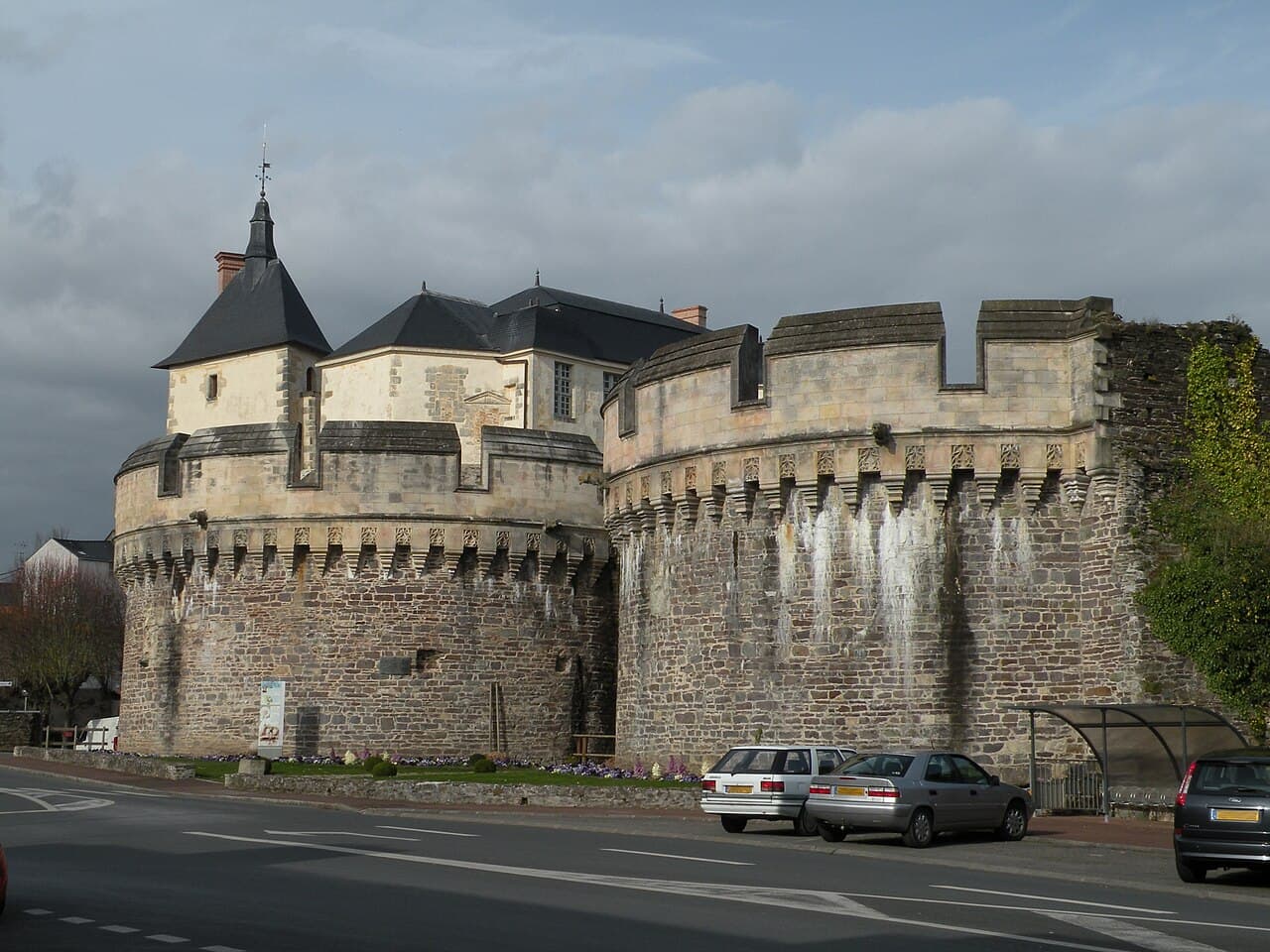
Château d'Ancenis
Château d'Ancenis stands as a significant historical monument on the banks of the Loire River in the town of Ancenis-Saint-Géréon, France. Originally established as a motte-and-bailey castle in the late 10th century, it evolved through centuries of military, political, and architectural transformations. The castle's strategic location on the Loire made it a crucial defensive and commercial stronghold during the Middle Ages, controlling river traffic and regional power dynamics.
The castle's earliest incarnation, attributed to Aremburga of Ancenis around 990 AD, featured wooden palisades and an earthen motte designed to protect the local population amid the volatile political landscape of medieval Brittany. While a plaque credits Guerech, Duke of Brittany, with founding the castle in 984, documentary evidence favors Aremburga's role as the primary builder. This original wooden fortification was typical of early medieval military architecture, emphasizing rapid construction and strategic placement.
Medieval origins and strategic importance
Throughout the 12th to 15th centuries, Château d'Ancenis underwent significant fortification, transitioning from wood to stone to better withstand sieges and assaults. Its position on the Loire River granted it immense military and economic significance. The castle served as a key point for controlling river navigation and commerce, which often led to conflicts with local lords who sought to exploit toll collections. By 1411, royal authorities intervened to curb these abuses, underscoring the castle's role in regional governance and law enforcement.
The castle witnessed numerous sieges and military engagements involving prominent historical figures such as English kings Henry II and John, and French monarchs including Louis IX, Louis XI, François II, and Charles, Duke of Brittany. The late 15th century marked an intense period of conflict under King Charles VIII of France, who in 1488 ordered the castle's partial demolition to neutralize its military threat. The strict enforcement of this demolition, forbidding holidays until completion, reflects the strategic importance attributed to the fortress.
Architectural evolution and Renaissance influences
By the 15th century, Château d'Ancenis had expanded to cover approximately 1.8 hectares, featuring robust stone curtain walls, multiple round towers, and dual courtyards. The castle's defensive architecture included machicolations—openings in parapets for dropping projectiles—and a monumental gatehouse designed to control access and resist attacks. This gatehouse, constructed between the late 14th and early 16th centuries, incorporated advanced defensive features such as a zigzag drawbridge and an ogival arched passage with a portcullis, demonstrating the adaptation of military architecture to evolving siege technologies.
The Renaissance period introduced significant residential enhancements, notably the construction of a Renaissance residence beginning around 1529 by Claude I de Rieux and Suzanne de Bourbon. This residence exemplifies the transition from Gothic to Renaissance architectural styles, blending structural Gothic elements with early Renaissance decorative motifs on its façade facing the central courtyard. This fusion reflects broader cultural shifts in France during the early 16th century, where fortifications increasingly incorporated comfortable living spaces and aesthetic considerations.
Decline, demolition, and later modifications
Despite its formidable design, the castle's military role declined in the 17th century. In 1626, Cardinal Richelieu ordered partial demolition of the castle's curtain walls and towers to prevent its use as a military stronghold against royal authority. This reduction in defensive capacity marked a turning point, aligning with broader trends of centralizing power and diminishing feudal fortresses.
The 18th and 19th centuries brought significant changes to the castle's surroundings and structure. The original moats, once filled by water from the Loire, were drained and filled during quay construction to accommodate urban development along the riverbank. In 1850, the castle's site was adapted for educational use with the establishment of a boarding school by the Ursuline religious order, leading to further modifications and additions that altered the castle's historic fabric.
Preservation and restoration efforts
Recognizing its cultural and historical significance, Château d'Ancenis was designated a national monument in 1977. The municipality acquired ownership in 1986 and initiated extensive restoration projects during the 1990s and again from 2013 to 2015. These efforts focused on removing non-original 19th- and 20th-century additions, reinforcing the castle's original stone structures, and restoring key architectural elements such as the Renaissance residence and the medieval gatehouse.
Current preservation work has emphasized reopening the castle's main entrances, repairing the machicolations on the towers, and conserving the logis de Marie Fouquet, a residential building on the site. The ensemble also includes a former chapel, which has been carefully maintained as part of the castle's historical narrative. These restorations have enhanced public access and understanding of the castle's layered history, from its medieval origins through Renaissance adaptations to modern conservation.
Architectural features and layout
The castle retains the characteristic layout of a hill castle with a raised motte originally surrounded by a wooden palisade and moat. The stone fortifications of the late medieval period include thick curtain walls punctuated by multiple round towers designed for both defense and surveillance. The gatehouse remains a focal point, notable for its defensive design with a chicane-style drawbridge and portcullis, which would have slowed attackers and provided multiple layers of security.
The Renaissance residence showcases early 16th-century architectural trends, with its façade combining Gothic structural forms and Renaissance ornamental details. The castle's two courtyards served distinct functions, separating military and residential areas and facilitating the organization of the castle's internal activities.
Although the original moats have been filled, the castle's location on a natural elevation near the Loire River provided strategic advantages in visibility and defense. The surrounding urban developments have altered the landscape, but the castle's core structures remain well-preserved, offering valuable insights into medieval and Renaissance castle construction and adaptation.
Historical significance and cultural heritage
Château d'Ancenis exemplifies the evolution of a medieval fortress into a Renaissance residence, reflecting broader historical shifts in military technology, political power, and architectural style. Its role in controlling the Loire River and its involvement in regional conflicts illustrate the complex feudal and royal dynamics of Brittany and France from the 10th to the 17th centuries.
The castle's multiple sieges and partial demolitions underscore its strategic importance and the changing nature of warfare and governance. Today, it stands as a protected monument that educates visitors about the region's medieval past and the Renaissance cultural transformation, supported by ongoing restoration and conservation efforts.
Frequently asked questions (FAQ)
- How do I get to Château d'Ancenis?
- Château d'Ancenis is located in Ancenis-Saint-Géréon, France, and is easily accessible by car or public transport. If you're traveling by train, the nearest station is Ancenis, which is just a short walk from the castle. You can also find parking available nearby for those driving.
- What is the historical significance of Château d'Ancenis?
- Château d'Ancenis dates back to the 11th century and played a vital role in the region's history, serving as a strategic fortress during various conflicts. The castle has witnessed significant events, including the Wars of Religion and the French Revolution. Today, it stands as a testament to the architectural and cultural heritage of the Loire Valley.
- When was Château d'Ancenis built?
- Construction of Château d'Ancenis began in the 11th century, with various modifications and expansions occurring over the centuries. The castle's architecture reflects the evolving styles of the medieval period through the Renaissance. Its enduring presence highlights the historical importance of the site.
- Can I visit Château d'Ancenis year-round?
- Yes, Château d'Ancenis is open to visitors throughout the year, although opening hours may vary by season. It's advisable to check the official website or contact the castle administration for the most current visiting hours. Special events and guided tours are often available to enhance your experience.
- Why is Château d'Ancenis popular among tourists?
- Château d'Ancenis attracts visitors due to its rich history, stunning architecture, and picturesque location overlooking the Loire River. The castle offers guided tours that provide insight into its fascinating past and the lifestyle of its former inhabitants. Additionally, the surrounding town offers charming shops and eateries, making it a perfect destination for a day trip.
- Is it possible to host events at Château d'Ancenis?
- Yes, Château d'Ancenis provides options for hosting various events, including weddings, corporate gatherings, and cultural activities. The enchanting setting and historical ambiance make it a unique venue for special occasions. It's recommended to contact the castle's administration for details on availability and facilities.
- What are the ticket prices for visiting Château d'Ancenis?
- Ticket prices for Château d'Ancenis vary depending on age and the type of tour you wish to take. Typically, adult tickets are reasonably priced, with discounts available for students and seniors. Children under a certain age may enter for free, making it an affordable outing for families.
- What is the best time to visit Château d'Ancenis?
- The best time to visit Château d'Ancenis is during the spring and early autumn months when the weather is mild and the gardens are in full bloom. Additionally, these seasons often feature fewer crowds, allowing for a more enjoyable experience. Summer can also be a great time, but be prepared for larger tourist numbers.
- Are there any nearby attractions to explore?
- Yes, there are several attractions near Château d'Ancenis that are worth exploring. The charming town of Ancenis-Saint-Géréon offers lovely shops and cafes, while the beautiful Loire River provides opportunities for scenic walks. Nearby, you can find other historical sites and vineyards to enhance your visit.
Photo gallery

Information
Website
Visit websiteSources & official resources
Verify the information above using these authoritative references.
Loading map...
Visitor reviews
No reviews yet. Been here? Write the first review and help other travelers!
Write the first reviewVisited this castle? Share your experience
Your review helps other travelers and adds first-hand knowledge to our encyclopedia.



