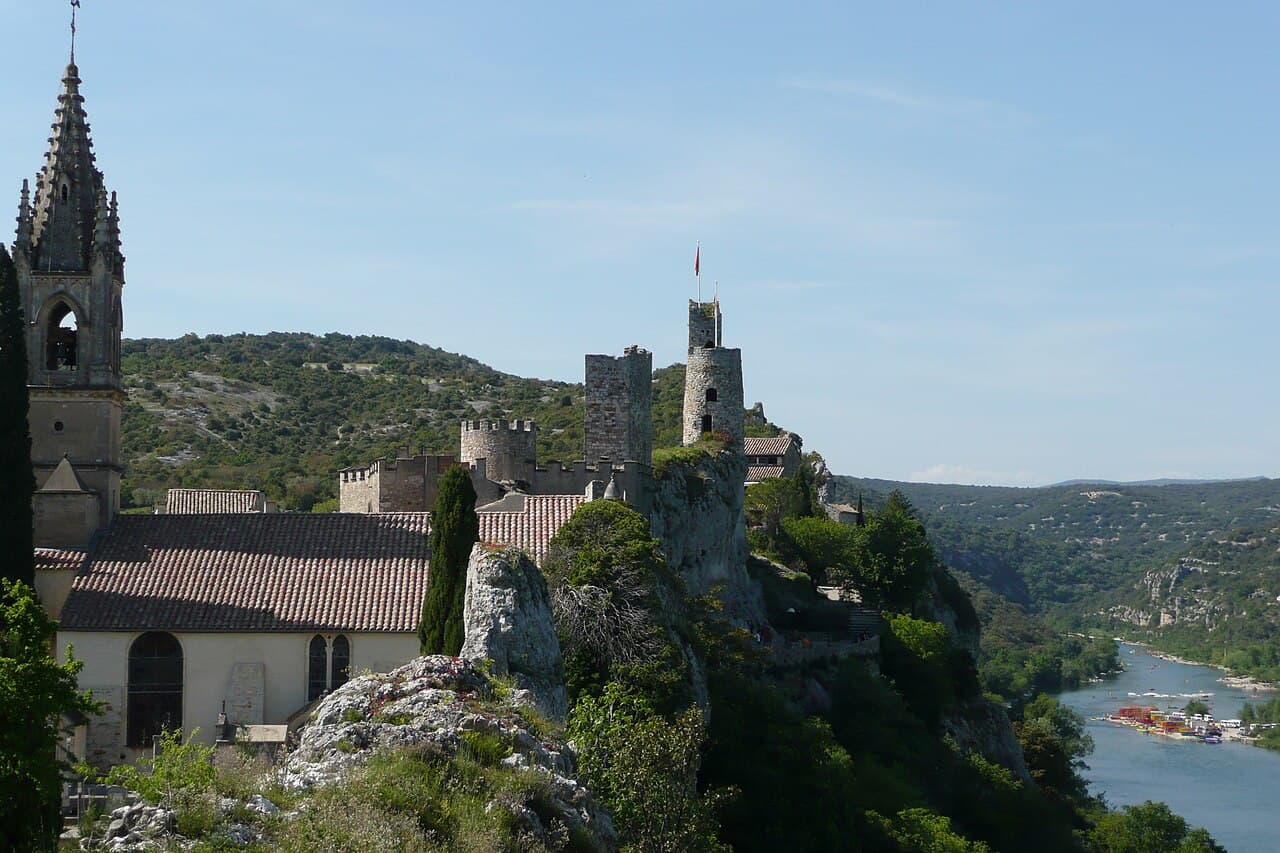
Château d’Aiguèze
The Château d’Aiguèze stands as a remarkable example of medieval military architecture, perched dramatically atop a cliff overlooking the Ardèche river and its deep gorge in southern France. This hill castle illustrates a rich history of defensive strategy and noble residence that spans from the early medieval period through the Renaissance and into modern restoration efforts. Its strategic location provided control over key routes and a commanding view of the surrounding landscape, making it a vital stronghold in regional power struggles for centuries.
The origins and early medieval significance
Originally established in the 8th century during the reign of the Carolingian Empire, the castle's earliest fortifications were ordered by Charles Martel following his victory at the Battle of Poitiers in 732. This initial construction served as a defensive position to guard the Kingdom of Provence against Saracen incursions. The earliest structure was a Merovingian cliffside fortification, ingeniously utilizing natural caves and rocky terrain to create a troglodyte refuge. This use of the natural geology for defense is a defining characteristic of the site.
Enhancements during the high medieval period
By the late 11th century, around 1080, the fortress was substantially reinforced under the direction of Raymond de Saint-Gilles, Marquis of Provence. His vassal, Pons de Balazuc, was tasked with upgrading the castle's defenses in anticipation of the First Crusade. This period marked the transformation from rudimentary tribal fortifications to a more formalized feudal stronghold, reflecting broader military and political changes in medieval Europe.
Medieval conflicts and changing ownership
The 12th and 13th centuries saw the castle embroiled in the complex power dynamics of the region. In 1196, Count-Bishop Nicolas de Viviers seized control, asserting ecclesiastical authority. Shortly after, around 1210, the fortress came under the possession of Simon IV de Montfort during the Albigensian Crusade, acting on behalf of King Philip II Augustus. These events highlight the castle's role as a contested site between secular lords, the Church, and the French crown.
The impact of the Hundred Years’ War and local revolts
The 14th century brought further turmoil. In 1374, King Charles V sold half of the lordship to Pions Bordon, a tax collector from nearby Pont-Saint-Esprit. The castle and village suffered during the widespread unrest of the Hundred Years’ War, including the Tuchin revolt in 1388 when rebels briefly captured the fortress. The violent suppression of the revolt led to extensive damage and a subsequent period of abandonment, reflecting the instability of the era.
Renaissance revival and early modern restoration
In the early 16th century, noble families such as the Beauvoir du Roure, Harcourt-Lorraine, and Vogüé undertook efforts to rebuild and adapt the castle and its barony, incorporating Renaissance architectural elements. This transition from purely military fortress to noble residence is evident in the design of the lordly residence within the castle complex, blending defensive features with more comfortable living quarters.
20th-century preservation efforts
From the French Revolution onward, the castle passed into the hands of the Romanet family. Significant restoration was initiated in the early 20th century by Monseigneur Frédéric Fuzet, Archbishop of Rouen. His work focused on preserving not only the castle but also the adjacent 11th-century Saint-Roch church and the medieval village, maintaining the site's historical integrity and medieval character.
Architectural features and fortifications
The Château d’Aiguèze is notable for its integration of natural rock formations into its defensive structures. The complex includes three main towers from different centuries, each reflecting the evolving military architecture of their times:
- The Saracen tower, dating from the 11th century, represents early medieval defensive design responding to the Saracen threat.
- The square donjon or keep, from the 12th century, served as the main stronghold and lordly residence.
- A round tower from the 13th century connects with the Saracen tower, illustrating the castle’s ongoing fortification enhancements during the medieval period.
Troglodyte galleries and defensive walkways
A distinctive feature of the castle is the system of chemins de ronde troglodytes, natural galleries carved into the cliff face. These elevated walkways along the battlements allowed defenders to patrol and observe the surrounding area effectively. This blend of natural geology and military architecture is rare and highlights the castle’s strategic use of its environment.
The lordly residence and medieval village
Within the castle grounds, the lordly residence showcases a blend of medieval and Renaissance architectural styles, reflecting the shift from a purely defensive fortress to a noble domicile. The adjacent medieval village has been carefully restored, preserving its historical ambiance and complementing the castle’s heritage.
Present condition and cultural significance
Today, the Château d’Aiguèze is well preserved, thanks largely to the early 20th-century restoration efforts. The stonework of the towers, walls, and troglodyte galleries remains largely intact, offering visitors a vivid glimpse into the castle’s layered history. The site stands as a testament to the military, religious, and noble influences that shaped the region over more than a millennium.
The castle and village attract visitors interested in medieval architecture, history, and the dramatic natural setting overlooking the Ardèche gorge. Its unique combination of early medieval origins, feudal fortifications, and Renaissance adaptations make it a significant cultural landmark in southern France.
Frequently asked questions (FAQ)
- How do I get to Château d’Aiguèze?
- Château d’Aiguèze is accessible by car and public transport, located in the charming village of Aiguèze in France. If you are driving, there is parking available nearby. For those using public transport, the nearest train station is in the town of Bagnols-sur-Cèze, from where you can take a taxi or local bus to the castle.
- What is the historical significance of Château d’Aiguèze?
- Château d’Aiguèze dates back to the 12th century and is a remarkable example of medieval architecture. It served as a strategic fortress during the conflicts between the French crown and the counts of Toulouse. The castle's well-preserved structure offers a glimpse into the past and its role in the region's history.
- When was Château d’Aiguèze constructed?
- The construction of Château d’Aiguèze began in the 12th century, with significant modifications occurring in the subsequent centuries. This long history has contributed to its unique architectural features, blending different styles from various periods. Visitors can see elements from both the medieval and later Renaissance periods throughout the castle.
- Can I take guided tours of Château d’Aiguèze?
- Yes, guided tours are available at Château d’Aiguèze, providing an in-depth look at the castle's history and architecture. The tours are typically conducted by knowledgeable guides who share fascinating stories and insights about the castle. It's recommended to check the schedule in advance, especially during peak tourist seasons.
- Why is the architecture of Château d’Aiguèze noteworthy?
- The architecture of Château d’Aiguèze is noteworthy for its blend of medieval and Renaissance styles, showcasing the evolution of fortification techniques over time. The castle features impressive stonework, a fortified wall, and a commanding view of the surrounding landscape. This unique style attracts architecture enthusiasts and history buffs alike.
- Is it possible to visit Château d’Aiguèze year-round?
- Yes, Château d’Aiguèze is open for visitors year-round, although hours may vary seasonally. It’s advisable to check the official website for the most current opening hours and any special events. Visiting during the spring or fall can provide a more pleasant experience with fewer crowds.
- What are the ticket prices for Château d’Aiguèze?
- Ticket prices for Château d’Aiguèze are generally affordable, with discounts available for students, seniors, and children. Family tickets may also be offered, making it an excellent option for visitors traveling with kids. Always check the official website for the latest pricing information before your visit.
- What is the best time to visit Château d’Aiguèze?
- The best time to visit Château d’Aiguèze is during the spring (April to June) and fall (September to October) when the weather is mild and the crowds are fewer. Summer can be quite busy due to tourist influx, while winter offers a quieter experience, although some tours may be limited. Planning your visit during off-peak times can enhance your experience.
- Are there nearby attractions to Château d’Aiguèze?
- Yes, there are several nearby attractions worth visiting, including the picturesque village of Aiguèze itself, which is classified as one of the "Les Plus Beaux Villages de France." Additionally, the nearby Gorges de l'Ardèche offers stunning natural landscapes perfect for hiking and outdoor activities. Exploring these attractions can enrich your visit to Château d’Aiguèze.
Photo gallery

Information
Loading map...
Visitor reviews
No reviews yet. Been here? Write the first review and help other travelers!
Write the first reviewVisited this castle? Share your experience
Your review helps other travelers and adds first-hand knowledge to our encyclopedia.



