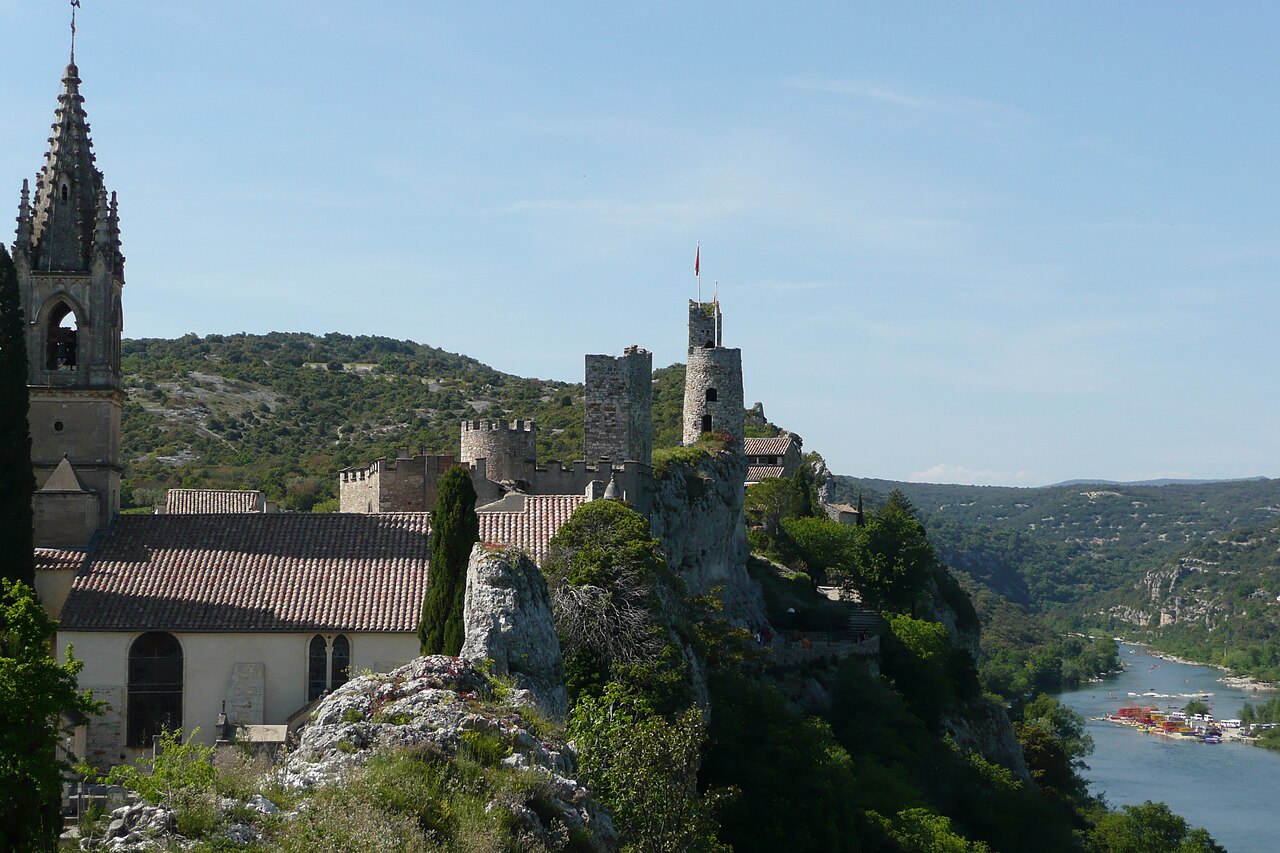
Château des Roure
The Château des Roure stands as a remarkable example of a medieval hill castle with a rich history spanning several centuries in the Hauts-de-France region of France. Originally constructed in the 11th century as a square tower fortress, it was strategically positioned to control the vital route through the Pont d’Arc area. This early fortification underscored the importance of regional defense and territorial control during the High Medieval period.
During the late 14th century, the original tower was replaced by a more substantial castle built by the Beauvoir de Grimoard du Roure family, who were prominent feudal lords of the area. This transition reflected the evolving military architecture of the time, moving from simple fortified towers to more complex and defensible structures. The castle's solid quadrangular layout with round towers and watchtowers (échauguettes) exemplifies typical medieval military design aimed at maximizing defense and surveillance.
Architectural features and medieval fortifications
The Château des Roure is characterized by its robust medieval construction, including two prominent round towers topped with distinctive orange tile roofs, which are visually striking and historically significant. The castle also features two smaller échauguettes, which served as elevated lookout points, allowing defenders to monitor the surrounding landscape effectively.
The battlemented chemin de ronde (wall-walk) encircles the fortress, providing a protected pathway for guards to patrol and defend the castle perimeter. At the heart of the complex stands the keep (donjon), the strongest part of the castle, designed as a final refuge during sieges. The presence of a large spiral staircase inside the keep demonstrates the skilled masonry typical of the era, facilitating movement between floors while maintaining structural integrity.
Inside, the castle contains elements reflecting later architectural influences, such as French-style ceilings and a grand fireplace, which served both functional and social purposes. These interior features indicate the castle's adaptation from purely military use to a more residential role over time.
Historical context and ownership
The castle's history is deeply intertwined with the turbulent religious and political conflicts of France. In the 16th century, the estate passed to Philippe Sautel, lord of Barjac, whose son Claude constructed a fortified house named Roure, symbolizing the fusion of noble families through marriage alliances, a common feudal practice to consolidate power and land.
During the French Wars of Religion in the late 16th and early 17th centuries, the castle gained strategic importance. It was owned by the Duke of Rohan, a leading Huguenot (French Protestant) figure, who resided there in 1628. However, following royal efforts to centralize power, King Louis XIII and Cardinal Richelieu ordered the dismantling of the castle's defensive structures in 1629. This included the removal of machicolations, watchtowers, the keep, and protective walls around the adjacent village, reflecting the broader policy of reducing noble fortifications to prevent rebellion.
After the revocation of the Edict of Nantes in 1685, which ended religious tolerance for Protestants, the count of Roure converted to Catholicism, illustrating the significant religious and social shifts imposed by the monarchy during this era.
The castle also played a role in the Camisard uprising of 1703, a Protestant rebellion in the Cévennes region. Jean Cavalier, one of the uprising's leaders, captured the château and set fire to the village church, highlighting the ongoing religious strife and the castle's continued symbolic importance.
Transition to silk production and modern preservation
In the 19th century, the castle transitioned from a feudal fortress to an agricultural estate. The Beauvoir du Roure family sold the property in 1825 to the Pradier family, who transformed it into a large magnanerie — a silk farm dedicated to breeding silkworms. This adaptation reflects the region's economic shift and the castle's integration into local industry.
The magnanerie became one of the most important in the region, contributing significantly to the local economy until its decline after the First World War. The preservation of this building today serves as a cultural and educational resource, illustrating the castle's diverse historical roles.
In the late 20th century, the descendants of the Pradier family opened the château to the public in 1975, marking a new chapter in its history as a heritage site. It was officially designated a historic monument in 1978, ensuring protection for its significant architectural and historical features.
Extensive restoration projects between 2013 and 2016 focused on reconstructing key elements of the castle's medieval fortifications, including the machicolations, watchtowers, and the central keep, restoring much of its original defensive silhouette. In 2018, a full-scale replica trebuchet was installed at the castle base, enhancing the visitor experience and providing insight into medieval siege technology.
Additionally, a nearby medieval-themed park complements the château, offering educational and cultural engagement with the history of the site and the region.
Castle layout and integration with the village
The Château des Roure is closely integrated into the surrounding village, with houses built directly around its walls. This layout is typical of medieval settlement patterns, where villages clustered around a fortified center for protection. The houses formed an additional defensive barrier, enhancing the castle's security.
The castle's facades, roof structures, interior courtyard, staircases, and fireplaces are protected elements under its historic monument status, preserving the architectural heritage and the evolution of the site from fortress to manor and silk farm.
Overall, the Château des Roure offers a compelling narrative of medieval military architecture, religious and political history, economic transformation, and modern heritage preservation. It stands as a testament to the adaptability and enduring significance of historic castles in France.
Frequently asked questions (FAQ)
- What is the historical significance of Château des Roure?
- Château des Roure is a remarkable example of medieval architecture in France, reflecting the rich history of the region. Originally built in the 16th century, it served as a noble residence and has been preserved to showcase the lifestyle of the period.
- When was Château des Roure built?
- The construction of Château des Roure began in the early 16th century and was completed in the latter half. This period marked the transition from the Middle Ages to the Renaissance, influencing its architectural style and historical importance.
- What are the opening hours for Château des Roure?
- Château des Roure is typically open to the public from 10 AM to 6 PM, Wednesday through Sunday. However, it's advisable to check their official website for any seasonal changes or special closures before planning your visit.
- Can I purchase tickets online for Château des Roure?
- Yes, visitors can purchase tickets online through the Château des Roure's official website. This option not only allows you to secure your entry in advance but also helps avoid long queues at the ticket counter.
- Is it possible to access Château des Roure with a wheelchair?
- Yes, Château des Roure is committed to accessibility and provides facilities for visitors with mobility challenges. However, due to the historical nature of the building, some areas may have limited access, so it's best to inquire in advance.
- When is the best time to visit Château des Roure?
- The best time to visit Château des Roure is during the spring and early autumn when the weather is mild, and the gardens are in full bloom. Additionally, visiting during these seasons allows you to enjoy the surrounding landscape and local events.
- What nearby attractions can I explore while visiting Château des Roure?
- While visiting Château des Roure, you can explore the charming village of Montélimar, known for its nougat production. Additionally, the beautiful Drôme Provençale region offers stunning landscapes and other historical sites worth visiting.
- How do I get to Château des Roure?
- Château des Roure is conveniently located in Montélimar, France, and can be reached by car or public transportation. The nearest train station is Montélimar, and from there, you can take a short taxi ride to the castle.
- What are the ticket prices for Château des Roure?
- Ticket prices for Château des Roure vary depending on age and group size, with discounts available for students and seniors. It's best to check their official website for the most current pricing and any special offers that may apply during your visit.
Information
Website
Visit websiteSources & official resources
Verify the information above using these authoritative references.
Loading map...
Visitor reviews
No reviews yet. Been here? Write the first review and help other travelers!
Write the first reviewVisited this castle? Share your experience
Your review helps other travelers and adds first-hand knowledge to our encyclopedia.