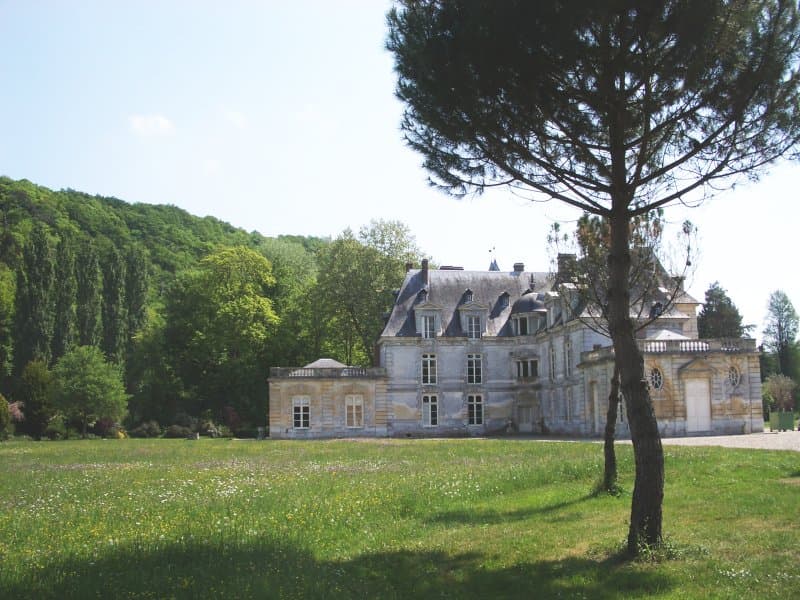
Château d\'Acquigny
Château d'Acquigny is a remarkable Renaissance hill castle located in Acquigny, Eure, Upper Normandy, France. It stands at the strategic confluence of the Eure and Iton rivers, a location historically significant for its natural defense and water management. The castle's setting is notable for the two rivers that were dammed and redirected in the 12th century by the monks of Conches-en-Ouche to power local mills, simultaneously creating branches that feed the castle's moats. This early hydraulic engineering contributed to the castle's defense and the protection of the neighboring Saint-Mals monastery and medieval village.
The historical significance of Acquigny castle
The site of Château d'Acquigny has long been of strategic importance. During the Hundred Years' War, after the imprisonment of Charles II of Navarre in 1356, the castle served as a key stronghold contested by both English and French forces. The original medieval fortress occupied the same site as the current structure, featuring high defensive walls and wide ditches filled by the waters of the Eure river, enhancing its defensive capabilities.
Architectural design and construction in the Renaissance era
The current castle was constructed in 1557 by Anne de Laval, widow of Louis Silly, who was a cousin of the king and closely connected to Catherine de Medici, the influential queen and first lady of honor. Anne de Laval commissioned renowned architects Philibert Delorme and Jacques Androuet Hoop to design a residence that symbolized her enduring love for her late husband.
The design of the castle is unique and elegant, reflecting the Renaissance architectural style with a complex structure that blends functionality and decoration. The castle's crest, featuring the intertwined initials of Anne de Laval and Louis Silly, adorns the building as a personal emblem of love and loyalty. A notable architectural feature is the center turret crowned with a superimposed scallop shell, a tribute to the Way of St. James pilgrimage route, symbolizing spiritual journey and protection.
The castle's facade is richly decorated with motifs celebrating family and love, showcasing the artistic tastes and cultural influences of the mid-16th century French nobility. The use of blue slate, pink brick, and white stone creates a harmonious color palette that enhances the building's visual appeal and balance.
Expansion and religious significance in the 17th and 18th centuries
In 1656, the castle was acquired by Claude Roux Cambremont. Later, in 1745, his great-grandson, Peter Robert Roux Esneval, known as the President of Acquigny, undertook significant expansions. He employed the architect Charles Thibault to rebuild the chapel of Saint-Mals as well as the stables and sheds. This period also saw the construction of the orangery, the church, and the Little Castle, which was intended to be attached to a hermitage.
Peter Robert Roux Esneval was a deeply religious man who chose to live as a hermit in the latter part of his life, adhering strictly to his faith and the principles of the Grande Trappe monastic order. From his pavilion, he could attend services in the church, reflecting the integration of religious devotion with the castle's architectural layout. The simplicity and harmony of the new constructions contrast with the ornate Renaissance main building, emphasizing spiritual humility.
Gardens and landscape design
The castle is surrounded by a vast park created in the 17th century, laid out along a circular route. The forested areas contain large chestnut trees over two centuries old, contributing to the estate's natural beauty. The grounds also include a vegetable garden, the restored orangery, and water features aligned perpendicularly to the main paths, although some of the original symmetrical rows of trees and flower beds have disappeared over time.
Despite changes, the park retains its charm with mature linden and chestnut trees that have grown beyond their original geometric planting, adding a picturesque quality to the landscape. The garden and orangery have been partially restored, recovering elements of their historical elegance.
Architectural features and cultural heritage
Château d'Acquigny is an outstanding example of a Renaissance hill castle that combines defensive medieval elements with the refined aesthetics of the French Renaissance. Its construction by notable architects and its association with prominent historical figures like Anne de Laval and Peter Robert Roux Esneval enrich its cultural significance.
The castle's listing in the French National Inventory of Historical Monuments in 1926 recognizes its architectural and historical value. The preservation of its distinctive features, including the moats fed by river branches, the decorative facades, and the harmonious blend of materials, make it a significant heritage site in Normandy.
Visiting Château d'Acquigny
Visitors to Château d'Acquigny can explore its elegant Renaissance architecture, the tranquil park with centuries-old trees, and the chapel and orangery added during the 18th century expansions. The castle's location at the meeting point of two rivers adds to its scenic appeal and historical context.
The castle remains a testament to the architectural innovation and noble life of the French Renaissance, offering insights into the social and religious history of the region. Its well-preserved state allows for an immersive experience of a noble residence that has evolved through centuries of French history.
Frequently asked questions (FAQ)
- When was Château d'Acquigny built and by whom?
- Château d'Acquigny was built in 1557 by Anne de Laval, widow of Louis Silly, with architects Philibert Delorme and Jacques Androuet Hoop involved in its design.
- What architectural style characterizes Château d'Acquigny?
- The castle is an example of Renaissance architecture, featuring elegant facades, decorative motifs, and a harmonious blend of blue slate, pink brick, and white stone.
- What is the historical significance of Château d'Acquigny's location?
- Situated at the confluence of the Eure and Iton rivers, the castle's location was strategically important during the Hundred Years' War and benefitted from water defenses created by redirected river branches.
- Can visitors explore the gardens and park of Château d'Acquigny?
- Yes, the castle is surrounded by a 17th-century park with large chestnut and linden trees, a vegetable garden, and a restored orangery, offering a picturesque landscape for visitors.
- What notable expansions occurred at Château d'Acquigny in the 18th century?
- In 1745, Peter Robert Roux Esneval expanded the castle by rebuilding the chapel of Saint-Mals, adding stables, sheds, an orangery, a church, and the Little Castle attached to a hermitage.
Photo gallery

Information
Loading map...
Visitor reviews
No reviews yet. Been here? Write the first review and help other travelers!
Write the first reviewVisited this castle? Share your experience
Your review helps other travelers and adds first-hand knowledge to our encyclopedia.


