Berlin Fortress
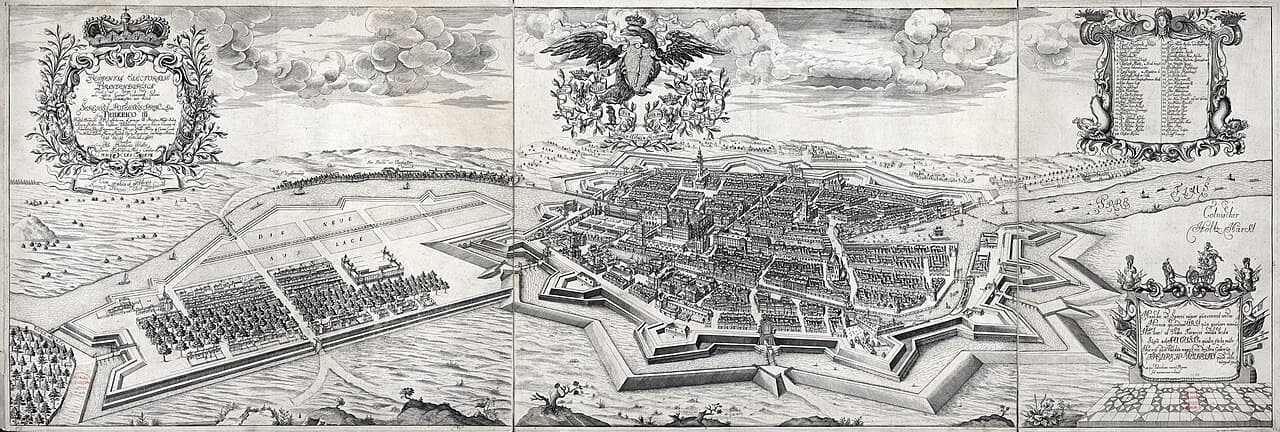
The Berlin Fortress (Festung Berlin) was a significant 17th-century bastion fort that served as the primary fortification for the historic city of Berlin. Construction began around 1650, reflecting the military architectural trends of the Renaissance period with its characteristic bastioned walls, moats, ramparts, and glacis. The fortress was designed to protect Berlin by encircling the city limits, creating a formidable defensive barrier against potential invaders.
Architectural design and fortifications
The layout of the Berlin Fortress followed the principles of the bastion fort or trace italienne style, which was prevalent in Europe during the 16th and 17th centuries. This design featured angled bastions projecting from the main walls, allowing defenders to cover adjacent walls with overlapping fields of fire. The fortress included thick stone and earth ramparts reinforced to absorb and deflect artillery fire, a wide moat surrounding the walls to hinder enemy approach, and a glacis—a gently sloping embankment to expose attackers to defensive fire while protecting the walls from direct artillery hits.
The walls and ramparts enclosed the historic core of Berlin, marking the city's limits at the time. The fortress was not a single castle structure but rather a complex system of fortifications integrated into the urban fabric, reflecting the evolving military technology and urban defense needs of the early modern period.
Historical context and evolution
Constructed during the mid-17th century, the Berlin Fortress was part of the broader trend of European cities upgrading their defenses in response to the increased use of gunpowder artillery. Berlin, then growing as a political and economic center, required robust fortifications to protect against siege warfare common in the Thirty Years' War and subsequent conflicts.
However, the fortress's military relevance declined by the early 18th century as warfare tactics evolved and urban expansion made the fortifications restrictive to the city's growth. Beginning in 1740, the demolition of the fortress's ramparts commenced, gradually dismantling the defensive walls to accommodate urban development and modernization.
Remnants and archaeological significance
Today, the Berlin Fortress exists primarily as archaeological ruins, with some sections of the original ramparts and moat traces still visible in parts of modern Berlin. These remnants offer valuable insights into the city's Renaissance-era military architecture and urban planning.
Archaeological excavations have uncovered foundations and structural elements that reveal the fortress's scale and construction techniques. The site is important for understanding the transformation of Berlin from a fortified medieval town to a modern capital.
Cultural heritage and public access
While most of the fortress no longer stands, its historical footprint influences Berlin's urban layout. Some parks and streets follow the lines of the former ramparts, preserving the memory of the city's defensive past.
Visitors interested in Berlin's military and urban history can explore museum exhibits and guided tours that discuss the fortress's role and its impact on the city's development. The archaeological sites are occasionally accessible, often integrated into broader heritage trails around Berlin's historic center.
Photo gallery

Photo by Johann Bernhard Schulz•Public domain
Information
Loading map...
Visitor reviews
No reviews yet. Been here? Write the first review and help other travelers!
Write the first reviewVisited this castle? Share your experience
Your review helps other travelers and adds first-hand knowledge to our encyclopedia.