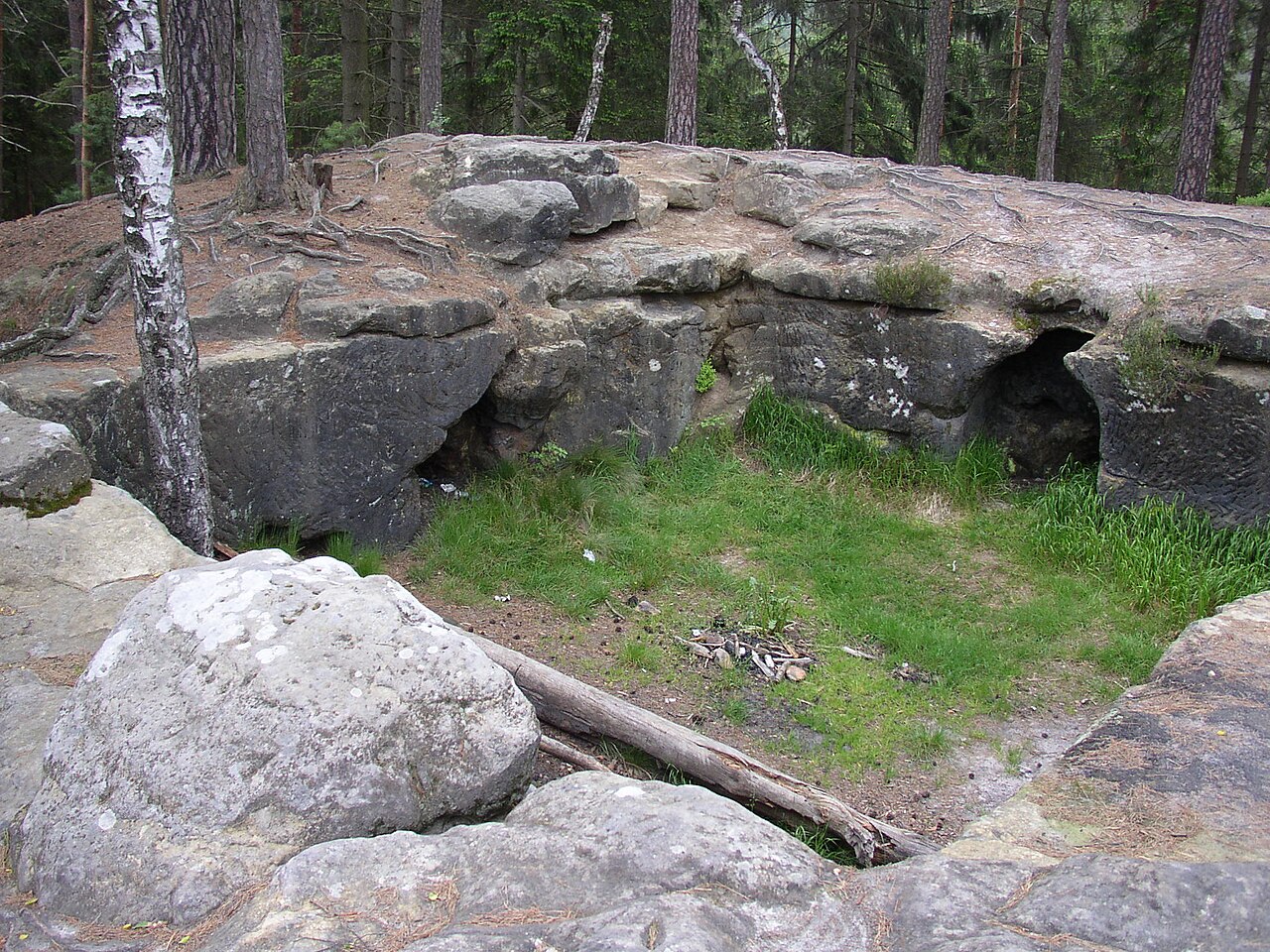
Česká Kamenice Castle

Česká Kamenice Castle: medieval hilltop fortress in Czechia
Česká Kamenice, Czech Republic
Late Medieval (14th–15th c.)
Partially Restored

Česká Kamenice Castle stands prominently above the town of Česká Kamenice in the Czech Republic, embodying the turbulent history and architectural evolution of the region during the late medieval period. Constructed in the early 15th century, this hill castle was strategically positioned on Zámecký Hill to oversee the surrounding landscape and assert control during a time marked by regional conflicts, including the Hussite Wars.

The foundation and early history

The castle's origins date between 1427 and 1433, when Zikmund Děčínský of Vartenberk, a notable member of the Bohemian nobility, established a new stronghold on Zámecký Hill. This construction followed his acquisition of the nearby Falkenštejn estate from Jindřich Berka of Dubá. The castle was intended to replace the nearby Fredevald Castle, which remained under the control of Jindřich’s wife, Jitka of Hazmburk. The first documentary mention of Česká Kamenice Castle appears in records from 1476.

In 1440, the castle and its environs were caught in the crossfire of regional skirmishes when the Lusatian Six Towns launched a raid that resulted in the burning of the town of Kamenice. Although it is uncertain if the castle itself was targeted, this event underscores the strategic importance of the site during this volatile period.

Architectural development and ownership changes

Ownership of the castle changed hands multiple times over the centuries. In 1515, the Salhausen family acquired the property and constructed a new chateau within the town below the hill, signaling a shift in residential preferences away from the hilltop fortress. By 1535, the Vartenberk family regained control but chose not to reoccupy the castle, reflecting its declining role as a noble residence.

The castle's military significance resurfaced during the Thirty Years’ War. In 1639, it was the scene of a skirmish, and despite partial restoration efforts aimed at reinforcing its defensive capabilities, the castle was heavily damaged and burned by Swedish troops. This marked the beginning of its long period of neglect and ruin.

Decline, restoration, and modern preservation

Following centuries of abandonment, the ruins of Česká Kamenice Castle were neglected until the late 19th century. In 1880, the local Beautification Society initiated efforts to clear overgrowth and stabilize the remaining walls. The former palace was adapted as a lodge for visitors, and a wooden lookout tower was erected to capitalize on the castle's panoramic views.

By 1910, the castle's knight’s hall was opened to the public, enhancing its role as a cultural and historical site. However, after 1940, the site gradually fell into disrepair once again. The wooden lookout tower deteriorated, and services such as the on-site restaurant closed mid-20th century.

Renewed restoration began in 1995 under the guidance of a local foundation. Volunteers worked diligently to clear debris, stabilize the ruins, and by 1998, a new wooden lookout tower was completed. The castle grounds were officially reopened, reaffirming their status as a protected cultural monument and popular destination for visitors interested in history and architecture.

Architectural features and layout

Perched atop a steep hill, the castle ruins reveal a layout that skillfully balances defensive structures with residential comfort. The original core of the castle was a single residential tower, which was later expanded into a larger palace featuring two rooms stacked across four floors. This palace included a taller section on its southeast side and a small annex on the southern end, interpreted as a latrine, highlighting the provision of essential sanitary facilities within the fortress.

Surrounding the main buildings, a curtain wall enclosed the castle grounds, reinforced by a barbican—an outer defensive gateway structure—parts of which remain visible on the southern and eastern sides. The construction predominantly used local basalt rock (čedič), prized for its durability, while sandstone blocks were employed to strengthen corners and other vulnerable points, showcasing a thoughtful use of regional materials for both strength and stability.

A notable feature of the site is the wooden lookout tower, approximately 12 meters tall and equipped with 58 steps. Although the current tower is a modern reconstruction completed in 1998, it reflects the historical use of elevated platforms for surveillance and landscape appreciation. From this vantage point, visitors can enjoy sweeping views over Česká Kamenice, the České středohoří hills, and the distant Lusatian Mountains.

Historical significance and cultural heritage

Česká Kamenice Castle serves as a tangible link to the medieval history of Bohemia, illustrating the architectural and military strategies employed during the Hussite Wars and subsequent conflicts. Its evolution from a noble residence to a military fortress and finally to a cultural monument reflects broader historical trends in castle usage and preservation.

The castle's ruins not only attract historians and architects but also tourists seeking to experience the dramatic landscape and rich heritage of the region. Its combination of military fortifications and residential elements provides insight into the dual roles castles played in medieval society as both defensive strongholds and noble homes.

Today, Česká Kamenice Castle stands as a protected site, maintained through ongoing preservation efforts that highlight its importance within Czech cultural heritage. Visitors can explore the ruins, ascend the lookout tower, and immerse themselves in the layered history encapsulated by this enduring hill castle.

Frequently asked questions (FAQ)

How do I get to Česká Kamenice Castle?
Česká Kamenice Castle is located on Zámecký Hill above the town of Česká Kamenice in the Ústí nad Labem Region of Czechia. Visitors can reach the castle by a short hike from the town center, following marked trails leading uphill to the ruins.
What is the best time to visit Česká Kamenice Castle?
The castle is best visited during the warmer months from spring to early autumn when the weather is favorable for hiking and outdoor exploration. The lookout tower offers panoramic views that are particularly stunning on clear days.
Is Česká Kamenice Castle suitable for families with children?
Yes, the castle ruins and surrounding trails are family-friendly. The wooden lookout tower is accessible via a staircase, so children should be supervised. The site provides an engaging historical experience for visitors of all ages.
What architectural style characterizes Česká Kamenice Castle?
Česká Kamenice Castle is primarily built in the Gothic style typical of late medieval hill castles in Bohemia, featuring robust stone walls, a residential tower, and defensive curtain walls with a barbican.
Are there guided tours available at Česká Kamenice Castle?
Currently, Česká Kamenice Castle does not offer regular guided tours, but informational panels at the site provide historical context. Visitors can explore the ruins independently to appreciate the architecture and history.

Information

Hill Castle

Opening hours

10:00-16:00, daily

Ticket prices

Free

Current owner

Local foundation

Loading map...

Visitor reviews

No reviews yet. Been here? Write the first review and help other travelers!

Write the first review

Visited this castle? Share your experience

Your review helps other travelers and adds first-hand knowledge to our encyclopedia.
Write a review

(5/5)

0/2000 characters

Your review will be visible after admin approval

Nearby castles

7.3 km
Falkenštejn Castle — Czech Republic castle

Falkenštejn Castle

Jetřichovice, Czech Republic

Falkenštejn Castle stands as a remarkable example of a medieval hill castle uniquely integrated into a natural sandstone rock formation near the municipality of Jetřichovice in Czechia. Constructed toward the end of the 13th century, this fortress reflects the strategic and architectural ingenuity of the Bohemian medieval period, serving both defensive and territorial purposes amid the region's complex feudal landscape. Historical background and ownership The castle's origins are closely tied to the expansion of noble families in Bohemia during the high medieval period. Initially, Falkenštejn was part of the estates of the Michalovic family in the 12th and 13th centuries, a prominent local dynasty. The first documented reference to the castle dates to 1395, naming Nice Hokacker as its governor under Jan III of Michalovic. This record attests to the castle's role as a feudal stronghold and administrative center. In 1406, ownership transferred to the Berka of Dubá family, another influential noble lineage. During the turbulent years of the Hussite Wars in the early 15th century, members of this family, notably Jan and Jindřich Berka, are documented to have used Falkenštejn as a base for raiding expeditions into Lusatia, reflecting the castle's strategic military significance and the period's widespread conflict. By 1428, the castle came under the control of Zikmund Děčínský of Vartenberk. Although the Vartenberk family did not reside permanently at Falkenštejn, they maintained a military garrison there throughout the Hussite conflicts. The castle became notorious as a refuge for robber knights, who launched plundering raids in the surrounding regions. Recorded attacks in 1427 and 1430 highlight its role in regional instability, with such activities possibly continuing until around 1444. In a decisive military action, the castle was besieged and destroyed in 1444 by the forces of the Upper Lusatian Six-City League, a coalition formed to maintain regional security and order. After this destruction, Falkenštejn was abandoned and gradually fell into ruin. The last historical mentions of the castle appear in documents from 1457 and 1460, marking the end of its active historical role. Architectural features and layout Falkenštejn Castle exemplifies the adaptation of medieval fortification techniques to a challenging natural environment. The castle is classified as a hill castle, perched atop a prominent sandstone rock outcrop, which provided natural defensive advantages. The layout is characterized by a fortified outer bailey situated below the summit, protected by an earth rampart and a surrounding ditch. These earthworks would have served to slow and expose attackers, enhancing the castle's defensibility. Access to the summit was ingeniously routed through a natural fissure in the rock, which was modified to function as a secure entrance passage. This narrow approach limited enemy movement and facilitated defense. At the plateau on top of the rock, the remains of a hall measuring approximately 6 by 12 meters are still visible. This hall featured a window with built-in seating, an architectural detail that provided both natural light and comfort for the castle's occupants. Adjacent to the hall lies a smaller carved chamber believed to have served as a chapel, indicating the presence of religious practices within the fortress. The integration of a chapel reflects the importance of spiritual life in medieval castles and the self-sufficiency of such fortifications. Historical evidence suggests that the summit was once crowned by a wooden tower surrounded by a wooden palisade. The presence of numerous beam sockets carved directly into the sandstone confirms the existence of significant timber structures, although these wooden elements have long since decayed. These features illustrate a mixed construction approach, combining natural rock formations with timber defenses. A particularly notable architectural element is a deep shaft or well, approximately 25 meters in depth, carved into a vertical fissure in the sandstone. This feature would have been essential for providing a reliable water source during sieges, enhancing the castle's ability to withstand prolonged attacks. The castle's decline and preservation Following its destruction in 1444, Falkenštejn Castle was not rebuilt or reoccupied. Over the centuries, natural erosion and the decay of wooden structures have reduced the site to a series of rock-cut rooms, beam sockets, and earthworks. Despite this, the castle remains a valuable archaeological and cultural heritage site, offering insights into medieval defensive architecture and feudal history in Bohemia. Preservation efforts focus on protecting the fragile sandstone surfaces from further erosion. Measures include restricting visitor access to vulnerable areas and stabilizing the remaining rock-cut features. These efforts aim to maintain the site's integrity and allow ongoing study and appreciation of its historical significance. Visitor experience and significance Today, Falkenštejn Castle is accessible to visitors interested in medieval history, architecture, and natural landscapes. The castle's dramatic setting atop a sandstone rock formation provides scenic views and a tangible connection to the region's medieval past. Interpretive signage and guided tours help contextualize the site’s history and architectural features. The castle’s story, from its origins in the high medieval period through its role in the Hussite Wars and eventual destruction, reflects broader themes of feudal power struggles, military conflict, and adaptation to natural landscapes. Falkenštejn remains a compelling destination for those seeking to explore the layered history of Czechia’s medieval fortifications.

High Medieval (11th–13th c.)
Details
9.2 km
Chřibský hrádek — Czech Republic castle

Chřibský hrádek

Doubice, Czech Republic

Chřibský hrádek, historically known as Karlštejn and in German as Unterer Karlstein or Wüstes Schloss, is a ruined rock castle situated in the village of Doubice within the Ústí nad Labem Region of the Czech Republic. This castle is located in the Elbe Sandstone Mountains, a distinctive geological formation known for its sandstone cliffs and unique rock formations, which provided natural defensive advantages for medieval fortifications.Constructed in the 13th century during the high medieval period, Chřibský hrádek was strategically built as a rock castle, utilizing the natural sandstone outcrops to form part of its defensive structures. This type of castle integrated the rugged terrain into its design, often resulting in a complex layout adapted to the rocky environment rather than traditional masonry alone.Historical background and significanceThe castle's origins trace back to the high medieval era, a time marked by the expansion of feudal territories and the establishment of numerous fortifications across Bohemia. The castle was likely erected to secure local trade routes and assert control over the surrounding land. Its alternative name, Karlštejn, should not be confused with the more famous Karlštejn Castle near Prague; rather, it reflects a common naming practice in medieval times.Throughout its history, Chřibský hrádek served as a minor stronghold and residence for local nobility. However, due to its remote location and the challenges posed by the sandstone terrain, it never evolved into a major political center. Over the centuries, the castle fell into disuse and was eventually abandoned, leading to its current state as ruins.Architectural features and layoutAs a rock castle, Chřibský hrádek was constructed by integrating natural sandstone formations into its defensive system. The castle's design made use of steep cliffs and rock faces as natural walls, reducing the need for extensive stone masonry. Remnants of defensive walls, gate structures, and small chambers carved into the rock can still be identified among the ruins.The castle likely included a keep or central stronghold area carved on or around a prominent rock outcrop, which would have served as the last refuge during attacks. Surrounding this were defensive walls and possibly wooden structures that have since decayed. The natural terrain limited the extent of the castle's footprint but enhanced its defensibility.Defensive advantages of the sandstone environmentThe Elbe Sandstone Mountains provided a natural fortress environment. The sandstone cliffs offered elevated vantage points for surveillance and made direct assaults difficult. The castle's builders exploited these features by positioning walls and watchpoints to maximize visibility and protection.Current condition and preservationToday, Chřibský hrádek remains in a state of ruins, classified as an archaeological site. The remnants of walls and rock-carved chambers are accessible to visitors interested in medieval history and castle architecture. Due to the fragile nature of sandstone, preservation efforts focus on preventing further erosion and damage caused by natural weathering.The site is a popular destination for hikers and history enthusiasts exploring the Elbe Sandstone Mountains. Informational signs and guided tours occasionally provide insights into the castle's history and architectural features, although no extensive reconstruction has been undertaken.Visiting Chřibský hrádekThe castle ruins can be reached by hiking trails from the nearby village of Doubice. Visitors should be prepared for uneven terrain and limited facilities at the site. There are no entrance fees, and the site is open year-round, with the best visiting conditions in late spring through early autumn.While the castle is not equipped with modern visitor amenities, its atmospheric ruins and scenic surroundings offer a glimpse into medieval fortification techniques adapted to the unique sandstone landscape of the region.

High Medieval (11th–13th c.)
Details
10.2 km

Benesov nad Ploucnici Castle

Benešov nad Ploučnicí, Czech Republic

Benesov nad Ploucnici Castle is a unique historical complex featuring two distinct castles known as the Lower and Upper castles, both originating in the 13th century. These castles dominate the town of Benešov nad Ploučnicí in the Czech Republic and represent a significant example of medieval fortification and architectural evolution through the centuries. Historical background and early development The history of the castle complex begins in the High Medieval period, specifically in the 13th century, when a settlement of tradesmen and shopkeepers emerged beneath the original castle known as Ostrý. This early settlement gradually expanded, benefiting from its strategic location and the protection offered by the castles above. In 1392, Jan from Michalovice, a prominent nobleman, officially designated the settlement as a town, marking a significant milestone in its urban development. During the early 15th century, the castle and town became embroiled in the religious and political turmoil of the Hussite Wars. Hynek Berka from Dubá, son of the castle's owner and a noted opponent of the Hussites, convened a congress of anti-Hussite Catholic nobility in 1422 at the castle. This event positioned the castle as a focal point of resistance in Northern Bohemia. Consequently, the Hussites besieged Benešov multiple times, exploiting the town's inadequate defenses, which consisted mainly of a simple wall, moat, and mound. These assaults led to repeated plundering and destruction of the town. Architectural features and castle layout The Lower and Upper castles form a distinctive twin castle arrangement, a relatively rare feature in Czech medieval architecture. The Upper castle was primarily the stronghold and residence of the ruling nobility, featuring fortified walls, towers, and residential buildings. The Lower castle served more functional and defensive purposes, including storage, workshops, and additional fortifications. Architecturally, the castles exhibit characteristics of Gothic style, evident in the pointed arches, ribbed vaults, and robust stone masonry of surviving structures. Over the centuries, Renaissance elements were introduced during renovations and expansions, especially after the castle changed hands in the early 16th century. Defensive structures The castles were originally protected by stone walls and a moat, which were typical defensive features of medieval fortifications. The mound or motte served as a raised platform for the main keep or tower, enhancing the castle's defensibility. Despite these defenses, the town's fortifications were relatively modest, which contributed to its vulnerability during the Hussite sieges. Ownership and transformations through the centuries In 1515, the castle was acquired by the Salhausen family from Míšeň, marking the beginning of a period of prosperity and architectural renewal. The Salhausen family undertook significant rebuilding efforts, incorporating Renaissance features and improving the castle's residential and defensive capabilities. Throughout its history, the castle changed ownership multiple times, each owner leaving their mark on the structure through renovations, expansions, or restorations. In 1945, the castle became state property, reflecting its cultural and historical importance. By 1956, it was officially declared a castle of the 1st category, recognizing its heritage value. Modern history and preservation The castle suffered a major setback in 1969 when a fire caused extensive damage. Restoration efforts took several years, but the castle was eventually reopened to the public, allowing visitors to explore its rich history and architectural features. Today, the castle hosts a permanent exhibition of Chinese art, which adds a unique cultural dimension to the site. Visitors can enjoy both day and night tours, as well as various social events that take place within the castle grounds, making it a vibrant cultural hub in the region. Visiting experience and cultural significance Benesov nad Ploucnici Castle offers a multifaceted experience for visitors interested in medieval architecture, Central European history, and cultural exhibitions. The twin castle complex provides insight into the defensive strategies and residential life of medieval nobility in Northern Bohemia. The castle's location in the town of Benešov nad Ploučnicí places it within a picturesque setting that combines historical ambiance with natural beauty. The availability of guided tours, including those after dark, allows visitors to appreciate the castle's atmosphere and historical narratives in different lights. Its designation as a castle of the 1st category underscores its importance as a heritage site and a symbol of the region's medieval past. The castle stands as a testament to the turbulent history of Bohemia, particularly during the Hussite Wars, and the architectural evolution from Gothic to Renaissance styles.

High Medieval (11th–13th c.)
Details