
Cathar Castles
The Cathar castles of southern France, particularly the Château de Villerouge-Termenès, stand as enduring symbols of the turbulent religious and political conflicts that shaped the High Medieval period in the region. Located in the Occitanie region within the Corbières Massif, this hill castle was a strategic fortress and administrative center controlled by the powerful archbishops of Narbonne from the 12th century until the French Revolution. Its history is deeply intertwined with the Cathar heresy, the Albigensian Crusade, and the ecclesiastical authority that sought to suppress the Cathar faith.
The castle's origins date back to the 12th century, with its first recorded mention in the early 1100s. The site was contested among local lords and the archbishops, reflecting the complex feudal landscape of medieval Languedoc. In 1107, Pope Pascal II confirmed the ownership of the castle and village of Villerouge-Termenès to Archbishop Richard of Narbonne, after it had been occupied by Pierre de Peyrepertuse and later linked to the Termes family through marriage dowry arrangements. Despite these disputes, the archbishops maintained control, reinforcing the castle's role as a seat of ecclesiastical power and local governance.
The castle’s role in the cathar crusade
The Albigensian Crusade (1209-1229) was a defining conflict that targeted the Cathar sect, regarded as heretical by the Catholic Church. The castle's location in Cathar country made it a focal point in this religious war. The crusade was marked by brutal episodes such as the massacre at Béziers, where crusaders under Arnaud Amaury infamously ordered the killing of all inhabitants, regardless of faith. This crusade was notable as the first to take place on European soil and for pitting Christians against Christians.
Though the castle itself was not the site of a major siege during the crusade, it was a significant stronghold of the archbishops who opposed the Cathars. In August 1321, the castle gained grim historical prominence as the execution site of Guilhem Bélibaste, the last known Cathar perfectus or "good man." His death by burning marked the effective end of the Cathar religious tradition, symbolizing the triumph of Catholic orthodoxy in the region.
Architectural features and fortifications
The Château de Villerouge-Termenès exemplifies medieval military architecture with a quadrangular plan fortified by four round towers at each corner. These towers are connected by curtain walls originally topped with battlements and protected walkways, designed for defense and surveillance. The castle’s exterior walls are robust, constructed with finely cut stones on the faces and a rubble core bound with mortar, typical of 12th-century masonry techniques.
Access was controlled through a northern entrance featuring a drawbridge gate, a common defensive element in medieval castles, and a smaller sally port on the southern side allowed defenders to launch sorties during sieges. One tower, larger and taller than the others, contains three stacked chambers with thick walls and a narrow spiral staircase, believed to have housed the bailli, the castle’s administrative official overseeing the archbishop’s domain.
The interior courtyard buildings mostly date from the 14th century, showing continued occupation and adaptation of the castle beyond its initial construction. A notable feature is the large hall in the southeastern donjon, which contains a painted wooden beam bearing the coat of arms of Bernard de Farges, archbishop of Narbonne from 1311 to 1341. The hall also preserves a Gothic fresco depicting a banquet scene that provides insight into medieval dining customs, alongside heraldic decorations that emphasize the castle’s ecclesiastical ties.
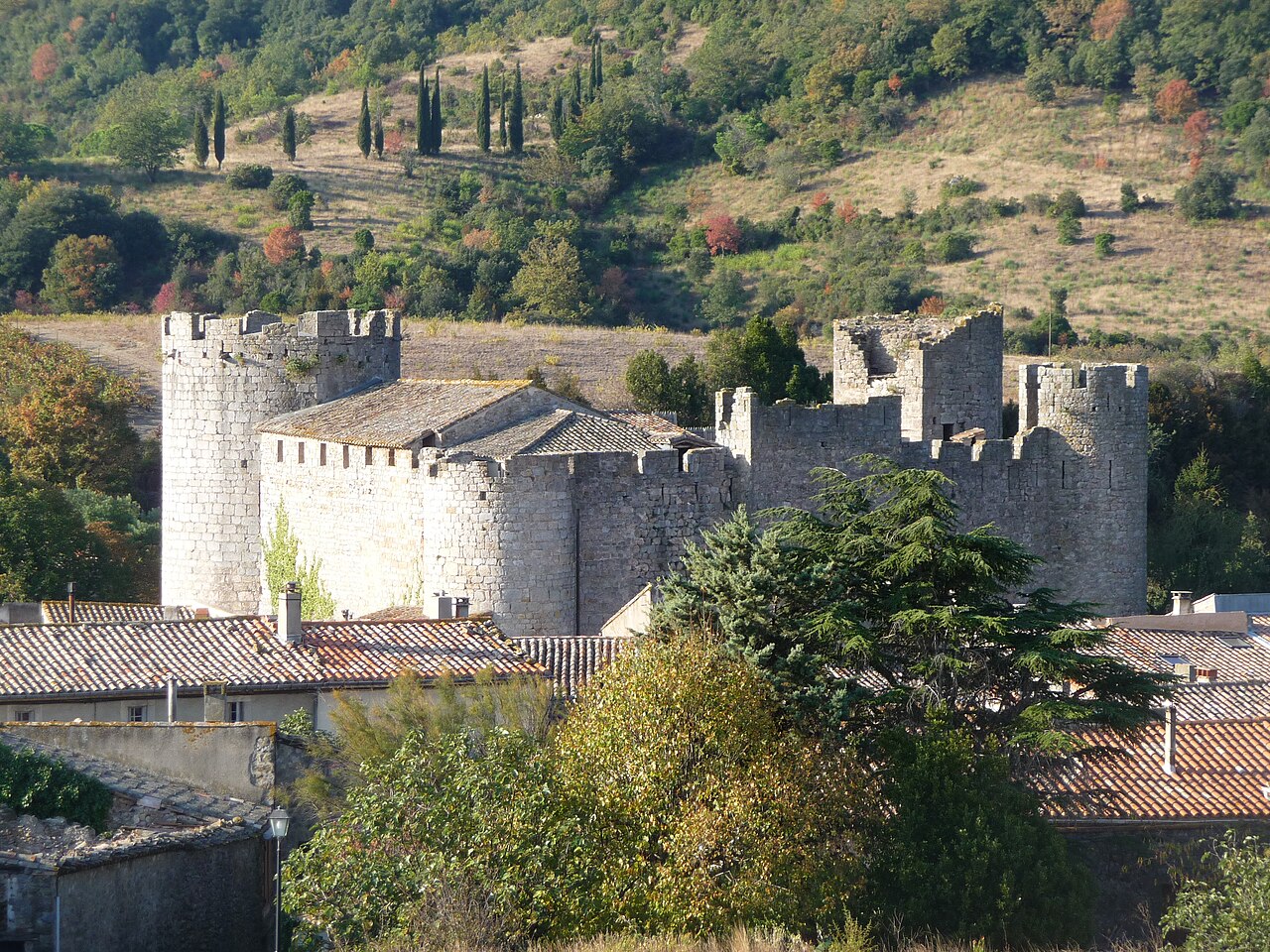
Photo by Martpan • CC BY-SA 3.0
Historical significance and legacy
Throughout its history, the castle was not only a military fortress but also an administrative center for the archbishopric’s extensive holdings in the region. It was the seat of one of the eleven bailiwicks, where the archbishop’s bailli managed local governance, tax collection, and judicial matters. This dual role highlights the integration of religious and feudal power in medieval southern France.
Despite its decline and partial ruin over the centuries, the castle’s cultural and historical importance was recognized in the 20th century. It was officially classified as a monument historique in 1976, prompting restoration efforts that have preserved much of its structure and artistic heritage. Today, the castle stands as a testament to the complex history of Catharism, the Albigensian Crusade, and the medieval church’s influence in the Languedoc region.
Visiting the cathar castles
The castle is accessible to visitors interested in exploring the rich history of the Cathar castles and the medieval architecture of southern France. Its well-preserved walls, towers, and frescoes offer a tangible connection to the past. The site’s location in the scenic Corbières Massif provides a dramatic natural backdrop that enhances the visitor experience.
Exploring the castle allows insight into the defensive strategies of medieval fortifications, the ecclesiastical power structures of the time, and the tragic history of the Cathar faith’s suppression. The castle’s exhibitions and guided tours often include detailed explanations of its architecture, history, and role in the Albigensian Crusade, making it a valuable destination for history enthusiasts and scholars alike.
Frequently asked questions (FAQ)
- How do I get to Cathar Castles?
- You can reach the Cathar Castles in Villerouge-Termenès by car, as it is located in the Aude region of France. The nearest major city is Carcassonne, which is approximately 30 kilometers away. Public transportation options are limited, so driving or joining a guided tour is recommended for convenience.
- What is the historical significance of Cathar Castles?
- The Cathar Castles are significant as they were strongholds of the Cathar sect during the Albigensian Crusade in the 13th century. These castles symbolize the struggle between the Cathars and the Catholic Church, making them an important part of French history. Today, they attract visitors interested in medieval history and the unique cultural heritage of the region.
- When was the Cathar Castle in Villerouge-Termenès built?
- The Cathar Castle in Villerouge-Termenès was originally constructed in the early 13th century, around 1250. It served as a fortress for the Cathar community and later transformed into a residence. The castle reflects the architectural style of its time, showcasing both defensive and residential features.
- Can I visit the Cathar Castles year-round?
- Yes, the Cathar Castles are open to visitors throughout the year, but it’s best to check specific opening hours, as they can vary by season. During the summer months, the castle is generally more accessible, with guided tours available. Be sure to plan your visit in advance, especially during peak tourist season.
- Why is the architecture of the Cathar Castles unique?
- The architecture of the Cathar Castles is unique due to their design, which combines defensive structures with living quarters, reflecting the dual purpose of these fortifications. The use of local stone and the strategic positioning on hilltops also contribute to their distinctive appearance. These castles embody the medieval military architecture of southern France.
- Is it possible to take guided tours of the Cathar Castles?
- Yes, guided tours are available at the Cathar Castles, providing visitors with in-depth knowledge of the history and architecture. These tours often include storytelling about the Cathar movement and the significance of the castles. It's advisable to book in advance, especially for larger groups or during busy seasons.
- What are the ticket prices for visiting the Cathar Castles?
- Ticket prices for visiting the Cathar Castles vary, typically ranging from €5 to €10 per person depending on the season and any additional guided tours. Discounts may be available for children, students, or groups. It’s a good idea to check the official website for the most current pricing and any special offers.
- What is the best time to visit the Cathar Castles?
- The best time to visit the Cathar Castles is during the spring (April to June) and fall (September to October) when the weather is mild and the tourist crowds are smaller. Summer can be quite hot and busy, while winter may bring closures and limited access. Planning your visit during shoulder seasons can enhance your experience.
- Are there nearby attractions to explore after visiting the Cathar Castles?
- Yes, there are several nearby attractions worth exploring, including the picturesque village of Lagrasse and the stunning landscapes of the Corbières region. You can also visit other Cathar castles, such as the famous Château de Peyrepertuse and Château de Quéribus, both offering breathtaking views and rich history. These sites make for a great day of exploration.
Photo gallery

Information
Website
Visit websiteSources & official resources
Verify the information above using these authoritative references.
Loading map...
Visitor reviews
No reviews yet. Been here? Write the first review and help other travelers!
Write the first reviewVisited this castle? Share your experience
Your review helps other travelers and adds first-hand knowledge to our encyclopedia.