Château de Durfort

Château de Durfort: medieval hill castle ruins in Occitanie, France
Vignevieille, France
High Medieval (11th–13th c.)
Ruins

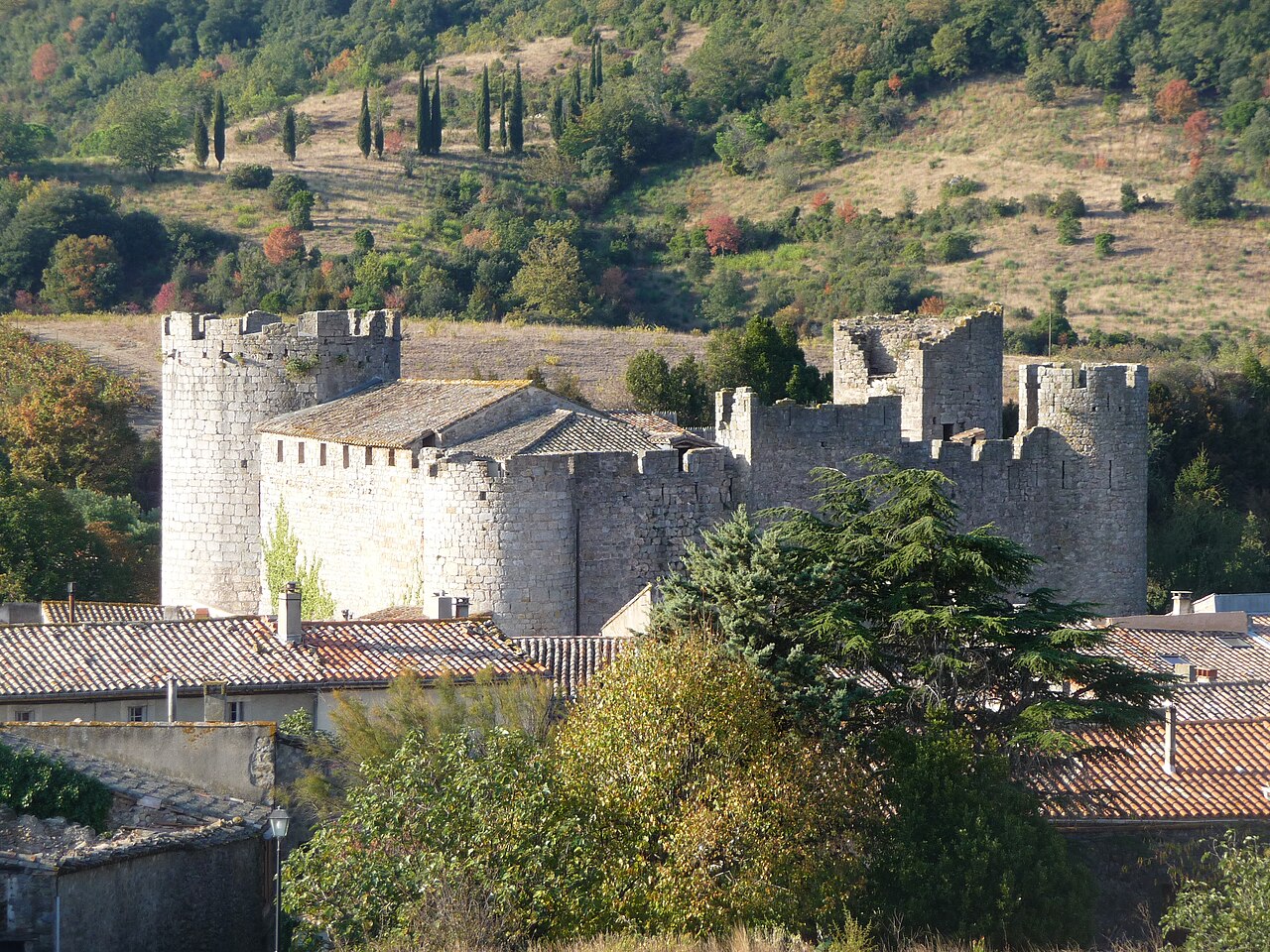
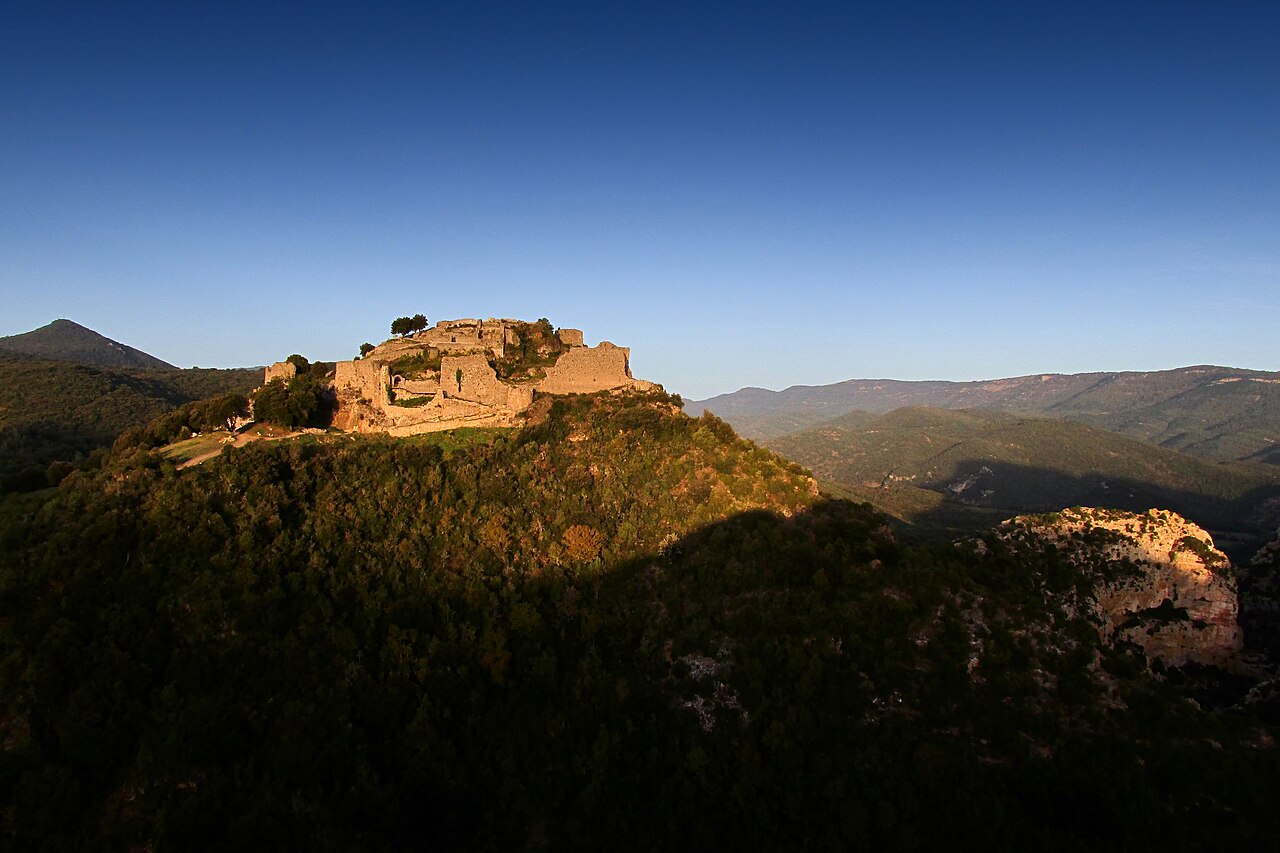
Château de Durfort is a striking example of a high medieval hill castle nestled on a rocky piton overlooking the valley of the Orbieu in the commune of Vignevieille, Occitanie, France. This 11th-century fortress commands a strategic vantage point, surrounded on three sides by a loop of the Orbieu river, providing natural defensive advantages that were typical of medieval military architecture. The castle's ruins today reveal a complex fortified habitat, including remnants of a chapel, dwellings with rectangular windows, a main tower, corner turrets, watch towers, high thick walls, cellars, wells, and arched rooms within square buildings.

Strategic location and architectural features

Perched on a rocky outcrop, the castle's location was chosen for its natural defensive advantages and its ability to oversee the surrounding valley and trade routes. The castle's design reflects the evolution of medieval fortifications from simple wooden palisades to durable stone masonry structures. The surviving elements such as the main tower (keep) and corner turrets illustrate the defensive priorities of the time, providing vantage points for surveillance and protection against attackers. The presence of cellars and wells indicates provisions for long sieges, while the arched rooms and rectangular windows suggest a blend of military and residential functions.

Historical origins and early references

The earliest documentary evidence for Château de Durfort dates back to 1093, when it appeared in a transaction involving Bertrand, son of the lord of Durfort, and the Abbey of Lagrasse. Throughout the 12th century, the castle was under the control of local lords who paid homage to regional viscounts such as Bernard Aton of Carcassonne and Raymond de Trencavel, reflecting the feudal hierarchy of the time. The castle's initial construction likely predates these records, as it fits the broader pattern of early medieval fortified residences evolving from simpler castral mounds.

The castle in the context of the Cathar Crusades

The Cathar heresy and regional conflict

The region around Durfort was deeply affected by the rise of the Cathar movement, a Christian dualist sect that challenged the authority of the Roman Catholic Church in the 12th and 13th centuries. The term "Cathar castles" is a modern tourism construct referring to fortresses in the area associated with this turbulent period. Although Château de Durfort predates the Cathar heresy, its later history is intertwined with the conflict. The castle's lord sided with the Cathars during the Albigensian Crusade initiated by Pope Innocent III in 1209 to suppress heresy in southern France.

Military and political changes

During the crusade, Simon de Montfort led campaigns in the region, and by 1215, the castle was seized and granted to his lieutenant Alain de Roucy. Despite royal conquest, the local population remained sympathetic to Cathar beliefs, and the movement persisted with councils held nearby, such as the one in Pieusse in 1225. The castle was integrated into a royal defensive network after the crusade, serving as a frontier fortress protecting the expanding Kingdom of France. Nearby castles like Château de Termes were remodeled to support royal garrisons.

Later history and decline

Following the Treaty of the Pyrenees in 1659, which shifted the Franco-Spanish border southwards, the strategic importance of castles like Durfort diminished. The castle was altered to increase comfort rather than defense, reflecting changing military and political realities. By the 18th century, Château de Durfort was abandoned, its remote location helping to preserve its ruins. Today, the castle remains privately owned and can be visited with prior authorization. The site is not actively maintained, and visitors should be cautious of falling stones.

Architectural significance and preservation

The ruins of Château de Durfort provide valuable insight into the architectural and military strategies of the high medieval period in southern France. The castle's combination of residential and defensive features exemplifies the dual role of such fortifications as noble residences and military strongholds. Its position within the network of fortresses established after the Cathar Crusades highlights its role in the consolidation of royal power in the region. Despite its current state as ruins, the castle remains an important cultural and historical monument within the Occitanie region.

Visiting information

Visitors interested in exploring Château de Durfort should seek permission from the private owners, as the castle is not open for unsupervised access. The lack of active preservation means that the site presents some hazards, including unstable masonry. However, the castle's dramatic location and evocative ruins offer a compelling experience for those interested in medieval history and architecture.

Frequently asked questions (FAQ)

How do I get to Château de Durfort?
Château de Durfort is located in Vignevieille, France, and is easily accessible by car. The nearest major city is Carcassonne, which is approximately a 30-minute drive away. Public transportation options are limited, so driving or arranging a taxi is recommended for the most convenient visit.
What are the opening hours for Château de Durfort?
Château de Durfort is open to visitors from 10 AM to 5 PM daily, with extended hours during the summer months. It is advisable to check the official website for any seasonal changes or special holiday hours. Guided tours are available at specific times, so plan your visit accordingly.
When was Château de Durfort built?
Château de Durfort dates back to the 12th century, showcasing medieval architectural styles that have been preserved over the centuries. Its rich history reflects the feudal era and the strategic importance of the region. Visitors can expect to learn about its significant role in local history during their tour.
Can I take photos inside Château de Durfort?
Yes, photography is allowed inside Château de Durfort, but visitors are asked to respect the privacy of other guests and refrain from using flash. Capturing the stunning architecture and beautiful gardens is encouraged, making for memorable keepsakes of your visit. However, be mindful of any specific areas where photography may be restricted.
Why is Château de Durfort considered historically significant?
Château de Durfort is significant due to its well-preserved structure and its representation of medieval military architecture in France. It played a key role in the region's defense during various historical conflicts. Today, it serves as a testament to the area's rich cultural heritage.
Is it possible to visit Château de Durfort with limited mobility?
Yes, Château de Durfort strives to be accessible to all visitors, including those with limited mobility. While some areas may have uneven surfaces due to the castle's historical nature, staff is available to assist and provide information on the best routes for easier access. It is recommended to contact the castle in advance to discuss specific accessibility needs.
What is the ticket price for visiting Château de Durfort?
The ticket price for adults is €10, while children under 12 can enter for free. Group discounts are available, making it an affordable option for families and school trips. Tickets can be purchased on-site or online to save time during your visit.
What is the best time to visit Château de Durfort?
The best time to visit Château de Durfort is during the spring and early autumn when the weather is mild and the gardens are in full bloom. These seasons offer a more pleasant experience for exploring the grounds and enjoying outdoor activities. Summer can be quite busy, so visiting during weekdays may provide a more tranquil experience.
Are there any nearby attractions to visit along with Château de Durfort?
Yes, nearby attractions include the picturesque village of Vignevieille and the historic town of Carcassonne, famous for its medieval fortress. Visitors can also explore local vineyards and enjoy wine tasting experiences in the surrounding countryside. These attractions make for a well-rounded day trip in the region.

Information

Hill Castle

Loading map...

Visitor reviews

No reviews yet. Been here? Write the first review and help other travelers!

Write the first review

Visited this castle? Share your experience

Your review helps other travelers and adds first-hand knowledge to our encyclopedia.
Write a review

(5/5)

0/2000 characters

Your review will be visible after admin approval

Nearby castles

1.8 km
Château de Termes — France castle

Château de Termes

Termes, France

The Château de Termes stands as a remarkable relic of medieval fortification and religious conflict in southern France. This hill castle is situated on a rocky promontory near the village of Termes in the Aude département. Its strategic position, protected on three sides by deep ravines carved by the river Sou, made it a formidable fortress during the High Medieval period. The castle's extensive ruins cover approximately 16,000 square meters, reflecting centuries of military and political significance. Originally constructed in the 12th century, the castle was closely tied to the Occitan culture and the regional nobility, notably the Trencavel family. It became a central stronghold for the Cathar movement, a religious group deemed heretical by the Catholic Church. The castle's most famous chapter unfolded during the Albigensian Crusade, particularly the siege of 1210. Held by Raymond de Termes, a Cathar vassal, the fortress endured a grueling four-month siege led by crusader commander Simon de Montfort. The defenders faced severe hardships including drought, disease, and relentless siege weapon attacks. Despite a brief reprieve when a storm replenished their cisterns, the garrison ultimately surrendered after a failed nighttime escape attempt and exhaustion from dysentery. Medieval history and cathar significance The origins of Château de Termes date back to the late 10th century, initially serving as a defensive lookout. By the 11th century, it had developed into the seat of a powerful feudal lordship, known as Termenès, which maintained close ties with the County and later Viscounty of Carcassonne. The castle was a key part of the Trencavel family's domain, who were influential rulers in the region during the 12th and early 13th centuries. The castle's association with the Cathars made it a target during the church-sanctioned Albigensian Crusade launched to eradicate heresy in southern France. The siege of 1210 was one of the most intense of the crusade's early phase. Contemporary accounts describe the defenders' resilience despite dwindling supplies and harsh conditions. After the fall of the castle, it briefly returned to Cathar control following Simon de Montfort's death but was soon absorbed into the expanding French royal domain. Royal fortress and border defense Following its capture, Château de Termes was rebuilt and reinforced in the late 13th and early 14th centuries under royal supervision. It became one of the famed "Five Sons of Carcassonne," a network of castles guarding the French border against the Kingdom of Aragon. This period saw significant architectural enhancements, including the construction of concentric defensive walls, fortified gates with barbicans, and additional outworks such as the forward fortification known as Termenet. The castle's layout features two main enceintes: a large outer wall enclosing the entire complex and a smaller inner wall protecting the core buildings. The inner enceinte housed a central keep or donjon, which was largely destroyed during the 17th century. The southern approach was heavily fortified with a man-made ditch and a complex chicane entrance designed to slow attackers. The castle’s masonry predominantly used local limestone from the Corbières massif, showcasing medieval construction techniques adapted to the rugged terrain. Decline and demolition By the 17th century, the border between France and Spain shifted southwards following the Treaty of the Pyrenees in 1659, rendering Château de Termes strategically obsolete. The fortress lost its military function and was subsequently occupied by brigands who used it as a base for raids in the surrounding countryside. To curb this lawlessness, the French crown ordered the castle's demolition in 1653-1654. A master mason from Limoux carried out the systematic destruction, using gunpowder to reduce the walls to rubble. The detailed invoice for this work survives, documenting the cost of the demolition. Archaeological rediscovery and preservation In the 20th century, recognition of the castle's historical and cultural value led to preservation efforts. Designated a monument historique in 1942, the ruins have been subject to archaeological excavations revealing important features such as a 13th-century staircase to the castle chapel and the clearing of a royal-period great hall. Since 1989, the site has been owned by the commune of Termes and is accessible to visitors via a short walk from the village. Today, visitors to Château de Termes can explore the substantial remains of its concentric walls, fortified gates, and defensive outworks. The site offers impressive views over the Termenet Gorges and surrounding landscape. Interpretive signage helps illuminate the castle’s complex history, from its Cathar association and royal garrison role to its dramatic siege and eventual ruin. Architectural features and layout The castle’s design reflects its dual function as a medieval fortress and royal border stronghold. The concentric walls provided layered defense, with the outer enceinte measuring approximately 125 by 70 meters. The inner enceinte, though partially ruined, enclosed the central keep and key buildings. Defensive towers and barbicans guarded the main gate and secondary postern entrances, enhancing security against attackers. The ruined chapel within the castle is notable for its cruciform window, a rare surviving element dating back to at least 1163. The forward fortification of Termenet, situated on a nearby rocky outcrop, complemented the main castle’s defenses by covering the most vulnerable northern approach. The use of local limestone and the adaptation to the natural topography exemplify the strategic and practical considerations in medieval castle construction. The castle’s role in regional politics Château de Termes was more than a military installation; it was a symbol of feudal authority and regional power. Its connection to the Trencavel family and later the French crown illustrates the shifting political landscape of medieval Languedoc. The castle’s role in the Albigensian Crusade underscores the intersection of religion and warfare during this turbulent period. Visitor information The castle is open to the public year-round, offering a glimpse into medieval fortification and Cathar history. Its location provides panoramic views and a tangible connection to the past. Visitors can explore the ruins on foot, with interpretive panels explaining the site's historical significance and architectural features.

High Medieval (11th–13th c.)
Details
6.5 km
Cathar Castles — France castle

Cathar Castles

Villerouge-Termenès, France

The Cathar castles of southern France, particularly the Château de Villerouge-Termenès, stand as enduring symbols of the turbulent religious and political conflicts that shaped the High Medieval period in the region. Located in the Occitanie region within the Corbières Massif, this hill castle was a strategic fortress and administrative center controlled by the powerful archbishops of Narbonne from the 12th century until the French Revolution. Its history is deeply intertwined with the Cathar heresy, the Albigensian Crusade, and the ecclesiastical authority that sought to suppress the Cathar faith. The castle's origins date back to the 12th century, with its first recorded mention in the early 1100s. The site was contested among local lords and the archbishops, reflecting the complex feudal landscape of medieval Languedoc. In 1107, Pope Pascal II confirmed the ownership of the castle and village of Villerouge-Termenès to Archbishop Richard of Narbonne, after it had been occupied by Pierre de Peyrepertuse and later linked to the Termes family through marriage dowry arrangements. Despite these disputes, the archbishops maintained control, reinforcing the castle's role as a seat of ecclesiastical power and local governance. The castle’s role in the cathar crusade The Albigensian Crusade (1209-1229) was a defining conflict that targeted the Cathar sect, regarded as heretical by the Catholic Church. The castle's location in Cathar country made it a focal point in this religious war. The crusade was marked by brutal episodes such as the massacre at Béziers, where crusaders under Arnaud Amaury infamously ordered the killing of all inhabitants, regardless of faith. This crusade was notable as the first to take place on European soil and for pitting Christians against Christians. Though the castle itself was not the site of a major siege during the crusade, it was a significant stronghold of the archbishops who opposed the Cathars. In August 1321, the castle gained grim historical prominence as the execution site of Guilhem Bélibaste, the last known Cathar perfectus or "good man." His death by burning marked the effective end of the Cathar religious tradition, symbolizing the triumph of Catholic orthodoxy in the region. Architectural features and fortifications The Château de Villerouge-Termenès exemplifies medieval military architecture with a quadrangular plan fortified by four round towers at each corner. These towers are connected by curtain walls originally topped with battlements and protected walkways, designed for defense and surveillance. The castle’s exterior walls are robust, constructed with finely cut stones on the faces and a rubble core bound with mortar, typical of 12th-century masonry techniques. Access was controlled through a northern entrance featuring a drawbridge gate, a common defensive element in medieval castles, and a smaller sally port on the southern side allowed defenders to launch sorties during sieges. One tower, larger and taller than the others, contains three stacked chambers with thick walls and a narrow spiral staircase, believed to have housed the bailli, the castle’s administrative official overseeing the archbishop’s domain. The interior courtyard buildings mostly date from the 14th century, showing continued occupation and adaptation of the castle beyond its initial construction. A notable feature is the large hall in the southeastern donjon, which contains a painted wooden beam bearing the coat of arms of Bernard de Farges, archbishop of Narbonne from 1311 to 1341. The hall also preserves a Gothic fresco depicting a banquet scene that provides insight into medieval dining customs, alongside heraldic decorations that emphasize the castle’s ecclesiastical ties. Historical significance and legacy Throughout its history, the castle was not only a military fortress but also an administrative center for the archbishopric’s extensive holdings in the region. It was the seat of one of the eleven bailiwicks, where the archbishop’s bailli managed local governance, tax collection, and judicial matters. This dual role highlights the integration of religious and feudal power in medieval southern France. Despite its decline and partial ruin over the centuries, the castle’s cultural and historical importance was recognized in the 20th century. It was officially classified as a monument historique in 1976, prompting restoration efforts that have preserved much of its structure and artistic heritage. Today, the castle stands as a testament to the complex history of Catharism, the Albigensian Crusade, and the medieval church’s influence in the Languedoc region. Visiting the cathar castles The castle is accessible to visitors interested in exploring the rich history of the Cathar castles and the medieval architecture of southern France. Its well-preserved walls, towers, and frescoes offer a tangible connection to the past. The site’s location in the scenic Corbières Massif provides a dramatic natural backdrop that enhances the visitor experience. Exploring the castle allows insight into the defensive strategies of medieval fortifications, the ecclesiastical power structures of the time, and the tragic history of the Cathar faith’s suppression. The castle’s exhibitions and guided tours often include detailed explanations of its architecture, history, and role in the Albigensian Crusade, making it a valuable destination for history enthusiasts and scholars alike.

High Medieval (11th–13th c.)
Details
16.3 km
Château de Peyrepertuse — France castle

Château de Peyrepertuse

Duilhac-sous-Peyrepertuse, France

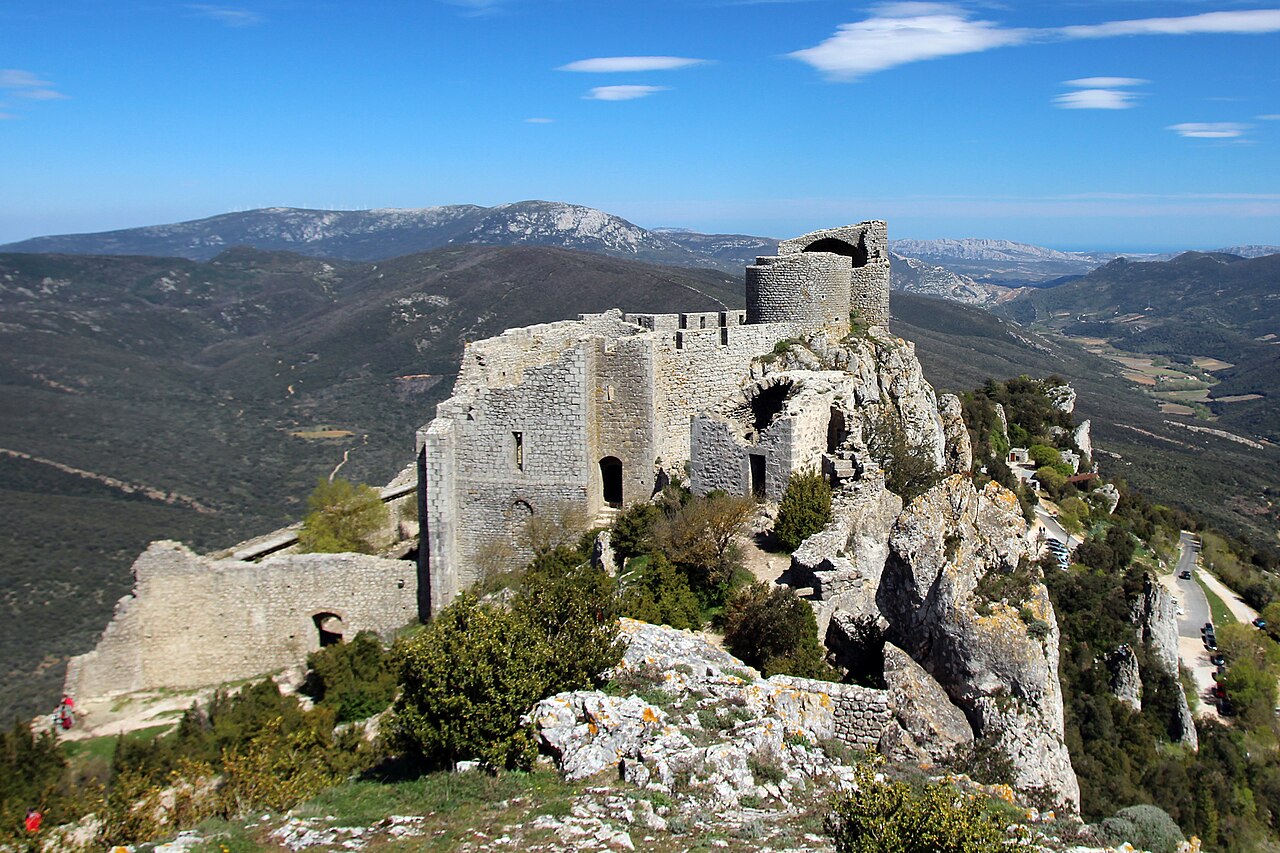
Château de Peyrepertuse stands as one of the most iconic and imposing Cathar castles in the French Pyrenees, perched dramatically atop a limestone ridge in the commune of Duilhac-sous-Peyrepertuse. This hill castle is renowned for its breathtaking location on cliffs rising 30 to 40 meters, offering commanding views over the surrounding landscape. Its strategic position and vast size have earned it a reputation as the largest among the so-called "Five Sons of Carcassonne," a group of fortresses that guarded the historic borderlands between France and Aragon. The castle's origins trace back to antiquity, with archaeological evidence confirming human occupation of the site since the 1st century BCE. The earliest historical records date from the early medieval period, specifically around 806 AD, when the fortress was known as Perapertusès under Catalan influence. Over the centuries, the castle passed through the hands of the Count of Besalú, the earldom of Barcelona, and the viscountcy of Narbonne, reflecting the complex feudal and political dynamics of the region. Historical significance and political context By the late 12th century, Peyrepertuse had become a crucial military stronghold on the frontier between the Kingdom of France and the Kingdom of Aragon. The castle's prominence grew during the Albigensian Crusade in the early 13th century, a campaign aimed at eradicating the Cathar heresy. At this time, the fortress was held by Guillaume de Peyrepertuse, a nobleman excommunicated for his Cathar sympathies. After the fall of nearby Carcassonne to crusader forces, Guillaume surrendered the castle to King Louis IX of France in 1240, marking its transition into French royal possession. Following this, the castle underwent significant reinforcement under royal direction. Between 1242 and 1251, the upper fortress known as the Sant Jòrdi donjon was constructed, perched at the highest point of the ridge. This addition, along with renovations to the older keep and the fortified Sainte-Marie church, transformed Peyrepertuse into a formidable border fortress. It was integrated into the defensive network called the "Five Sons of Carcassonne," alongside Quéribus, Puilaurens, Termes, and Aguilar castles, all strategically positioned atop rocky peaks to guard the frontier. Architectural features and layout Site and fortifications The castle extends along a limestone ridge approximately 300 meters long and up to 60 meters wide, situated around 800 meters above sea level. Its natural defenses are formidable, with steep cliffs on the southern side and a heavily fortified northern approach. The main entrance is located on the north, featuring robust curtain walls and two semicircular towers. A secret postern gate, now closed, once allowed discreet access via a narrow path and a detachable ladder, highlighting the fortress's defensive ingenuity. Lower castle and church The lower section of the castle contains the oldest structures, dating from the 12th century. Central to this area is the Romanesque Sainte-Marie church, notable for its vaulted apse and remnants of its vaulted ceiling and altar. Adjacent to the church lies the old keep, comprising the church itself and an adjoining residential building with two vaulted chambers stacked vertically. The castle's water needs were met by four cisterns, capable of holding between 12 and 40 cubic meters, essential for sustaining inhabitants during sieges. Upper fortress and donjon sant jòrdi The Sant Jòrdi donjon, constructed in the mid-13th century, crowns the ridge and represents the castle's most elevated and defensible point. Accessed by the steep Saint Louis staircase carved into the rock face, this upper keep features its own defensive walls and a single-nave chapel dedicated to Saint George. The battlements across the fortress are topped with crenellations, with square merlons pierced by narrow arrow slits, allowing defenders to fire while remaining protected. The governor's residence included shovel-shaped arrow slits for wider defensive angles. Defensive systems and daily life The castle's defensive architecture reflects the military technologies and strategies of the medieval period. The curtain walls and towers provided overlapping fields of fire, while the secret postern gate allowed for covert movement. The presence of domestic ovens and a vaulted passage leading to the spring known as Font de la Jaqueta ensured the castle's self-sufficiency during prolonged sieges. Building materials were primarily local limestone, with timber and metal fittings brought from nearby forests and workshops, lifted into place using a medieval hoisting device likely similar to a "cage à écureuil" or squirrel cage pulley. Later history and preservation Throughout the late medieval period, Peyrepertuse remained a key royal fortress guarding the French border against the Crown of Aragon and later Spain. The castle was restored in 1355 and briefly served as a refuge for Henri de Trastámara, a pretender to the Castilian throne. In 1542, it was seized during the religious conflicts by Jean de Graves, a Protestant lord, but was quickly recaptured. Its military importance waned after the Treaty of the Pyrenees in 1659, which moved the border southwards, leading to its gradual abandonment during the French Revolution. Sold as national property in 1820, the fortress fell into ruin. Preservation efforts began in 1950, stabilizing the ruins and opening the site to visitors. Today, Château de Peyrepertuse attracts nearly 100,000 visitors annually, celebrated for its dramatic setting, extensive ruins, and rich history. It has been protected as a historic monument since 1908 and is under consideration for UNESCO World Heritage status alongside other Cathar castles in the region. Cultural and touristic importance The castle's integration into the natural landscape, combined with its vast size and complex history, makes it a significant cultural landmark in southern France. Its ruins offer insight into medieval military architecture, Cathar history, and the turbulent border politics of the Middle Ages. The site also features climbing routes on the surrounding cliffs, connecting outdoor adventure with historical exploration. Visitors can explore the multiple courtyards, towers, chapels, and defensive walls, gaining a vivid impression of a fortress that evolved over centuries to meet the demands of warfare and political change. The preservation of the site ensures that this remarkable example of medieval fortification continues to educate and inspire future generations.

Early Medieval (5th–10th c.)
Details