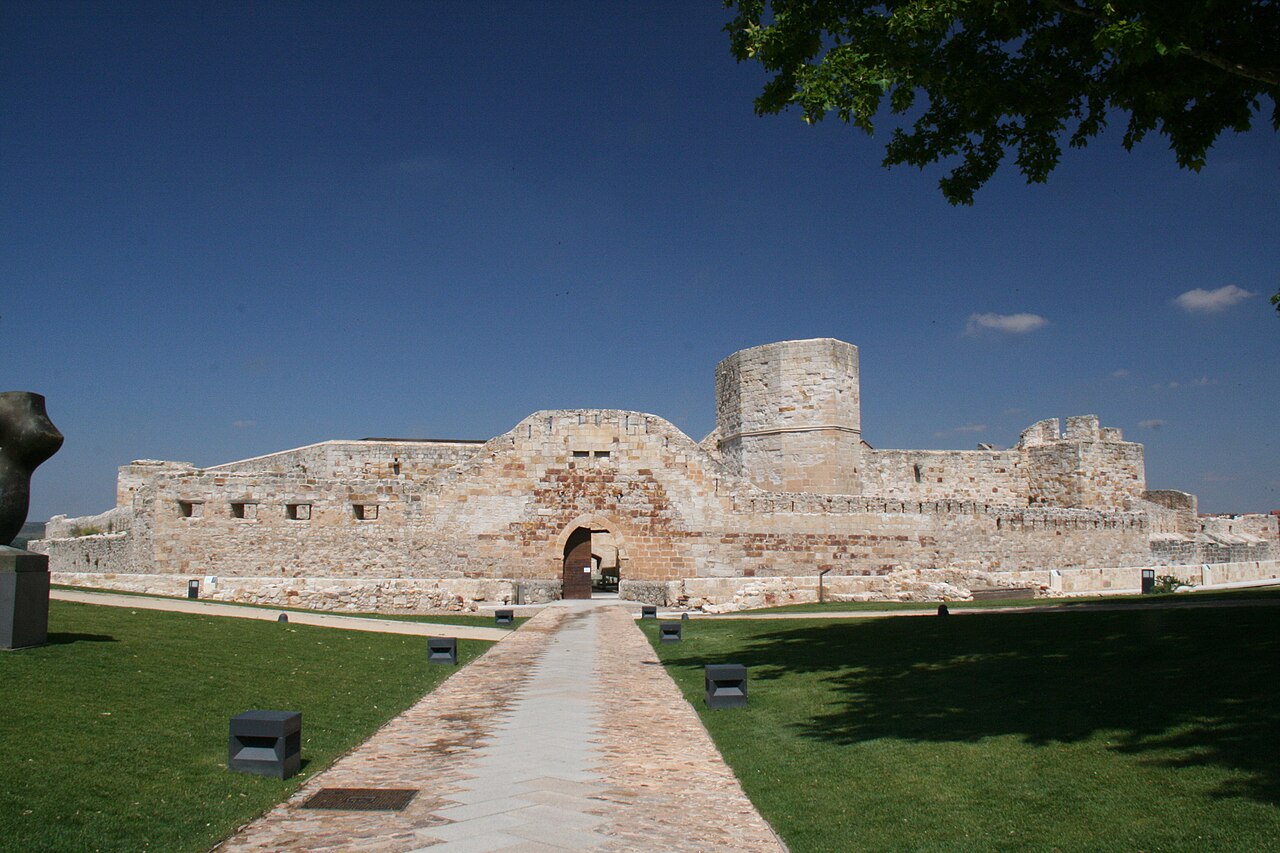
Castrotorafe Castle
Castrotorafe Castle stands as a significant example of high medieval military architecture in the province of Zamora, Spain. Located in the municipality of San Cebrián de Castro, this hill castle occupies a strategic vantage point overlooking the Esla River at approximately 718 meters above sea level. The castle's ruins lie within the ancient settlement known as Zamora la Vieja, a site that reflects centuries of defensive and administrative activity from the 12th century through the early modern period.
Historical background and significance
The origins of Castrotorafe Castle trace back to the 12th century, with construction initiated under the auspices of the medieval Castilian kingdom. The fortress was built to assert feudal control over the surrounding lands and to protect the adjacent village. One of the key historical figures associated with the castle's development was Infante Juan de Castilla, "el de Tarifa", son of King Alfonso X of Castile, who undertook significant construction efforts before 1319.
Throughout the late 13th and early 14th centuries, the castle formed the core of the village's defenses, embodying the turbulent political and military landscape of medieval Spain. Its role as a military stronghold was complemented by its administrative functions, serving as a seat of local power within the feudal hierarchy.
In the 15th century, the castle underwent notable modifications under the command of Alfonso de Valencia y Bracamonte. These changes were driven by the need to adapt to evolving military technologies, particularly the introduction of artillery. The fortress was reinforced to accommodate cannons, marking its transition into the early modern era of warfare and reflecting broader trends in castle fortification across Europe.
Maintenance and repairs continued into the 16th and early 17th centuries, with documented work as late as 1604. However, by the late 17th century, specifically around 1688, the castle had fallen into decline and ceased to function as an active military installation. This decline mirrors the broader obsolescence of medieval castles in the face of changing military and political realities.
Architectural features and layout
The castle occupies an irregular trapezoidal plan divided into two main enclosures. The outer enclosure is defined by robust masonry walls constructed from slate and mortar, reinforced by angular bastions known as cubos. Two of these bastions were altered in the 15th century to mount artillery, illustrating the castle's adaptation to gunpowder weaponry.
The inner enclosure maintains a similar trapezoidal shape and contains two prominent towers on its southern side. These towers are built from ashlar masonry, featuring finely cut stone blocks that contrast with the rougher masonry of the outer walls. One of these towers is believed to have served as the keep or torre del homenaje, the principal stronghold and last line of defense within the castle.
The castle originally featured a double defensive wall system and was surrounded by a moat, remnants of which still survive today. The moat would have served as a critical defensive obstacle, preventing direct assaults on the walls. The two main gates controlled access to the fortress: one gate led to the village, while the other opened toward a nearby bridge, underscoring the castle's role in controlling local transportation routes.
Inside the enclosures, the castle's interior space has largely fallen into ruin. However, sections of the southern and eastern walls remain, with the eastern wall housing the main entrance gate. The castle's complex layout reflects centuries of construction phases and adaptations to changing military needs.
Strategic location and defensive importance
Castrotorafe Castle occupies a commanding position on a hill that overlooks the Esla River, providing natural defensive advantages and extensive visibility over the surrounding landscape. This location was crucial for monitoring and controlling movement along the river valley and nearby routes, enhancing the castle's military and administrative effectiveness.
The fortress's design, with its dual enclosures and reinforced bastions, was well-suited to withstand sieges and attacks typical of the medieval period. The later adaptations for artillery demonstrate the castle's continued strategic relevance into the early modern era, as it evolved to meet the challenges posed by new forms of warfare.
Preservation and current state
Today, Castrotorafe Castle is classified as ruins, with many of its structures partially preserved. The remains offer valuable insights into medieval fortification techniques and the evolution of military architecture in the region. The surviving walls, towers, and bastions provide a tangible connection to the castle's historical past, while the remnants of the moat and gates illustrate its comprehensive defensive system.
The site, encompassing approximately 4,709 square meters, includes not only the castle but also the hermitage and surrounding walls. The castle's ruins attract historians, archaeologists, and visitors interested in Spain's medieval heritage and the architectural legacy of the Castilian kingdom.
Castrotorafe castle in the context of Spanish medieval fortifications
As a high medieval hill castle, Castrotorafe is representative of the military and feudal structures that dominated the Iberian Peninsula during the Middle Ages. Its construction and subsequent modifications reflect the shifting political dynamics and technological advancements of the period, particularly the transition from traditional medieval defenses to artillery-capable fortifications.
The castle's layered history, from its 12th-century origins through its 15th-century artillery adaptations, offers a microcosm of broader trends in castle architecture and military strategy in medieval Spain. Its preservation as ruins allows for ongoing study and appreciation of these historical developments.
Information
Loading map...
Visitor reviews
No reviews yet. Been here? Write the first review and help other travelers!
Write the first reviewVisited this castle? Share your experience
Your review helps other travelers and adds first-hand knowledge to our encyclopedia.