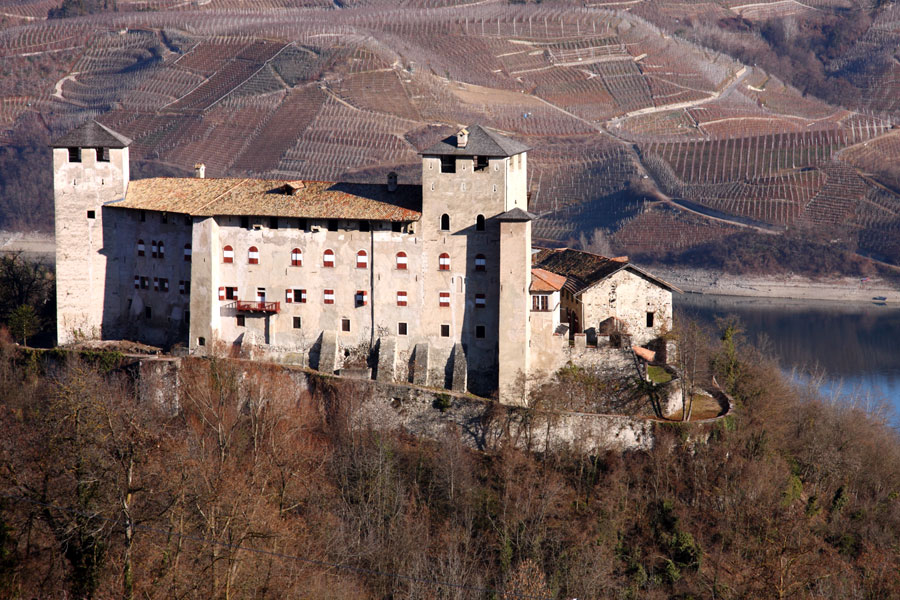
Castle Vasio
Castle Vasio stands prominently on a hill overlooking the Nonstal valley within the municipality of Loc in modern-day Italy. This hill castle was most likely established in the 12th century by the noble Counts of Eppan, who constructed the fortress to control and oversee an important ancient Roman road crossing the nearby Torrente Novella stream. The castle also functioned as a strategic point for managing toll collection in the region, highlighting its economic and military significance during the medieval period.
The earliest surviving written mention of the castle dates to 1237, where it appears as "Castrum de Vaz" in historical documents. This record notes that Count Egno II of Eppan granted the castle as a fief to Berthold of Cloz. Following the death of Egno II, ownership of Castle Vasio transferred to the Prince-Bishopric of Trento in 1273, thereby linking the fortress directly to ecclesiastical authority. Subsequently, the castle became the residence of the Vasio family, who acted as ministerial agents or administrators on behalf of the bishopric. The Vasio lineage ended around 1445, after which the property passed through several noble families.
Historical ownership and feudal significance
During the 15th and 16th centuries, Castle Vasio was held by various noble families including the Hack, Trapp, Cles, Malosco, and finally the Arsio family. The Arsios maintained the castle as a fief granted by the bishopric until the 19th century. The fortress endured damage amid regional conflicts such as the Spaur feud (1418-1420) but was subsequently repaired. A significant restoration effort occurred in the 18th century, led by Anton and Felix von Arz, commemorated by memorial stones still visible on the site.
Architectural features and castle layout
The bergfried and defensive structures
Castle Vasio was originally centered around a square bergfried tower measuring approximately 8 by 8 meters, with walls ranging from 1 to 2.5 meters thick. This tower was crowned with distinctive Ghibelline battlements, characterized by swallowtail-shaped crenellations, a style associated with medieval Italian fortifications. The bergfried served as the core defensive and residential structure of the castle.
Surrounding fortifications
The bergfried was flanked by two attached buildings, creating a compact layout constrained by the hilltop's limited space. Surrounding this central complex was a defensive curtain wall. On the side facing the road, the castle's defenses were reinforced with a zwinger—an enclosed killing ground between two walls—and a ravelin, a triangular outwork designed to protect the main wall from direct assault. The main entrance was secured by a moat and a drawbridge, enhancing the castle's control over access and its defensive capabilities.
Expansions and internal buildings
In the 14th century, the buildings adjacent to the bergfried were expanded both vertically and horizontally to accommodate increased residential and economic functions. A chapel was also part of the castle complex, documented as late as 1749. However, the chapel was later absorbed into the 19th-century farmhouse structures that incorporated parts of the old castle.
Later history and restoration efforts
The castle suffered a partial destruction of its western wing due to a fire in 1885. Following this event, the bergfried was lowered to the height of the surviving wings and the entire structure was unified under a single four-sided roof, which altered the original silhouette of the fortress. Today, only fragments of the bergfried remain visible as distinct architectural elements, while much of the castle has been integrated into agricultural buildings erected during the 19th century.
In 1878, the property was acquired by Battista Rizzi, who adapted the remaining structures by constructing a farmhouse that incorporated parts of the medieval castle. More recently, in the early 2000s, the site underwent extensive restoration and some sections of the former fortress were converted into guest accommodations, blending historical preservation with modern use.
Historical depictions and cultural significance
Historical maps from the early 17th century such as the Tirol map by Matthias Burglechner and the Codex Brandis depict Castle Vasio in its original medieval form prior to the 18th-century restorations. These illustrations provide valuable insights into the castle’s architectural evolution and its role within the region's feudal landscape.
Castle Vasio remains an important cultural and historical landmark within the Nonstal valley, offering a tangible connection to the medieval history of northern Italy and the complex interplay of noble families, ecclesiastical power, and military architecture. The site’s layered history—from its origins in the 12th century through periods of conflict, restoration, and adaptive reuse—makes it a compelling subject for historians and visitors interested in medieval fortifications and Italian heritage.
Frequently asked questions (FAQ)
- What is the historical significance of Castle Vasio?
- Castle Vasio was established in the 12th century by the Counts of Eppan to oversee a Roman road and manage tolls, linking it to regional trade and feudal power.
- Can visitors see the original medieval features of Castle Vasio?
- Yes, visitors can observe remnants of the original bergfried with its distinctive Ghibelline battlements, as well as parts of the defensive walls and other medieval structures.
- When was Castle Vasio last restored?
- The castle underwent significant restoration in the early 2000s, which included adapting parts of the fortress for guest accommodations while preserving historical elements.
- How did the ownership of Castle Vasio change over time?
- Originally owned by the Counts of Eppan, the castle passed to the Prince-Bishopric of Trento in 1273, then to various noble families including the Vasio and Arsio families until the 19th century.
- Is the castle accessible to the public?
- Some sections of Castle Vasio have been converted for guest use, but public access details may vary; visitors should check local resources for current visiting information.
Information
Website
Visit websiteSources & official resources
Verify the information above using these authoritative references.
Loading map...
Visitor reviews
No reviews yet. Been here? Write the first review and help other travelers!
Write the first reviewVisited this castle? Share your experience
Your review helps other travelers and adds first-hand knowledge to our encyclopedia.