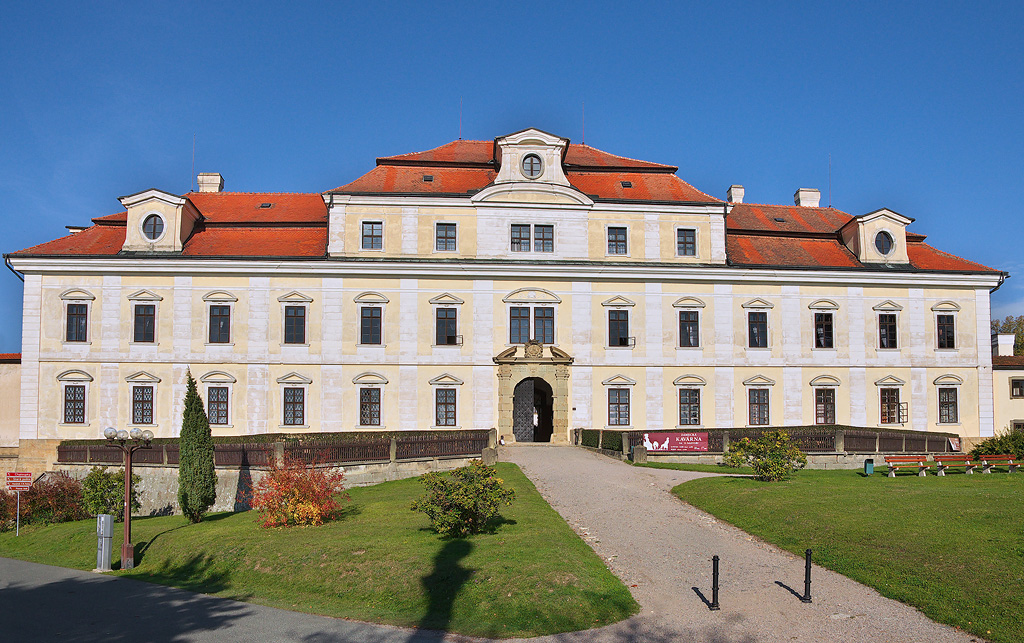
Castle Skuhrov
Castle Skuhrov stands as a significant medieval ruin located near the village of Skuhrov nad Bělou in the Czech Republic. Established towards the end of the 13th century by the Bohemian nobility, it is a fine example of a hill castle designed for both defense and residence during a period when fortified structures were essential across the region.
The castle's origins are closely tied to Jan of Meziříčí, a nobleman active until the early 14th century. His son Tas, who adopted the surname "of Skuhrov" in 1303, signified the family's deep connection to the estate. The inheritance division in 1338 between Jan's sons, Vznata and Tas, saw Tas retaining control of the castle. Tas's service under Charles IV, King of Bohemia and later Holy Roman Emperor, is documented until 1359, marking the castle's importance within the noble network of the time.
Throughout the 14th century, the Meziříčí family maintained ownership, with figures such as Jan and Vznata linked to the castle and adjacent estates like Rychmberk. In 1387, ownership changed hands when the castle was sold to Půta of Častolovice and Boček of Kunštát and Poděbrady, indicating shifts in regional power and the castle's strategic role.
The castle also played a part in matrimonial alliances, such as when Anna Osvětimská brought the estate as a dowry to her marriage with Půta II of Častolovice. After Půta II's death in 1403, Anna managed the property, reflecting the role of noblewomen in estate stewardship during this era.
Following a period of limited records, the castle returned to royal possession in 1454 under King Ladislaus the Posthumous, who granted it to Zdeněk Konopišťský of Šternberk. Subsequently, it passed to George of Poděbrady, a prominent noble who later became King of Bohemia. The castle may have suffered damage during conflicts in this turbulent period, though detailed accounts are scarce.
By the late 15th century, Castle Skuhrov was no longer actively used as a noble residence. The 1495 acquisition of the estate by Vilém of Pernštejn mentions only the settlement, implying the castle was already abandoned. Official records from 1558 confirm the castle's deserted status, marking the end of its functional life.
Architectural layout and defensive features
Castle Skuhrov is situated on a slightly trapezoidal promontory overlooking the right bank of the Bělá stream. The castle's design reflects careful planning to integrate both defensive and residential elements within its walls.
The complex was enclosed by a perimeter wall, which remains the most intact part of the ruin today. Foundations of buildings are still visible on the southern and eastern sides, indicating where residential quarters or service buildings once stood. This layout suggests a well-organized spatial arrangement typical of medieval hill castles.
Access to the castle was likely through a tower gate positioned at the northeastern corner of the outer bailey, serving as the initial defensive barrier. Surrounding the front and western sides of this bailey was a zwinger, an enclosed outer ward designed to trap or expose attackers, complemented by a protective moat in front.
In front of the former front wall lies a large rectangular depression, a modern feature that once served as an orchestra pit for a theater constructed in 1949, illustrating later adaptations of the site.
Further defensive measures included a neck moat that followed the western and southern sides, supplemented by an outer rampart—an earthen embankment enhancing the castle's fortifications. The northeastern corner of the castle curves inward; earlier theories suggested this was the site of a bergfried (a tall main tower), but surviving stonework does not support this interpretation.
Archaeological research by historian Tomáš Durdík proposes the castle's main structure featured either a shield wall facing potential attack routes or more likely a two-winged building layout. The discovery of a wall parallel to the front wall supports the latter, indicating two wings arranged to defend and organize the interior space effectively.
Historical significance and legacy
Castle Skuhrov reflects the complex feudal and political dynamics of medieval Bohemia. Its ownership history illustrates the interconnectedness of noble families, royal authority, and regional power struggles. The castle's decline and abandonment by the mid-16th century align with broader shifts in military technology and noble residence preferences, which rendered many hill castles obsolete.
Today, the ruins of Castle Skuhrov offer valuable insights into medieval castle construction and defensive strategies. The preservation of its perimeter walls and visible foundations allows historians and visitors to appreciate the spatial organization and architectural sophistication typical of 13th and 14th-century hill castles in Central Europe.
As a heritage site, Castle Skuhrov contributes to the cultural landscape of the Czech Republic, attracting interest from scholars, tourists, and enthusiasts of medieval history and architecture. Efforts to maintain and study the ruins continue to enhance understanding of the region's feudal past and architectural evolution.
Visitor experience and accessibility
While Castle Skuhrov remains a ruin without extensive modern facilities, its location on a hilltop provides scenic views of the surrounding landscape. Visitors can explore the remnants of the defensive walls and building foundations, gaining a tangible connection to medieval life and fortification techniques. The site is accessible from the nearby village of Skuhrov nad Bělou, making it a worthwhile destination for those interested in history and architecture.
Frequently asked questions (FAQ)
- How do I get to Castle Skuhrov?
- Castle Skuhrov is located near the village of Skuhrov nad Bělou in the Hradec Králové Region of Czechia. Visitors can reach the site by car or local transport followed by a short walk up the hill where the castle ruins stand.
- What is the best time to visit Castle Skuhrov?
- The best time to visit Castle Skuhrov is during the late spring to early autumn months when the weather is favorable for hiking and outdoor exploration. The castle ruins are outdoors and can be less accessible in winter due to snow and ice.
- Is Castle Skuhrov accessible for people with limited mobility?
- Due to its hilltop location and uneven terrain, Castle Skuhrov is not fully accessible for visitors with limited mobility. The site involves walking on slopes and uneven ground, which may be challenging without assistance.
- What can I expect to see at Castle Skuhrov?
- Visitors to Castle Skuhrov can explore the well-preserved perimeter walls, foundations of former residential and service buildings, the tower gate area, and defensive features such as the moat and zwinger. The site offers insight into medieval castle architecture and defensive strategies.
- Are there guided tours available at Castle Skuhrov?
- Guided tours may be available through local historical societies or the state museum managing the site. It is recommended to check in advance for tour schedules and availability to enhance the visitor experience.
Information
Current owner
State museum
Loading map...
Visitor reviews
No reviews yet. Been here? Write the first review and help other travelers!
Write the first reviewVisited this castle? Share your experience
Your review helps other travelers and adds first-hand knowledge to our encyclopedia.