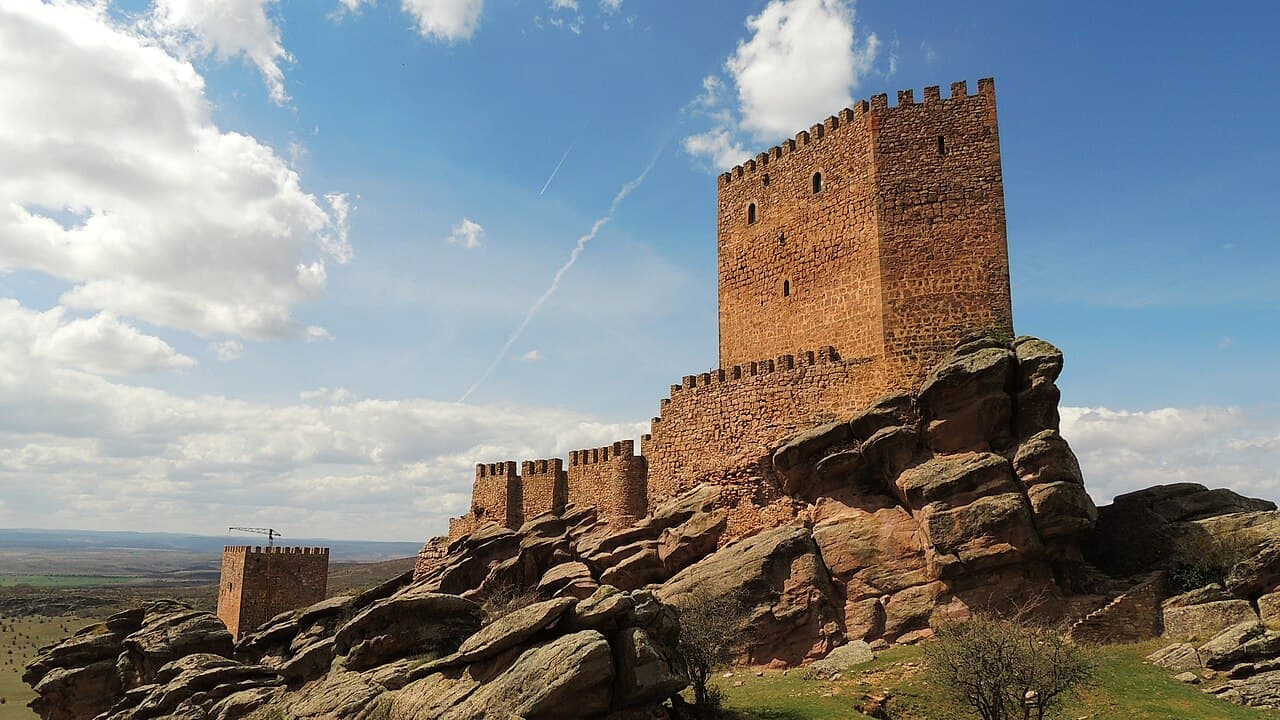
Castle of Zafra
The Castle of Zafra stands as a remarkable example of medieval military architecture perched atop a prominent sandstone outcrop in the Sierra de Caldereros, near the village of Campillo de Dueñas in Castilla-La Mancha, Spain. Constructed in the late 12th or early 13th century, this hill castle occupies a site with a long history of fortification, originally hosting Visigothic and later Moorish defenses before falling into Christian hands during the Reconquista in 1129. Its imposing position and robust design made it a virtually impregnable fortress on the volatile frontier between Christian and Muslim territories during the High Medieval period.
Throughout its history, the Castle of Zafra played a pivotal role in regional power struggles, serving as a key stronghold for the Kingdom of Aragon and the Señorío de Molina. Notably, it withstood a significant siege in 1222 when Don Gonzalo Pérez de Lara sought refuge there against the forces of King Fernando III of Castile. The castle's robust defenses prevented its capture, leading to a negotiated settlement known as the Agreement of Zafra, which arranged the castle's transfer to royal control through strategic marriage alliances.
Historical context and strategic importance
The site of the Castle of Zafra has been occupied since ancient times, with archaeological finds including Bronze and Iron Age pottery fragments and evidence of Roman-era structures. The earliest known fortress dates to the Visigothic Kingdom era, prior to the early 8th century, followed by a Moorish fortress during the Islamic period in Spain.
Its capture by Christian forces in 1129 marked a turning point in the control of the region, as the castle became a critical defensive bastion on the border between Christian and Muslim domains. The castle's location in the rugged uplands of the Sierra de Caldereros provided natural defenses, while its construction utilized the entire sandstone outcrop, making direct assaults extremely difficult.
During the 12th and 13th centuries, the castle was a focal point in the territorial disputes between the Kingdom of Castile and the Kingdom of Aragon, as well as local noble families such as the Manrique de Lara. Its role as a military stronghold diminished after the union of Castile and Aragon in 1469 and the completion of the Reconquista by the end of the 15th century.
Architectural features and layout
The Castle of Zafra is notable for its integration with the natural landscape, occupying the entire length of a narrow sandstone ridge aligned northeast to southwest. The fortress is enclosed by a defensive wall that connects the entrance tower at the southwest end to the main buildings at the northeast end.
The castle's internal layout is divided into four principal areas: the entrance tower, an open courtyard, the Place of Arms, and the Tower of Homage or donjon. The Place of Arms served as a troop assembly area and contains cisterns essential for water storage during sieges. The donjon was the lord's residence, containing chambers and kitchens across two floors connected by a spiral staircase leading to an upper terrace with panoramic views of the surrounding countryside.
The castle was designed to accommodate up to 500 people, reflecting its role as a refuge and military bastion. Surrounding the main structure are remains of additional buildings, possibly used as outer fortifications, stables, or storage facilities. The original access route, once described as ingeniously constructed, no longer exists, and modern visitors must climb a stone staircase or ladder installed by the current owners to reach the entrance.
Construction techniques and materials
The builders utilized the natural sandstone rock extensively, shaping and integrating the castle's walls and towers directly onto the outcrop. This not only enhanced the castle's defensive capabilities but also minimized the need for additional building materials. The masonry work reflects typical High Medieval military architecture, with thick walls, narrow arrow slits, and battlements designed for defense.
Notable historical events and ownership
Throughout the 13th to 15th centuries, the Castle of Zafra witnessed numerous conflicts and changes in ownership amid the turbulent political landscape of medieval Spain. It was a contested site during the Castilian Civil War and various rebellions, involving prominent figures such as Henry II of Castile, the French commander Bertrand du Guesclin, Peter IV of Aragon, and Henry IV of Castile.
One of the castle's most famous castellans was Don Juan de Hombrados Malo, who maintained royal control over the fortress and was granted hereditary wardenship, ensuring his family's long-term association with the castle. The castle ultimately passed into the hands of the Catholic Monarchs following the unification of Castile and Aragon in 1479, marking the end of its strategic military role.
Decline and restoration efforts
With the completion of the Reconquista and the political unification of Spain, the Castle of Zafra lost its military significance and gradually fell into disrepair from the 16th century onward. It remained state property until 1971, when it was sold at auction to Don Antonio Sanz Polo, a descendant of the castle's historic warden, Don Juan de Hombrados Malo.
Don Antonio dedicated over thirty years and significant personal resources to restoring the castle from a state of ruin. His efforts included hiring architects, historians, and utilizing modern equipment to carefully reconstruct the two main towers and other key structures. His work was recognized with a Medal of Merit from the National Association of Friends of Castles.
Cultural significance and modern recognition
Today, the Castle of Zafra is privately owned by the family of Don Antonio Sanz Polo. While its exterior is accessible for viewing, entry to the interior requires permission from the owners. The castle's dramatic setting and well-preserved medieval architecture have made it a popular destination for visitors interested in Spanish history and castle architecture.
The castle gained international cultural prominence as a filming location for the sixth season of HBO's Game of Thrones, where it portrayed the iconic Tower of Joy. This exposure has increased interest in the site, linking its historical legacy with contemporary popular culture.
Visitor information and accessibility
Located in a remote mountainous area, the castle is accessible by a challenging hike or via rugged vehicles on dirt roads from the nearby village of Hombrados. Visitors should plan accordingly for the physical demands of reaching the site. Access to the interior is restricted and requires prior arrangement with the owners.
The castle's preservation and restoration efforts highlight the importance of private stewardship in maintaining Spain's cultural heritage. Its blend of natural fortification and medieval construction offers a unique glimpse into the military and social history of the High Medieval period in the Iberian Peninsula.
Frequently asked questions (FAQ)
- How do I get to the Castle of Zafra?
- The Castle of Zafra is located in Campillo de Duenas, Spain, and can be accessed by car or public transport from nearby cities. The closest major city is Guadalajara, which offers bus services to the area. Once in Campillo de Duenas, the castle is a short walk from the town center.
- What is the historical significance of the Castle of Zafra?
- The Castle of Zafra, built in the 15th century, is a remarkable example of medieval architecture in Spain and played a crucial role during the Reconquista. It served as a defensive fortress and a lookout point for the surrounding region. Today, it stands as a symbol of the area's rich history and cultural heritage.
- When was the Castle of Zafra built?
- The construction of the Castle of Zafra began in the late 15th century, specifically around 1490. It was completed within a few years and has since been preserved as a historical monument. Its architectural features reflect the transitional style from Gothic to Renaissance, showcasing the era's craftsmanship.
- Can I visit the Castle of Zafra?
- Yes, visitors are welcome to explore the Castle of Zafra. It is open to the public, allowing guests to wander through its ancient walls and enjoy the panoramic views of the surrounding landscape. Guided tours may also be available for those interested in learning more about its history.
- Why is the Castle of Zafra an important architectural site?
- The Castle of Zafra is considered an important architectural site due to its unique blend of Gothic and Renaissance styles, showcasing the evolution of military architecture in Spain. Its well-preserved structure provides insight into the defensive strategies of the time. Additionally, the castle's strategic location adds to its historical significance.
- What are the opening hours of the Castle of Zafra?
- The Castle of Zafra typically opens to visitors from 10 AM to 6 PM, but hours may vary depending on the season. It is recommended to verify the current opening hours on the official website or local tourist information before planning your visit. Always check for any holiday closures as well.
- What is the best time to visit the Castle of Zafra?
- The best time to visit the Castle of Zafra is during the spring and fall months when the weather is mild and pleasant for outdoor exploration. Visiting during these seasons allows you to enjoy the surrounding natural beauty without the extreme heat of summer. Additionally, you may find fewer crowds during these times.
- Are there any nearby attractions to visit along with the Castle of Zafra?
- Yes, there are several nearby attractions worth exploring, including the picturesque village of Campillo de Duenas itself, which offers charming streets and local culture. Additionally, the natural parks and hiking trails in the surrounding area provide opportunities for outdoor activities and scenic views. Make sure to allocate time to explore these nearby sites during your visit.
- What are the ticket prices for visiting the Castle of Zafra?
- Ticket prices for the Castle of Zafra are generally affordable, with discounts available for students and seniors. Entry fees help support the maintenance and preservation of the castle. It's best to check the official website or local tourist information for the most current pricing details before your visit.
Photo gallery

Information
Website
Visit websiteSources & official resources
Verify the information above using these authoritative references.
Loading map...
Visitor reviews
No reviews yet. Been here? Write the first review and help other travelers!
Write the first reviewVisited this castle? Share your experience
Your review helps other travelers and adds first-hand knowledge to our encyclopedia.


