Castle of Molina de Aragon
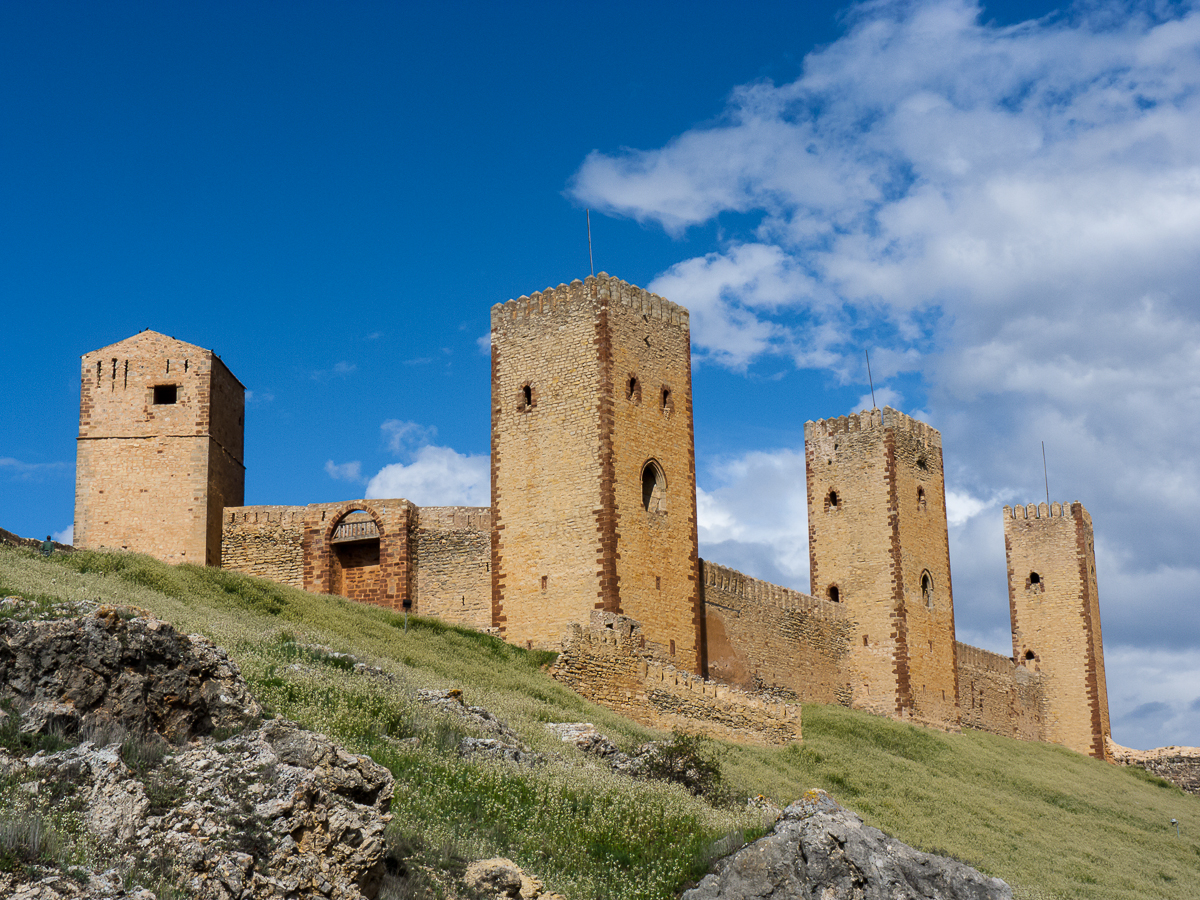
The Castle of Molina de Aragon stands as a monumental example of Romanesque military architecture in Spain, commanding a strategic hilltop overlooking the Gallo River valley in the province of Guadalajara. This imposing hill castle is notable for its extensive fortifications, including a complex system of walls, towers, and gates that reflect its historical significance and defensive role throughout the High medieval period.
Originally constructed in the 10th to 11th century by Andalusian Muslims as an alcázar on the site of a pre-existing Celtiberian fortification, the castle's foundations reveal a long history of military occupation. Its position was chosen to control vital routes between the kingdoms of Aragon and Castile, making it a key site during the Reconquista. The fortress served as the residence of the taifa kings of Molina, who ruled during the fragmentation of Muslim power in the Iberian Peninsula.
Historical significance and early history
The castle's early history is intertwined with notable figures such as the caíd Ibn Galbun, who defended Córdoba against Alfonso VII of Castile. Ibn Galbun, identified with the Abengalbón mentioned in the medieval epic Cantar de mio Cid, was the castle's alcaide or governor and an ally of the legendary Castilian hero El Cid. According to tradition, El Cid himself resided at the castle during his exile from Castile, underscoring its importance as a stronghold in the turbulent political landscape of medieval Spain.
In 1129, the castle was conquered by Alfonso I of Aragon, who initiated a significant reconstruction in the Romanesque style. Following this conquest, the castle and its surrounding lands were granted to the noble Lara family, who governed Molina from the fortress until the late 13th century. The castle then became a seigneurie under the Castilian crown through the marriage of Doña María Lara to King Sancho IV of Castile, further emphasizing its political importance.
Architectural features and layout
The Castle of Molina de Aragon is the largest surviving fortress in the Guadalajara province, comprising two main sections: an outer bailey known as the albacara and an inner castle. The outer enclosure measures approximately 80 by 40 meters and is surrounded by crenellated walls punctuated by numerous defensive towers.
The outer walls feature five principal gates: the Traitor’s Gate to the north, the Horses’ Gate to the south, the Field Gate to the east, and the Clock Tower and Hogalobos gates to the west. Historically, additional gates existed in the medieval city walls, including the Medinaceli, Baños, Valencia, and Puente gates. The main entrance to the outer enclosure is marked by a semicircular arch flanked by two towers, a characteristic feature of Romanesque military design.
The inner castle originally contained eight towers, of which four remain well preserved or restored, two are in ruins, and two have been lost. These towers are connected by a battlemented wall-walk, known as an adarve, which allowed defenders to move swiftly along the ramparts. Noteworthy towers include the Veladores Tower in the southwest, the central Arms Tower, the Keep or Doña Blanca’s Tower in the southeast, and the Covered or Knights’ Tower on the northern wall.
Stone mason marks found on the western walls of both the inner and outer enclosures provide insight into the construction techniques and artisans involved in the castle’s building phases. These marks, totaling 46 signs of 16 different types, are an important feature for understanding medieval masonry practices.
Later history and preservation
During the Carlist Wars in the 19th century, the castle was attacked by Carlist forces under General Vallés in 1875, reflecting its continued military relevance. It served as a military barracks well into the early 20th century before being abandoned by the army.
Recognizing its cultural and historical value, the castle was declared a National Monument on June 3, 1931. It is protected under Spanish heritage laws enacted in 1949 and 1985, ensuring its preservation as a significant monument of medieval military architecture. The castle has also appeared in popular culture, notably on the cover of the 1985 album "Songs" by the Norwegian band Fra Lippo Lippi and on a 2005 Spanish postage stamp, which was famously printed inverted horizontally.
Current condition and visitor information
Today, the Castle of Molina de Aragon remains in a state of consolidated ruin, retaining much of its original layout and defensive features. The site includes the adjacent Church of Santa María del Collado, which forms part of the historical complex and adds to the cultural richness of the location.
Visitors can access the castle by prior arrangement, allowing them to explore its extensive fortifications and appreciate the blend of Romanesque military architecture and historical layers spanning from Celtiberian times through the medieval period. The castle’s commanding position and well-preserved elements make it a compelling destination for those interested in Spain’s medieval heritage and military history.
Frequently asked questions (FAQ)
- How do I visit the Castle of Molina de Aragon?
- The castle is accessible to visitors by prior arrangement. It is recommended to contact local tourist offices or heritage organizations in Molina de Aragon to arrange a guided tour or visit.
- What is the historical significance of the Castle of Molina de Aragon?
- The castle served as the residence of the taifa kings during the Muslim period and was a strategic fortress during the Reconquista. It was also the residence of El Cid during his exile and later governed by the Lara family and the Castilian crown.
- What architectural features make the castle notable?
- The castle features extensive Romanesque fortifications, including an outer bailey (albacara), multiple defensive towers, battlemented walls with an adarve, and five principal gates. Stone mason marks on the walls provide insight into medieval construction techniques.
- Is the castle well preserved?
- The castle is in a state of consolidated ruin, with several towers well preserved or restored, while others remain in ruins or have been lost. It retains much of its original layout and defensive features.
- When was the castle declared a National Monument?
- The Castle of Molina de Aragon was declared a National Monument on June 3, 1931, and is protected under Spanish heritage laws.
Information
Website
Visit websiteSources & official resources
Verify the information above using these authoritative references.
Loading map...
Visitor reviews
No reviews yet. Been here? Write the first review and help other travelers!
Write the first reviewVisited this castle? Share your experience
Your review helps other travelers and adds first-hand knowledge to our encyclopedia.