Castle of Tomar
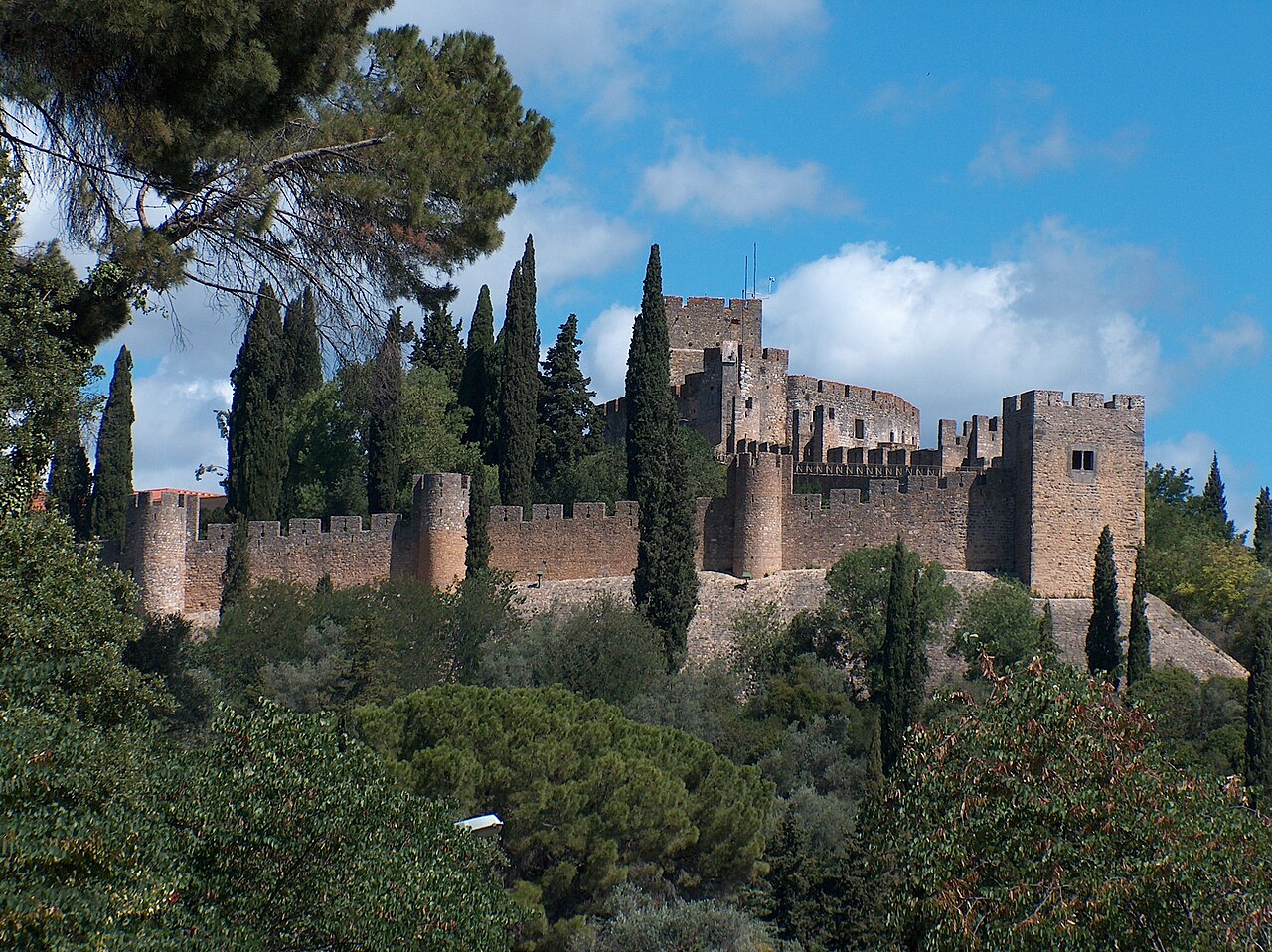
The Castle of Tomar stands as a remarkable testament to the military and architectural prowess of the Knights Templar in medieval Portugal. Located in the historic city of Tomar, within the Santarém region, this fortress is an integral part of the Convent of Christ complex, a UNESCO World Heritage site since 1983. The castle's strategic hilltop position overlooking the Nabão River provided a formidable defense point during the turbulent period of the Reconquista.
Founded in the early 12th century, the castle was constructed under the direction of Gualdim Pais, the Grand Master of the Templar Order in Portugal. Its design reflects the military innovations brought by the Templars from their experiences in Normandy and Brittany, notably the introduction of the keep tower and round towers in the outer walls, which enhanced defensive capabilities against siege warfare. The castle's architecture reveals a blend of Romanesque, Gothic, Manueline, and Renaissance styles, reflecting its continuous evolution over several centuries.
Historical significance and foundation
The Castle of Tomar was established on March 1, 1160, replacing the earlier Castle of Cera as the headquarters of the Knights Templar in Portugal. Its location on a hill near the Nabão River was chosen for its defensive advantages and control over the surrounding region. The castle played a crucial role in the Reconquista, serving as a key fortress in the defensive "Linha do Tejo" or Line of the Tagus, a network of fortifications protecting Christian territories from Muslim forces.
In 1190, the castle famously endured a six-day siege by the Almohad forces. Despite the southern gate, later known as the Porta do Sangue or "Gate of Blood," being breached, the defenders successfully repelled the attackers, underscoring the castle's strategic importance and robust fortifications.
Architectural features and military innovations
Keep tower and defensive walls
The castle's centerpiece is the Torre de Menagem or keep tower, the oldest example of this architectural feature in Portugal, introduced by the Templars. This rectangular tower served both residential and defensive functions and is divided into three floors. A Latin inscription on the second floor commemorates the commencement of construction in 1160, highlighting its historical significance.
Surrounding the keep is a complex system of double defensive walls forming irregular polygonal shapes. The walls incorporate a sloped base known as an alambor, designed to thwart siege towers and mining attempts. The outer walls are reinforced by a series of semi-circular and quadrangular towers, a design inspired by Eastern fortifications such as those at Saphyum and the Hospitaller fortress in Hom. This combination of defensive elements made the castle highly resilient during sieges.
Gates and access points
The castle features several gates, each with historical and defensive significance. The main entrance, Porta de Santiago, provided controlled access to the fortress. Other notable gates include the Porta do Sol, Porta do Sangue (Gate of Blood), and Porta de São Martinho. These gates were strategically positioned to manage entry and exit while maximizing defensive capabilities.
The convent of christ and later developments
Adjacent to the castle is the Convent of Christ, founded by the Templars and expanded over several centuries. The convent's architectural styles range from Romanesque and Gothic to the ornate Manueline and Renaissance, reflecting its evolving religious and cultural significance.
After the suppression of the Templar Order in 1312 by Pope Clement V, King Dinis of Portugal established the Order of Christ in 1321, which inherited the Templar properties including the castle. By around 1338, the castle became the residence of Prince Henry the Navigator, linking it to Portugal's era of maritime exploration and expansion.
In the 16th century, restoration and expansion works were undertaken under Kings Manuel I and João III, including enlarging the convent and relocating the population from the castle walls to the riverside town in 1499. The northwest tower was demolished in 1618 to widen the entrance, adapting the fortress to changing military and urban needs.
Preservation and cultural heritage
The Castle of Tomar was declared a National Monument in Portugal in 1910, recognizing its historical and architectural importance. Restoration efforts throughout the 20th century, notably in 1973 and 1986, have helped preserve the castle's fabric and maintain its status as one of Portugal's most authentic medieval fortresses.
Embedded within the castle walls are decorative plaques with Visigothic or Mozarabic motifs, likely sourced from the nearby Santa Maria dos Olivais site. These elements hint at earlier Roman and Islamic military influences in the region, enriching the castle's historical narrative.
Today, the castle and the Convent of Christ attract visitors worldwide, offering insight into medieval military architecture, the legacy of the Templar Order, and Portugal's rich cultural heritage. Its well-preserved structures and complex layout continue to fascinate historians, architects, and tourists alike.
Frequently asked questions (FAQ)
- How do I get to the Castle of Tomar?
- The Castle of Tomar is located in the city of Tomar, Santarém region, Portugal. It is accessible by car, bus, and train, with local signage guiding visitors to the site.
- What are the visiting hours for the Castle of Tomar?
- The castle and Convent of Christ are generally open to visitors daily, with typical hours from 9:00 AM to 6:00 PM, but it is advisable to check current times before planning your visit.
- Is the Castle of Tomar wheelchair accessible?
- While some areas of the castle and convent are accessible, the medieval terrain and historic structures may pose challenges for wheelchair users. It is recommended to inquire locally about specific accessibility options.
- What architectural styles are represented at the Castle of Tomar?
- The castle and Convent of Christ showcase a blend of Romanesque, Gothic, Manueline, and Renaissance architectural styles, reflecting centuries of construction and renovation.
- Why is the Castle of Tomar historically significant?
- The castle was the headquarters of the Knights Templar in Portugal and played a key role in the Reconquista. It also became the residence of Prince Henry the Navigator, linking it to Portugal's maritime discoveries.
Information
Website
Visit websiteSources & official resources
Verify the information above using these authoritative references.
Loading map...
Visitor reviews
No reviews yet. Been here? Write the first review and help other travelers!
Write the first reviewVisited this castle? Share your experience
Your review helps other travelers and adds first-hand knowledge to our encyclopedia.