
Castle of the Dukes of Brittany
The Castle of the Dukes of Brittany, located in Nantes, France, stands as a monumental symbol of the historical province of Brittany. Built initially in the 13th century on the remnants of a Gallo-Roman wall, the castle served as the primary residence and administrative center for the Dukes of Brittany until the 16th century. Its strategic position on the right bank of the Loire River allowed it to function as both a formidable military fortress and a seat of ducal power.
The castle’s origins trace back to construction phases beginning around 1207 under Guy de Thouars, then Duke of Brittany, who established the original stronghold known as the Château de la Tour Neuve. This early fortress was designed to assert ducal authority amidst regional rivalries involving local lords, counts, and bishops. Over the centuries, the castle underwent significant transformations, particularly during the late 15th century when Duke Francis II, the last independent Duke of Brittany, initiated extensive rebuilding efforts to enhance its defensive capabilities and residential grandeur.
Architectural evolution and renaissance influence
The castle as it stands today largely reflects the work carried out between 1466 and the early 16th century. Duke Francis II sought to create a fortress that could withstand royal French aggression while serving as the main residence of the ducal court. His daughter, Anne of Brittany, who became queen of France twice through her marriages to Charles VIII and Louis XII, further embellished the castle with Renaissance architectural elements. Notably, the Tour de la Couronne d’Or (Crown of Gold Tower) features Italian Renaissance-style loggias combined with Gothic decorative motifs, illustrating the cultural transition occurring in Brittany at the time.
The castle complex comprises several key buildings, including the Grand Logis and Grand Gouvernement. These structures display flamboyant Gothic dormer windows, pinnacles, and intricate stone tracery, built primarily from white tuffeau stone on a foundation of schist and granite bedrock. The Grand Logis contains expansive vaulted kitchens on the ground floor and large chambers designed for ducal administration and domestic life. The Grand Gouvernement, partially destroyed by a fire in 1670 and an explosion in 1800, was rebuilt in a classical style during the reign of Louis XIV.
Fortifications and defensive features
The castle is surrounded by a robust curtain wall fortified with seven main towers, including the Pied de Biche, Boulangerie, Jacobins, Espagnols, Port, Rivière, and Fer-à-Cheval towers. These towers are connected by thick walls featuring decorative machicolations, which, while ornamental, reflect medieval defensive architecture. The Tour du Fer-à-Cheval, a large horseshoe-shaped artillery bastion, stands out with walls up to seven meters thick and multiple covered firing chambers called casemates. It was strategically positioned to guard the approach from the Loire River and nearby eastern roads.
The castle moat, historically filled with water from the Loire, has been restored and refilled, enhancing the site's defensive authenticity. The main entrance, known as the châtelet, lies between the Pied de Biche and Boulangerie towers and is flanked by two restored drawbridges. These towers also housed prison cells notorious for their harsh conditions.
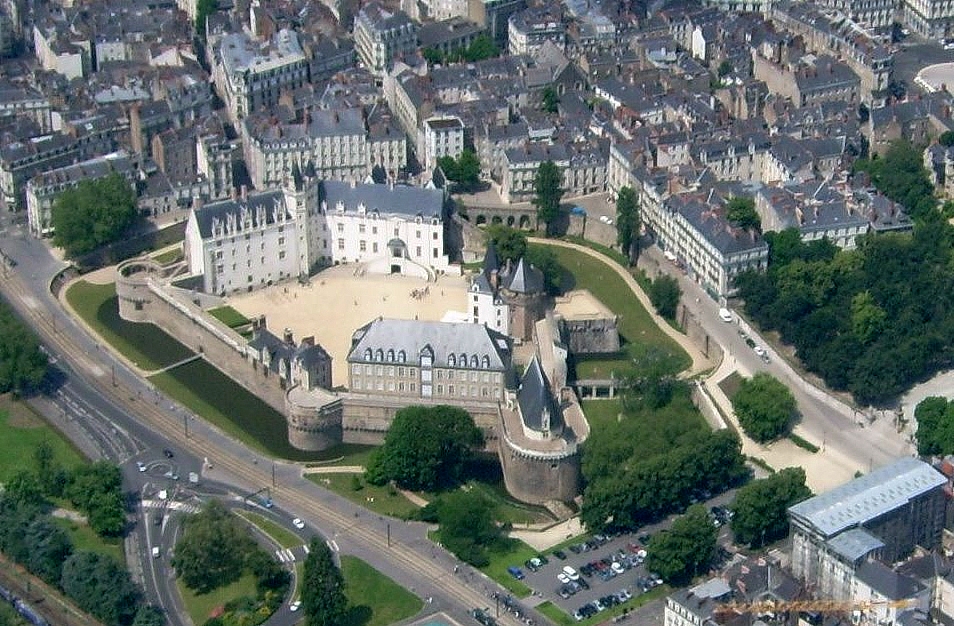
Photo by Jibi44, avec l'aimable autorisation de LP de Nantes • CC BY-SA 3.0
Historical significance and transformations
Following the 1532 union of Brittany and France under the Edict of Union signed within the castle, the fortress transitioned from ducal residence to a royal administrative center. It became the Breton home for French kings and their provincial governors, adapting to new political realities. During the Wars of Religion in the late 16th century, the Duke of Mercœur fortified the castle further with bastions and artillery installations.
Over the centuries, the castle's military function grew, serving as barracks, an arsenal, and a prison. It suffered damages from a fire in 1670 and a significant explosion in 1800 that destroyed parts of the Grand Gouvernement, the castle chapel, and archival rooms. In the 18th century, the Harnachement building was constructed to store artillery equipment, replacing an earlier 16th-century artillery terrace.
During World War II, German occupation forces installed a bunker within the castle walls, using it as a command post. Despite this, the castle escaped bomb damage during the conflict.
Restoration and modern use
Recognized as a historic monument since 1862, the castle was sold to the City of Nantes in 1915 and converted into a municipal museum by 1924. Extensive restoration efforts began in the 1990s, culminating in the castle's reopening in 2007 as the Nantes History Museum. The museum occupies 32 rooms within the castle and displays over 850 objects, using multimedia to present the rich history of Nantes, Brittany, and the castle itself.
The site features a 500-meter chemin de ronde along the fortified ramparts, offering panoramic views of the castle and the city. Modern accessibility improvements include elevators and well-maintained walkways. Nighttime illuminations designed by Sylvie Sieg and Pierre Nègre highlight the castle’s architectural complexity and have won awards for their artistic lighting design.
Archaeological discoveries and heritage value
Archaeological excavations conducted throughout the 20th century and early 21st century uncovered significant remains beneath and around the castle. These include the complete layout of the Gallo-Roman city walls, foundations of medieval towers, and fragments of the original 13th-century Tour Neuve. These findings provide valuable insights into the castle’s layered history and the evolution of Nantes from antiquity through the medieval period.
Today, the Castle of the Dukes of Brittany remains a vital cultural and historical landmark. It embodies the rich heritage of Brittany and France, serving as a testament to the region’s complex political history, architectural innovation, and enduring cultural identity.
Frequently asked questions (FAQ)
- How do I visit the Castle of the Dukes of Brittany in Nantes?
- The castle is open daily from 10:00 to 18:00. Visitors can explore the castle grounds, the Nantes History Museum, and the restored ramparts. Tickets cost €8 for adults and €5 for children.
- What is the historical significance of the Castle of the Dukes of Brittany?
- The castle was the residence of the Dukes of Brittany and later served as the Breton residence of the French monarchy. It played a key role in regional defense and governance from the 13th to the 17th centuries.
- Can I walk along the castle ramparts?
- Yes, the castle features a 500-meter chemin de ronde along its fortified ramparts, offering panoramic views of Nantes and the castle's architectural features.
- Is the castle accessible for visitors with limited mobility?
- The castle has been equipped with elevators and accessible walkways to accommodate visitors with limited mobility, ensuring an inclusive experience.
- When was the castle restored and reopened as a museum?
- Extensive restoration began in the 1990s, and the castle was reopened as the Nantes History Museum in 2007 after 15 years of work and a three-year closure to the public.
Photo gallery

Information
Opening hours
10:00-18:00, daily
Ticket prices
€8 adult, €5 child
Current owner
Municipality
Website
Visit websiteSources & official resources
Verify the information above using these authoritative references.
Loading map...
Visitor reviews
No reviews yet. Been here? Write the first review and help other travelers!
Write the first reviewVisited this castle? Share your experience
Your review helps other travelers and adds first-hand knowledge to our encyclopedia.