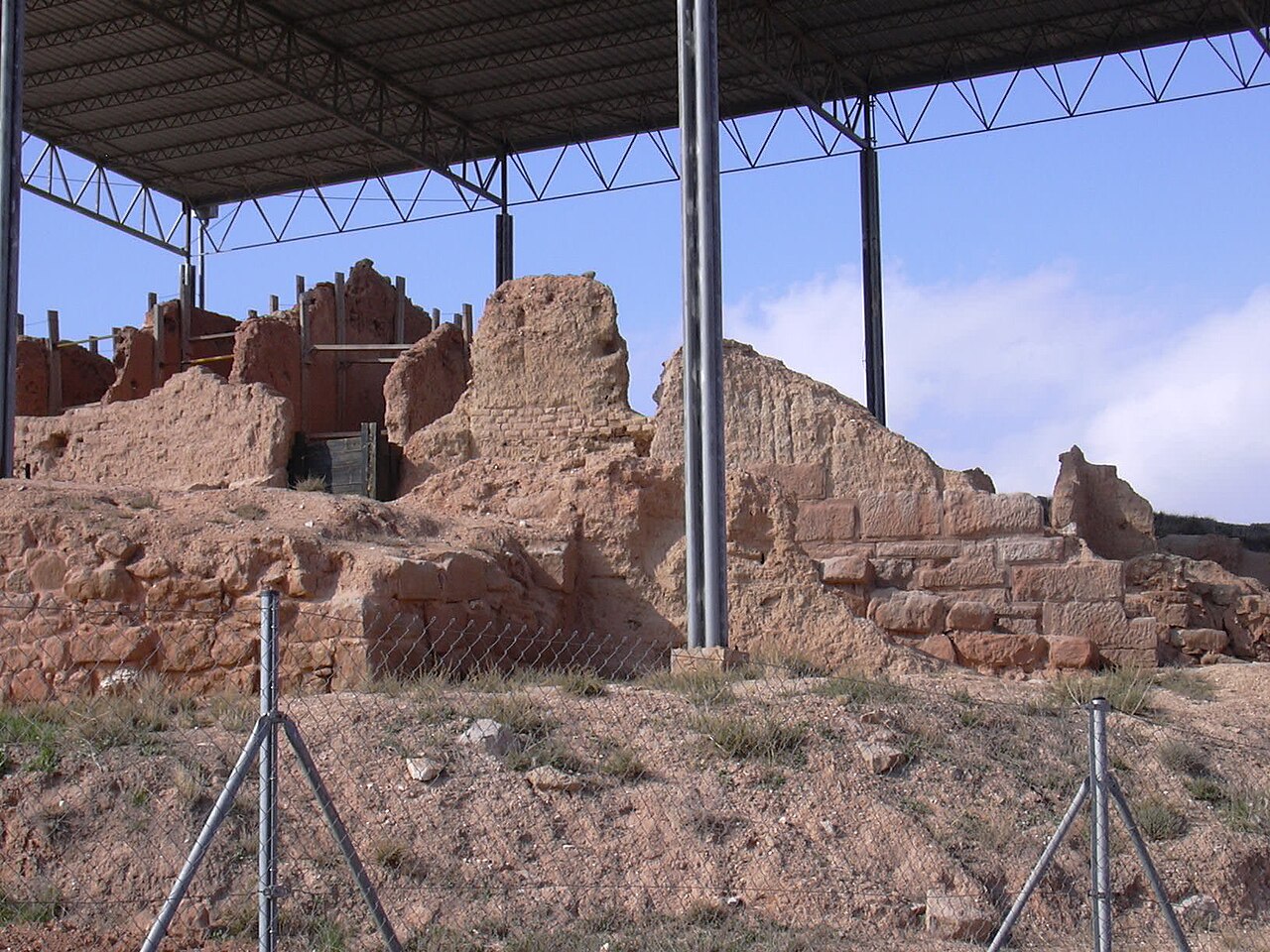
Castle of Rueda de Jalón
The Castle of Rueda de Jalón stands as a significant medieval fortress located in the municipality of Rueda de Jalón, Spain. This hill castle occupies a commanding position on a rocky spur, which was naturally inaccessible on two sides, underscoring its strategic military importance throughout its long history. The castle's architecture and history reflect the complex interplay of Islamic and Christian kingdoms on the Iberian Peninsula, making it a valuable site for understanding medieval military and political dynamics in the region.
Originally known as Rota or Rotalyeu, the fortress was initially controlled by the Banu Qasi, a prominent Muslim dynasty, after they captured it from Zaragoza in 882. This early period highlights the castle's role within the Muslim-controlled territories of the Iberian Peninsula. In 935, the fortress endured a siege led by Durrí, a general serving the caliph Abderramán III, while under the governance of Tuchibí of the Taifa kingdom of Zaragoza. This event illustrates the castle's importance amid the shifting power struggles among Muslim rulers during the mid-10th century.
Transition from Muslim to Christian rule
In the late 11th century, the castle was under the command of Al-Mustaín, its alcaide or fortress commander, when Alfonso VI of León attempted to capture it in 1083. This siege was unsuccessful, but soon after, the fortress changed hands through negotiation rather than warfare. Amed-Saif-Dola, successor to the Banu Hud dynasty in Rueda, exchanged the fortress with Alfonso VII of León for land in Toledo, marking a significant transfer from Muslim to Christian control.
The castle was definitively taken by Alfonso I of Aragón, further integrating it into the expanding Christian realms of the Iberian Peninsula. During the latter half of the 12th century, notable figures such as Pedro Ortiz in 1165 and Ortún de Sotiu in 1178 served as tenentes or governors under the reign of Alfonso II of Aragón, reflecting the castle's continued administrative and military significance.
Political significance and noble ownership
In 1228, Alfonso III of Aragón granted the fortress to the noble faction known as the Unión. By the 13th century, the castle gained additional political importance when Jaime II of Aragón entrusted it as a pledge to his fiancée, Isabel of Castile. Ownership shifted again by 1291 when Lope Ferrench de Luna, the seventh lord of the Luna family, took possession. The Luna family maintained control until 1315.
Throughout the 14th century, ownership continued to evolve. In 1391, King Juan I of Aragón sold the castle to Ramón de Perelló, and two years later, it was acquired by the lord of Épila. This acquisition incorporated the castle into the estates that would later become the viscountcy of Rueda. These successive transfers highlight the castle's persistent role as a valuable hereditary and strategic asset within medieval Aragonese nobility.
Architectural features and layout
The Castle of Rueda de Jalón features a large triangular layout adapted to the rocky spur on which it stands. The fortress is naturally protected on two sides by steep terrain, with the original entrance located on the third side, though this gate no longer survives. The enclosed area is organized into three stepped terraces, each serving distinct functions within the complex.
Upper terrace and defensive tower
At the highest terrace stands a tower whose upper section and original entrance have been lost over time. This tower likely served as a key defensive structure, overseeing the surrounding landscape and controlling access. Today, it remains as a partial ruin, indicative of the castle's age and historical wear.
Middle terrace with residential quarters
The middle terrace contains a surviving stretch of wall with foundational remains of several rectangular rooms. These rooms were likely used as residential quarters or administrative spaces during the castle's occupation. Notably, parts of the walls in this area were constructed using the tapial technique, a method involving rammed earth, which was common in medieval Iberian military architecture.
Lower terrace and albarrana tower
The lowest terrace is the most expansive and flat portion of the enclosure but shows minimal visible remains, suggesting significant decay over time. A prominent feature here is a crenellated wall segment connected to a square albarrana tower. Albarrana towers are detached or semi-detached defensive towers positioned to protect vulnerable points of a fortress. This particular tower includes a door and windows fashioned in the caliphal style, reflecting the castle's Muslim architectural heritage.
Water supply and defensive infrastructure
Within the castle's enclosure lies a subterranean cistern, locally known as an aljibe, accessed by stairs carved directly into the bedrock. This cistern was essential for collecting and storing rainwater, enabling the fortress's inhabitants to endure prolonged sieges and droughts. The presence of the aljibe highlights the castle's self-sufficiency and the strategic planning involved in its design.
Additionally, the site features two elegant square towers constructed using the tapial technique on the summit of the rocky outcrop. These towers, along with the walls and defensive structures, illustrate the blend of Muslim and Christian architectural influences that characterize the castle.
Current condition and heritage status
Today, the Castle of Rueda de Jalón is in a ruinous condition, with many structural components deteriorated or lost. Despite this, it retains significant elements that reveal its original form as a formidable defensive complex. The combination of Muslim and Christian design elements makes it an important example of medieval military architecture in Spain.
The castle's fragile state has led to its listing among Spain's most endangered heritage sites, emphasizing the need for preservation efforts. Its ruins continue to attract historians, architects, and visitors interested in the layered history of the Iberian Peninsula's medieval fortifications.
Frequently asked questions (FAQ)
- How do I get to the Castle of Rueda de Jalón?
- The Castle of Rueda de Jalón is located in the municipality of Rueda de Jalón, Spain. Visitors can reach it by car or local transport from nearby towns in the Zaragoza province.
- What is the historical significance of the Castle of Rueda de Jalón?
- The castle played a crucial role in the military and political struggles between Muslim and Christian kingdoms in medieval Spain, reflecting the shifting control of the Iberian Peninsula.
- Can I visit the Castle of Rueda de Jalón today?
- Yes, the castle is accessible to visitors, though it is in a ruinous state. Visitors should exercise caution while exploring the site due to its fragile condition.
- What architectural styles are visible at the castle?
- The castle features a blend of Muslim and Christian architectural elements, including caliphal-style windows and tapial construction, illustrating the cultural influences over its history.
- When was the Castle of Rueda de Jalón built?
- The castle's origins trace back to the 9th century under Muslim control, with significant developments during the High Medieval period.
Information
Loading map...
Visitor reviews
No reviews yet. Been here? Write the first review and help other travelers!
Write the first reviewVisited this castle? Share your experience
Your review helps other travelers and adds first-hand knowledge to our encyclopedia.