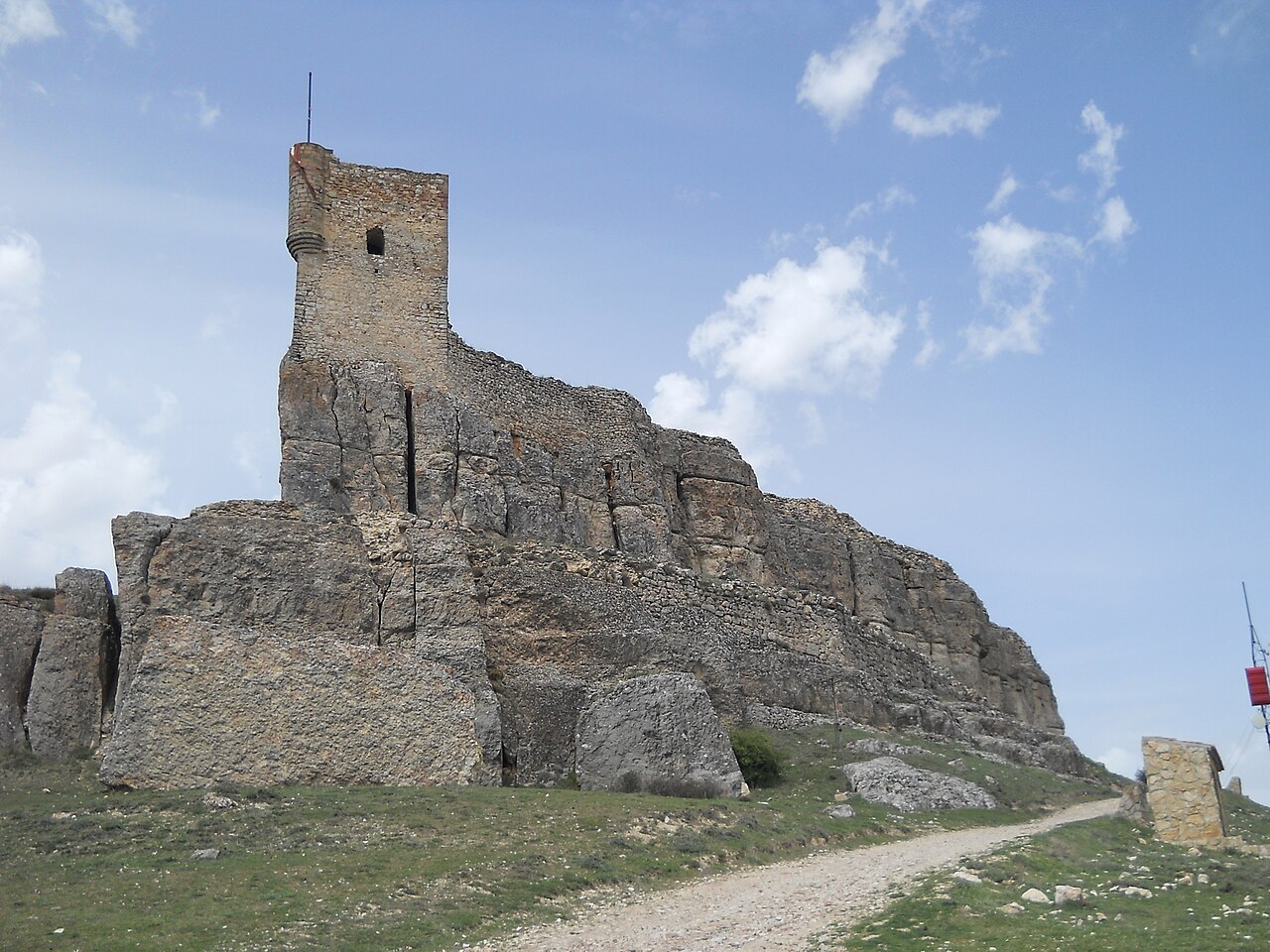
Castle of Riba de Santiuste
The Castle of Riba de Santiuste stands as a significant hill castle in Spain, with origins tracing back to the 9th century during the Andalusian period. Built by Muslim forces, its primary purpose was to defend the region against advancing Christian kingdoms from the north. This fortress played a crucial role in the turbulent frontier zone of the Early Middle Ages, where Taifa kingdoms and Christian realms frequently clashed.
Historical context and strategic importance
Located in the municipality of Riba de Santiuste, the castle was part of a wider defensive network, including a nearby watchtower at Cerrillo de la Horca. This system was designed to secure strategic control over the surrounding territory. In 917, the castle notably served as a refuge during raids led by Ordoño II of León, highlighting its defensive value for local inhabitants.
The castle's history reflects the broader shifts of the Reconquista. In 1085, Alfonso VI of León captured the fortress, marking a key transition from Muslim to Christian control. Subsequently, in 1129, Alfonso VII granted the castle and village to the Bishopric of Sigüenza. The bishop at the time, Bernardo de Agén, undertook significant renovations and expansions, strengthening the castle's defenses to meet evolving military needs.
During the 15th century, the castle became a focal point of regional conflict. In 1451, forces loyal to Infante Juan of Navarre seized it, using the stronghold to threaten the nearby town of Sigüenza. The following year, troops under Bishop Fernando de Luján recaptured the castle, restoring ecclesiastical authority. The castle remained under church control until its destruction in 1811 amid the Peninsular War, when it was deliberately demolished during military confrontations with French forces.
Architectural features and layout
Perched atop a steep rocky outcrop overlooking the village and the Salado River valley, the castle's design closely adapts to the natural terrain. Its elongated enclosure measures approximately 90 by 12 meters, with walls constructed from roughly cut stone blocks known as sillarejo. This gives the fortress a solid and austere appearance typical of early medieval military architecture.
The defensive perimeter is characterized by high battlemented walls interspersed with towers of varying sizes. The main entrance is located on the northern side, accessible via a narrow path running alongside the wall. Inside the enclosure, two cisterns (aljibes) are present, designed to collect and store rainwater, an essential feature for sustaining the castle during sieges.
The internal layout divides into three large compartments with further subdivisions indicating smaller rooms arranged into two main sections. The southern portion, facing the village, includes a trapezoidal courtyard enclosed by battlemented walls that slope gently downward from a main tower. This courtyard is flanked by two twin towers at opposite corners, connected by a closing wall. This advanced defensive structure was intended to impede attackers and provide vantage points for observing the slope below.
Extending northward from the northern tower, the castle's defenses enclose an elongated triangular area ending in a distinctive pentagonal tower shaped like a spur. This feature adds a unique architectural element to the fortress, enhancing its defensive capabilities.
Later history and preservation efforts
Following its destruction in the early 19th century, the castle remained in ruins for over a century. In 1973, the Spanish state auctioned the site, which was purchased by a private individual who initiated restoration efforts. Later, the castle was used temporarily by the cultural organization Nueva Acrópolis, reflecting its ongoing cultural significance.
Recognizing its historical and architectural value, the castle was declared a Bien de Interés Cultural in 1992, a designation that protects important cultural heritage sites in Spain. Despite its relatively smaller size and signs of deterioration compared to other regional castles, the Castle of Riba de Santiuste remains an important archaeological and historical site, illustrating the medieval feudal fortifications that once controlled the surrounding landscape.
Architectural significance and regional context
The castle exemplifies early medieval military architecture with subsequent modifications from the late 12th and early 13th centuries. Its use of sillarejo stone masonry and the adaptation to the rocky terrain demonstrate practical defensive design tailored to the local environment. The combination of battlemented walls, towers, and water storage systems such as cisterns highlights the strategic planning involved in sustaining long-term defense.
Within the broader context of Spanish castles, the Castle of Riba de Santiuste reflects the complex history of the Iberian Peninsula during the Middle Ages, marked by cultural exchanges and military confrontations between Muslim and Christian powers. Its preservation offers valuable insights into the evolution of fortification techniques and the shifting political landscape of medieval Spain.
Defensive structures and military role
The castle's twin towers and pentagonal spur tower are notable defensive features that provided overlapping fields of fire and enhanced protection against siege tactics. The trapezoidal courtyard allowed defenders to organize and deploy forces effectively within the enclosure. The castle's position on a steep outcrop further increased its defensibility, making direct assaults challenging for attackers.
Cultural heritage and tourism
Today, the Castle of Riba de Santiuste is recognized as a cultural landmark, attracting visitors interested in medieval history and architecture. Its status as a Bien de Interés Cultural ensures ongoing preservation efforts and promotes awareness of Spain's rich historical heritage. Visitors can explore the remains, gaining a tangible connection to the region's past and the enduring legacy of medieval fortifications.
Frequently asked questions (FAQ)
- How do I get to the castle of Riba de Santiuste?
- The castle is located in the municipality of Riba de Santiuste in Castilla-La Mancha, Spain. Visitors can reach it by car via local roads; parking is available near the village, followed by a short walk uphill to the site.
- What is the historical significance of the castle?
- The castle dates back to the 9th century and played a key role during the Andalusian period and the Christian Reconquista. It was a defensive stronghold during regional conflicts and changed hands between Muslim and Christian forces.
- Is the castle accessible to visitors year-round?
- Access to the castle depends on weather and maintenance conditions, as it is a ruin situated on a rocky hill. Visitors should check locally for opening hours and any seasonal restrictions before planning a visit.
- Can I explore the interior of the castle?
- Visitors can explore the castle ruins, including the defensive walls, towers, and courtyards. However, some areas may be unsafe due to deterioration, so caution is advised during the visit.
- Are there guided tours available at the castle?
- Guided tours may be available through local tourism offices or cultural organizations. It is recommended to inquire locally in Riba de Santiuste for any scheduled tours or educational programs.
Information
Current owner
Private owner
Loading map...
Visitor reviews
No reviews yet. Been here? Write the first review and help other travelers!
Write the first reviewVisited this castle? Share your experience
Your review helps other travelers and adds first-hand knowledge to our encyclopedia.