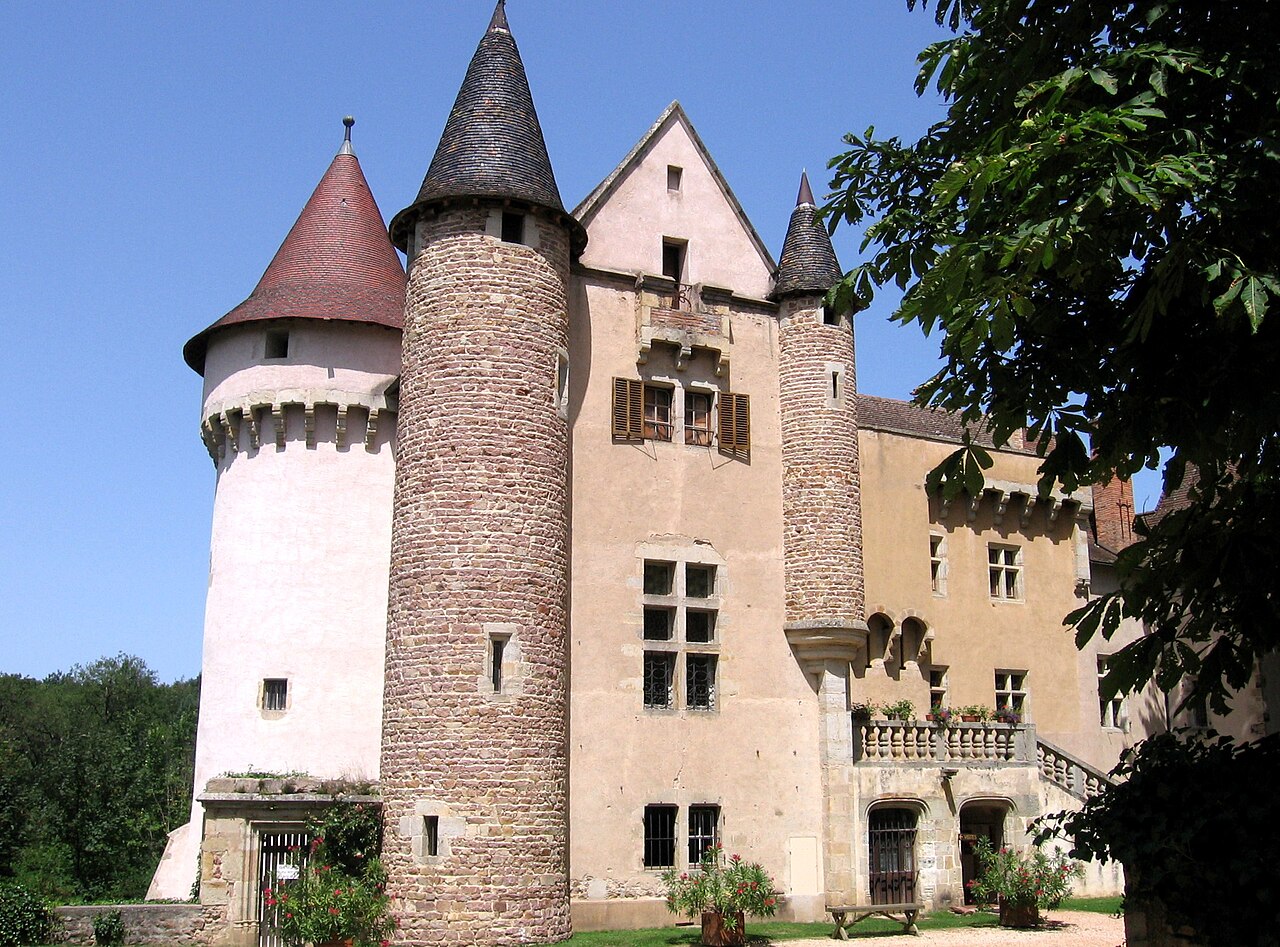
Castle of Ravel

Castle of ravel: medieval fortress transformed into elegant stately home
Ravel, Auvergne-Rhone-Alpes, France
High Medieval (11th–13th c.)
Well Preserved

The Castle of Ravel, located in the commune of Ravel, France, stands as a remarkable example of the architectural evolution from a medieval fortress to an elegant stately home. Originally constructed in the 12th century during the High Medieval period, the castle retains much of its Gothic framework and defensive features, while also showcasing later modifications that reflect changing tastes and functions over the centuries.

Medieval origins and defensive architecture

Built in the 12th century, the Castle of Ravel was initially designed as a fortified stronghold typical of the High Medieval era. The castle’s layout includes a courtyard surrounded by robust stone walls and punctuated by ancient towers that once served defensive purposes. The preservation of the courtyard facade and the Gothic architectural elements provides valuable insight into medieval military architecture, with features such as narrow arrow slits and thick walls designed to withstand sieges.

Transformation into a stately home in the 18th century

In the 18th century, the castle underwent significant changes to adapt it from a fortress into a comfortable and refined residence. Remarkably, these renovations were carried out with respect for the original Gothic structure, preserving the historic character of the castle while introducing new elements of 18th-century interior design. The apartments were built without demolishing the essential medieval framework, maintaining the integrity of the courtyard facade and the surrounding towers.

Notable interior features

The interior of the Castle of Ravel is a harmonious blend of medieval and later styles. The chapel remains a highlight, retaining its Gothic stylistic features such as pointed arches and ribbed vaults, which create an atmosphere of solemn grandeur. Another centerpiece is the Salle des Etats, considered the castle’s masterpiece, which exemplifies the fusion of Gothic and 18th-century aesthetics.

Additional noteworthy rooms include the staircase and entrance hall, which welcome visitors with their elegant design, the dining room reflecting the social customs of the period, the great gallery used for gatherings and displaying art, and the music room, emphasizing the cultural life of the castle’s inhabitants.

Architectural significance and heritage value

The Castle of Ravel is significant not only for its historical role as a medieval fortress but also as a testament to the adaptive reuse of such structures. The careful preservation of the Gothic framework alongside the introduction of 18th-century stately home features makes it a valuable case study in architectural history. This blending of styles illustrates the evolution of castle architecture from purely defensive constructions to residences emphasizing comfort and status.

Today, the castle is recognized for its well-preserved condition and serves as a cultural landmark in the Auvergne region. Its combination of medieval and later architectural elements attracts historians, architects, and visitors interested in the layered history of French castles.

Visiting the castle of ravel

Visitors to the Castle of Ravel can explore its historic courtyards, admire the Gothic towers, and experience the grandeur of the 18th-century apartments. The castle offers an immersive journey through centuries of French history and architecture, highlighting the transition from medieval fortification to aristocratic residence.

While specific visiting hours and ticket prices may vary, the castle remains an important destination for those interested in medieval architecture, French heritage, and the preservation of historic buildings.

Frequently asked questions (FAQ)

How do I get to the Castle of Ravel?
The Castle of Ravel is located in the heart of Ravel, France, and is easily accessible by public transportation. You can take a train to the nearest station and then a short bus ride or taxi to reach the castle. If you prefer driving, there is ample parking available nearby.
What are the opening hours of the Castle of Ravel?
The Castle of Ravel is open to visitors from 10 AM to 6 PM daily, with extended hours during the summer months. It's recommended to check the official website for any seasonal changes or special events that may affect opening times. Guided tours are available during these hours, providing an enriching experience.
When was the Castle of Ravel built?
The Castle of Ravel was constructed in the late 12th century, showcasing a blend of medieval and Renaissance architectural styles. Its rich history reflects the significance of the castle as a strategic fortification during various historical conflicts. The castle has undergone numerous renovations, preserving its historical elements while accommodating modern visitors.
Can I buy tickets online for the Castle of Ravel?
Yes, tickets for the Castle of Ravel can be purchased online through the official website, allowing you to skip the line on your visit. Online purchases often come with the added benefit of discounts or promotions. It's advisable to book in advance, especially during peak tourist seasons.
Why is the Castle of Ravel historically significant?
The Castle of Ravel played a crucial role in the defense of the region during the medieval period, serving as a residence for noble families. Its strategic location made it a key site in numerous historical events, contributing to the local culture and heritage. Today, it stands as a testament to the architectural advancements of its time.
Is it possible to access the Castle of Ravel with a wheelchair?
Yes, the Castle of Ravel is committed to accessibility and offers facilities for visitors with mobility challenges. Ramps are installed at key entry points, and staff are available to assist as needed. It's advisable to contact the castle in advance to ensure a smooth visit.
What is the best time to visit the Castle of Ravel?
The best time to visit the Castle of Ravel is during the spring and early autumn months when the weather is mild and pleasant. These seasons also feature fewer crowds, allowing for a more enjoyable experience. Special events and festivals are often held during the summer, making it a vibrant time to explore the castle.
Are there any nearby attractions to visit alongside the Castle of Ravel?
Yes, there are several attractions near the Castle of Ravel, including beautiful gardens and local museums that showcase the region's history. The charming town of Ravel offers quaint shops and restaurants, perfect for a leisurely day. Hiking trails in the surrounding countryside also provide a scenic backdrop for visitors.
What are the ticket prices for the Castle of Ravel?
Ticket prices for the Castle of Ravel are generally €10 for adults and €5 for children aged 6-12. Special rates may apply for seniors and groups, so it's worth checking the official website for the latest pricing information. Family passes are also available, making it an affordable option for visitors traveling with children.

Information

Hill Castle

Sources & official resources

Verify the information above using these authoritative references.

Loading map...

Visitor reviews

No reviews yet. Been here? Write the first review and help other travelers!

Write the first review

Visited this castle? Share your experience

Your review helps other travelers and adds first-hand knowledge to our encyclopedia.
Write a review

(5/5)

0/2000 characters

Your review will be visible after admin approval

Nearby castles

0.6 km
Château de Ravel — France castle

Château de Ravel

Ravel, France

The Château de Ravel is a prominent medieval castle located in the commune of Ravel within the Puy-de-Dôme department of central France. Its origins date back to the 12th century, with the earliest recorded occupant, Pierre de Ravel, documented in 1147. The castle's initial construction phase began notably in 1171 under Bernard de Ravel, the royal administrator of Clermont and Pont-du-Château, establishing the oldest surviving parts of the fortress. Medieval origins and royal ownership In 1283, the castle entered royal possession when Chatard de Ravel sold it to King Philip III of France. Shortly thereafter, in 1294, it was granted by King Philip IV to Pierre Flote, his future chancellor. Flote undertook significant expansions, adding at least five towers and enclosing a large trapezoidal courtyard, reinforcing the castle's defensive capabilities and residential grandeur. His tenure ended with his death at the Battle of Courtrai in 1302, a notable conflict during the medieval period. Architectural evolution and noble lineage Over the centuries, the castle passed through various noble families by inheritance and marriage. In 1647, it became part of the d’Estaing family holdings through the marriage of Marie Comborcier du Terrail to Jean d’Estaing. The d’Estaings initiated major renovations during the 17th and 18th centuries, transforming the medieval fortress into a refined stately home. These renovations respected the original Gothic framework, especially visible in the main courtyard façade, which rests upon medieval towers. Medieval core and defensive structures The castle retains a medieval core centered around a 13th-century donjon (fortified tower) and five ancient towers, including an octagonal one. These structures enclose a large trapezoidal courtyard, with eastern walls and towers dating back to the feudal era. The layout reflects the castle’s original defensive purpose, with thick stone walls and battlements designed to withstand sieges. Classical renovations and interior design The 18th-century renovations introduced classical-style elements such as an entrance gallery, a grand staircase, and a dining room on the ground floor. On the first floor, a great gallery and a music room were added, the latter adorned with panelling decorated with musical instruments. Despite these updates, the renovations carefully preserved the Gothic character of the castle, blending medieval and classical aesthetics harmoniously. Notable interior features and family heritage Inside the castle, the Salle des États stands out as a Gothic hall notable for one of France’s oldest heraldic friezes. This decorative band features 49 coats of arms from the 13th century, accompanied by a terracotta tiled floor displaying heraldic emblems, exemplifying medieval artistry and noble symbolism. The complex also includes a Gothic chapel and 17th-century stables. The castle houses original furnishings and family memorabilia, including portraits of the d’Estaing family, navigation instruments, ship models, and a series of ten paintings by Lebas depicting naval battles from 1759 to 1760. These artifacts reflect the family's maritime heritage and historical connections, particularly Admiral Charles Henri Théodat d’Estaing, born at the castle in 1729, who fought in the American War of Independence and was executed during the French Revolution. Landscape and gardens The castle’s terrace, designed in the 17th century by the renowned landscape architect André Le Nôtre, overlooks the Limagne plain and offers views of the volcanic Chaîne des Puys hills. The gardens comprise a terrace, an independent staircase, a small park with an alley and basin, and a kitchen garden. The terrace, retaining walls, and park are protected as historic monuments, highlighting their cultural and heritage significance. Historical events and modern preservation The Château de Ravel experienced military occupations during turbulent periods, including by routiers (mercenary soldiers) in 1377 during the Hundred Years’ War and by Protestant troops in 1589 during the French Wars of Religion. In 1806, the castle was sold to Charles de Riberolles-Beaucène, whose descendants maintained ownership until 2014. In recent years, decorators Joseph Achkar and Michel Charriere acquired the property and began extensive restoration efforts. The French Ministry of Culture recognized the château’s historical importance by listing it as a monument historique in 1958. Despite a fire in 2016 that destroyed approximately 400 square meters, the château’s fundamental décor and key architectural elements remain intact, allowing visitors to appreciate both its medieval and classical features in their original context. Cultural significance and media presence The Château de Ravel is regarded as an interesting example of how a medieval castle was converted into a stately home, preserving its Gothic framework while incorporating classical style elements. It served as a filming location for the 2004 French film Les Choristes, directed by Christophe Barratier, further highlighting its cultural relevance.

High Medieval (11th–13th c.)
Details
8 km
Château d’Aulteribe — France castle

Château d’Aulteribe

Sermentizon, France

The Château d’Aulteribe stands as a remarkable example of a medieval hill castle in the heart of the Auvergne region of central France. Located in Sermentizon within the Puy-de-Dôme department, this castle has a rich history that spans from its origins in the late 13th century through significant transformations in the 15th, 17th, and 19th centuries. Its strategic position near the ancient Roman Via Agrippa highlights its historical importance in controlling regional routes connecting major cities such as Lyon, Clermont-Ferrand, and Limoges. The castle’s initial construction dates to the late 13th century, with the earliest recorded noble associated with the estate being Odinet Cholet, a young nobleman or "damoiseau". By around 1400, the estate had established a hereditary lordship under Pierre Cholet. The castle’s fortifications were significantly enhanced in 1467 by Charles Motier de La Fayette, who added arrow slits and cannon openings to adapt to evolving military technology during the turbulent late Middle Ages. Ownership passed through the Montboissier family and later the Montagu family, reflecting the shifting noble alliances and inheritance practices characteristic of the period. Architectural evolution and defensive features The Château d’Aulteribe is built on a polygonal plan featuring rooms arranged around a small interior courtyard. Originally, the castle had a square plan with four corner towers and was naturally defended by ravines on three sides. The southern side included an enclosure with towers, a gatehouse, and a drawbridge, emphasizing its defensive role. These fortifications were typical of late medieval hill castles designed to withstand sieges and control the surrounding territory. The south façade is notable for its asymmetrical design facing an outer courtyard. This façade features a central two-story section topped with machicolations—openings in the parapet used to defend the castle by dropping projectiles on attackers—and a small projecting gallery known as a bretèche. The windows incorporate mullions and transoms, vertical and horizontal stone bars dividing the glass panes, which were characteristic of late medieval and early Renaissance architecture. The main staircase connects a square tower on one side with a pavilion featuring a turret and a distinctive pepperpot-shaped tower made of pink stone on the other. The first floor preserves a medieval pointed arch at the family entrance, while a depressed arch door below the porch leads to the interior courtyard and kitchens. The south façade blends neo-Renaissance and picturesque elements, reflecting the 19th-century romantic restoration style. The west façade is distinguished by large windows opening onto a granite-console balcony, which illuminates the great hall historically used by the lords. The façades facing the ravine rise two stories and feature regularly arranged mullioned and transomed windows, enhancing both the castle’s defensive posture and aesthetic appeal. The neo-Romanesque chapel and artistic details A small neo-Romanesque chapel stands before the castle, inspired by the Romanesque art of the Auvergne region. It has a simple layout with an apse and two small apsidioles—side chapels—flanking a short nave. The exterior decoration features colorful effects created by alternating brick and stone, along with sculpted anthropomorphic modillions, carved supports shaped like human figures, adding a rich visual texture to the chapel’s façade. Interior furnishings and collections The castle’s interior showcases a furnishing collection spanning several centuries, from the 15th to the 19th century. This includes Breton furniture, Renaissance chests, 18th-century chairs, and 19th-century kitchen stoves. The rooms are further enriched by Flemish and Aubusson tapestries, as well as Chinese and Japanese porcelain, reflecting the diverse tastes and collecting interests of the castle’s owners over time. Paintings by notable artists such as Philippe de Champaigne, Hyacinthe Rigaud, and Jean-Baptiste Martin decorate the interiors, adding artistic prestige. A wood-carved fireplace in the Fontainebleau style and a monumental chimney bearing the de Pierre family crest are among the castle’s most striking features. Some rooms display portraits, orientalist objects, and musical instruments associated with the composer George Onslow, highlighting the cultural richness preserved within the castle. The arrangement of the castle’s collections and decorative elements evokes the atmosphere of a collector’s residence from the early 20th century, preserving both the historical architecture and the accumulated art and furnishings. This makes Château d’Aulteribe not only a monument of medieval military architecture but also a vibrant repository of cultural heritage. Historical significance and preservation The Château d’Aulteribe’s history reflects the broader socio-political changes in France from the Middle Ages through the 19th century. Its fortifications illustrate the evolution of defensive architecture responding to the advent of artillery, while its later romantic restoration embodies the 19th-century fascination with medieval heritage and aesthetics. Classified as a historic monument in 1949, with its entire furniture collection protected since 1953, the castle has been managed by the Centre des monuments nationaux since 1965. It is open to the public, offering visitors a chance to explore its well-preserved medieval and neo-Renaissance architecture, extensive collections, and beautifully maintained grounds. Since 1999, Château d’Aulteribe has also hosted a specialized two-year furniture restoration training program, utilizing its rich collections for practical education. This initiative underscores the castle’s ongoing role in heritage preservation and cultural education.

Late Medieval (14th–15th c.)
Details
8.3 km

Castle of Aulteribe

Sermentizon, France

The Castle of Aulteribe, located in Sermentizon, France, is a remarkable example of a late medieval fortress that underwent significant transformation during the 19th century. Originally constructed in the 15th century, this castle embodies the architectural and historical evolution from the turbulent Middle Ages to the romanticized restorations of the 1800s. Historical context and origins Built toward the end of the Middle Ages, the castle was initially designed as a fortified residence typical of the late medieval period. Its strategic location in the region of Auvergne provided both defense and control over the surrounding lands. The original 15th-century structure reflected the defensive needs of the time, with robust stone walls and limited ornamental detailing. 19th-century restoration and architectural transformation During the second half of the 19th century, the Castle of Aulteribe underwent extensive restoration and alteration under the influence of the romantic revival movement. This period saw a renewed interest in medieval architecture, leading to the addition of many medieval-style features that were not part of the original construction. These restorations enhanced the castle's aesthetic appeal, blending historical authenticity with 19th-century romantic ideals. The restoration included the enhancement of towers, battlements, and decorative stonework, which contributed to the castle's picturesque silhouette. The renovations respected the castle's original late medieval character while adding elements that reflected the tastes and architectural trends of the 1800s. Interior furnishings and artistic heritage The interior of the Castle of Aulteribe is distinguished by its rich collection of furnishings and artworks spanning several centuries. Visitors can admire exquisite tapestries from Flanders and Aubusson, renowned for their intricate designs and craftsmanship. These tapestries add color and historical ambiance to the castle's halls and chambers. Additionally, the castle houses a notable collection of Chinese porcelain, illustrating the historical trade connections and the taste for exotic luxury items among the European aristocracy. The paintings displayed within the castle date from the 17th to the 19th centuries, showcasing a range of artistic styles and subjects that enrich the cultural experience of the site. Preservation and public access The Castle of Aulteribe has been officially recognized for its cultural and historical significance. It was listed as a monument historique by the French Ministry of Culture on 30 March 1949, ensuring its protection and conservation. The castle is currently managed by the Centre des monuments nationaux, which oversees its maintenance and facilitates public access. Visitors to the castle can explore its well-preserved rooms, admire the historic furnishings, and experience the atmosphere of a noble residence that bridges medieval fortification and 19th-century romanticism. Surrounding park and landscape The castle is set within a beautifully landscaped park, believed to have been developed in the first half of the 19th century. This park was added to the inventory of national heritage in 1991, highlighting its importance as part of the castle's historical environment. The grounds provide a serene setting that complements the architectural grandeur of the castle and offers visitors a tranquil space for reflection and enjoyment. Architectural features and castle type The Castle of Aulteribe is classified as a hill castle, situated on elevated terrain that provided natural defense advantages. Its construction features characteristic elements of late medieval architecture, including thick stone walls, defensive towers, and a compact layout designed for protection. The 19th-century restorations introduced stylistic flourishes that enhanced its visual impact without compromising its historical integrity. Visitor information and cultural significance Open to the public, the Castle of Aulteribe offers a unique opportunity to explore a site where medieval history and 19th-century romanticism converge. The castle's collections and architectural features provide insights into the lifestyles of the nobility across centuries. Its status as a protected monument and its management by a national heritage organization ensure that it remains a valuable cultural asset for future generations.

Late Medieval (14th–15th c.)
Details