
Castle of Pierrefonds
The Castle of Pierrefonds, located in Pierrefonds, Hauts-de-France, France, stands as a remarkable example of a late medieval hill castle that has undergone extensive restoration to become a symbol of both medieval military architecture and 19th-century romantic revival. Originally founded in the 12th century by the Nivelon family, lords of Pierrefonds, the castle's earliest surviving elements include cellars beneath an 11th-century lodging, showcasing its deep historical roots. The castle's strategic position on the southeast edge of the Forest of Compiègne allowed it to control vital trade routes between Flanders and Burgundy, making it a significant military and political stronghold during the Middle Ages.
Medieval origins and strategic importance
The castle first became royal property under King Philip Augustus at the end of the 12th century. In 1392, King Charles VI elevated the County of Valois to a duchy, granting it to his brother Louis, Duke of Orléans. Between 1393 and 1407, Louis undertook a near-complete reconstruction of the castle, transforming it into a formidable fortress designed to assert his power and control over the region. This reconstruction project, possibly designed by the architect Raymond du Temple and supervised by Jean Lenoir and later Jean Aubelet, introduced the castle's distinctive irregular quadrilateral plan measuring approximately 65 by 85 meters, fortified with eight large towers named after the Nine Worthies, legendary medieval heroes symbolizing knightly virtues.
The castle's defensive features from this period include massive towers such as Charlemagne and Jules César with walls up to 4.5 meters thick, designed to resist artillery, and the Alexandre tower containing medieval oubliettes or dungeons. The defensive system also incorporated two superimposed covered wall-walks (chemins de ronde) with machicolations and cruciform arrow slits, along with crenellations aligned with the towers for communication between them.
Conflicts, decline, and partial destruction
During the early 15th century, the castle became a contested site amid the power struggle between the Dukes of Orléans and Burgundy. It endured multiple occupations and damage, including the burning of roofs in 1413 and occupation by Burgundian and English forces until around 1436. After the return of Charles d’Orléans in 1440, repairs were made, and the castle passed through various noble hands, including Louis XII and François, Duke of Valois.
In 1617, under orders from Cardinal Richelieu and King Louis XIII, royal troops besieged and partially demolished the castle to suppress rebellious factions. The destruction was incomplete due to the castle's massive construction, but external fortifications were destroyed, roofs removed, and breaches made in towers and walls, leaving the castle in ruins.
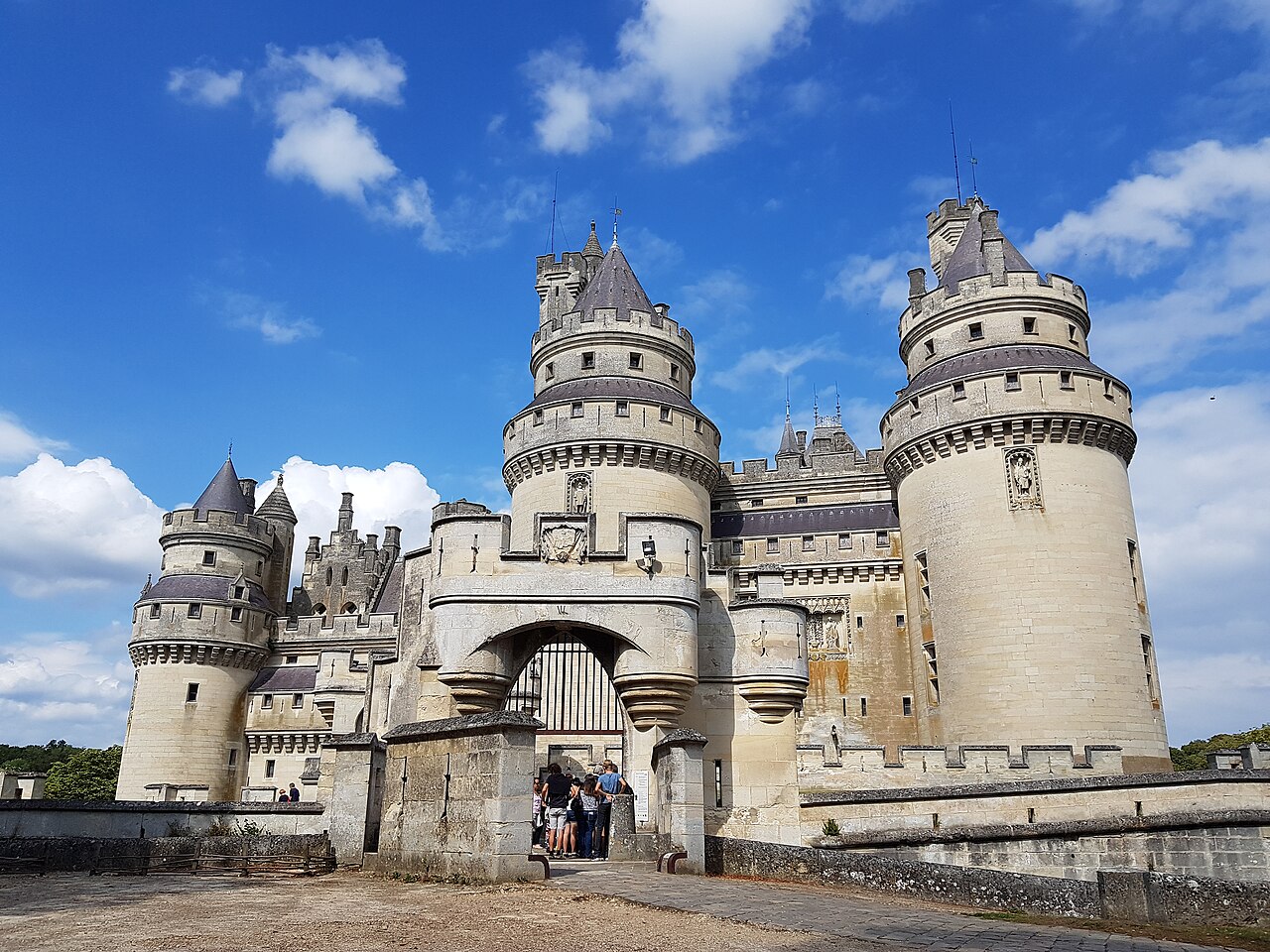
Photo by Crazyswan85 • CC BY-SA 4.0
19th-century restoration and romantic reinterpretation
After centuries of abandonment, the castle was purchased by Napoleon I in 1813 and became part of the Compiègne forest estate. Its romantic ruins inspired artists such as Corot, and it was classified as a historic monument in 1862. In 1857, Napoleon III commissioned architect Eugène Viollet-le-Duc to restore the castle. Initially intended as a partial restoration, the project expanded into a full reconstruction to serve as an imperial residence showcasing Napoleon III's collection of arms and armor.
Viollet-le-Duc's restoration, which continued until 1885, six years after his death, was a creative reinterpretation rather than a strict archaeological restoration. He combined medieval architectural principles with 19th-century building techniques and decorative styles, including early Art Nouveau elements, to create an idealized medieval castle. The restoration included the addition of a third defensive level with crenellated chimneys on the two largest towers, a feature debated by historians for its historical accuracy.
The castle's interior was richly decorated with painted stenciled emblems, wood carvings, and symbolic motifs such as the imperial eagle and the Valois porcupine. The grand logis features large Gothic halls like the Salle des Preuses, used as a reception and ballroom during the Second Empire, adorned with statues representing the female counterparts of the Nine Worthies and elaborate sculptural and painted ornamentation.
Architectural features and layout
Defensive structures
The castle is built on an irregular quadrilateral plan with eight large towers, each named after one of the Nine Worthies. The towers vary in size, with diameters between 10 and 16 meters. The defensive system includes two levels of covered wall-walks equipped with machicolations and arrow slits, providing effective means of defense. The moat surrounds the castle, enhancing its security by isolating it on an island.
The donjon and chapel
The donjon, dating from the 14th century, consists of two large towers, César and Charlemagne, connected by a square building with multiple rooms per floor. It housed the lord’s apartments and was restored with a grand staircase and richly decorated interiors. The chapel, fully rebuilt and integrated into the Judas Maccabeus tower, features a façade reminiscent of medieval Sainte-Chapelles and includes a tribune for guards above the choir. Sculptures of Louis d’Orléans, Valentine Visconti, and saints adorn the portal and tympanum.
Courtyard and galleries
The main courtyard, or cour d’honneur, is surrounded by Renaissance-style facades designed as theatrical screens. A 57-meter-long gallery features sculpted keystones depicting medieval trades and scenes from the Roman de Renart, a collection of medieval animal tales. The courtyard also contains a bronze equestrian statue of Louis d’Orléans and salamander-shaped gargoyles symbolizing the duke, sculpted by Emmanuel Frémiet.
Materials, decorations, and modern additions
The castle's construction employs traditional masonry with slate roofing. Viollet-le-Duc introduced extensive use of iron in roof structures, floor reinforcements, and metal portcullises and drawbridges. Modern comforts added during the 19th-century restoration include a central heating system distributing warm air through iron and plaster ducts.
The exterior features theatrical defensive elements such as a deep ditch and multiple cannon emplacements on the south side, which, while historically anachronistic, enhance the castle's romantic appearance. Sculptural decorations, including gargoyles, chimera, and bas-reliefs like the Annunciation on the main façade, enrich the visual impact.
Current status and preservation efforts
Today, the Castle of Pierrefonds is managed as a national domain by the Centre des monuments nationaux. Recent restoration projects, including a two-year effort completed in 2024 on the Preuses wing, have focused on preserving both structural integrity and decorative elements. The castle remains a popular tourist destination, admired for its blend of authentic medieval architecture and 19th-century romantic reinterpretation, making it a unique monument historique in France.
Visitor information and cultural significance
The castle's dramatic silhouette and elaborate decoration have inspired numerous artists and filmmakers, contributing to its cultural significance. Visitors can explore the extensive halls, towers, and courtyards, gaining insight into medieval fortifications and 19th-century restoration philosophy. The castle's location near the Forest of Compiègne offers additional opportunities for nature walks and exploration of the surrounding historic landscape.
Frequently asked questions (FAQ)
- How do I get to the Castle of Pierrefonds?
- The Castle of Pierrefonds is located in Pierrefonds, France, and is easily accessible by car or public transport. If you are traveling by train, the nearest major station is Compiègne, from which you can take a local bus or taxi to the castle.
- What is the historical significance of the Castle of Pierrefonds?
- The Castle of Pierrefonds was originally built in the 14th century and is a remarkable example of medieval architecture. It was restored in the 19th century by architect Viollet-le-Duc, who aimed to preserve its historic character while enhancing its aesthetic appeal.
- When was the Castle of Pierrefonds constructed?
- The original construction of the Castle of Pierrefonds began in 1393 under the order of Duke Louis of Orléans. It underwent significant renovations in the mid-19th century, led by Eugène Viollet-le-Duc, who transformed it into the picturesque castle we see today.
- Can I take guided tours of the Castle of Pierrefonds?
- Yes, guided tours are available at the Castle of Pierrefonds, providing visitors with in-depth information about its history and architectural features. These tours usually last around an hour and allow guests to explore both the exterior and interior of the castle.
- Why is the architecture of the Castle of Pierrefonds unique?
- The architecture of the Castle of Pierrefonds is unique due to its combination of medieval design elements and 19th-century restoration techniques. Its fairy-tale appearance, complete with towers, turrets, and intricate stonework, showcases the romantic vision of Viollet-le-Duc.
- Is it possible to visit the Castle of Pierrefonds year-round?
- Yes, the Castle of Pierrefonds is open to visitors year-round, although the opening hours may vary by season. It’s advisable to check the official website for current visiting hours, especially during public holidays.
- What is the best time to visit the Castle of Pierrefonds?
- The best time to visit the Castle of Pierrefonds is during the spring and early autumn months when the weather is mild and the gardens are in bloom. Visiting during weekdays can also help you avoid the larger crowds that are common on weekends.
- What are the ticket prices for the Castle of Pierrefonds?
- Ticket prices for the Castle of Pierrefonds vary depending on age and group status, with discounts available for students and seniors. Typically, adult tickets are around €10, while children under 18 can enter for free, making it an affordable outing for families.
- Are there any nearby attractions to visit while at the Castle of Pierrefonds?
- Yes, nearby attractions include the charming village of Pierrefonds itself, which features quaint shops and cafes, as well as the surrounding Compiègne Forest, perfect for hiking and picnicking. The city of Compiègne, with its own historical sites, is also just a short drive away.
Photo gallery

Information
Website
Visit websiteSources & official resources
Verify the information above using these authoritative references.
Loading map...
Visitor reviews
No reviews yet. Been here? Write the first review and help other travelers!
Write the first reviewVisited this castle? Share your experience
Your review helps other travelers and adds first-hand knowledge to our encyclopedia.