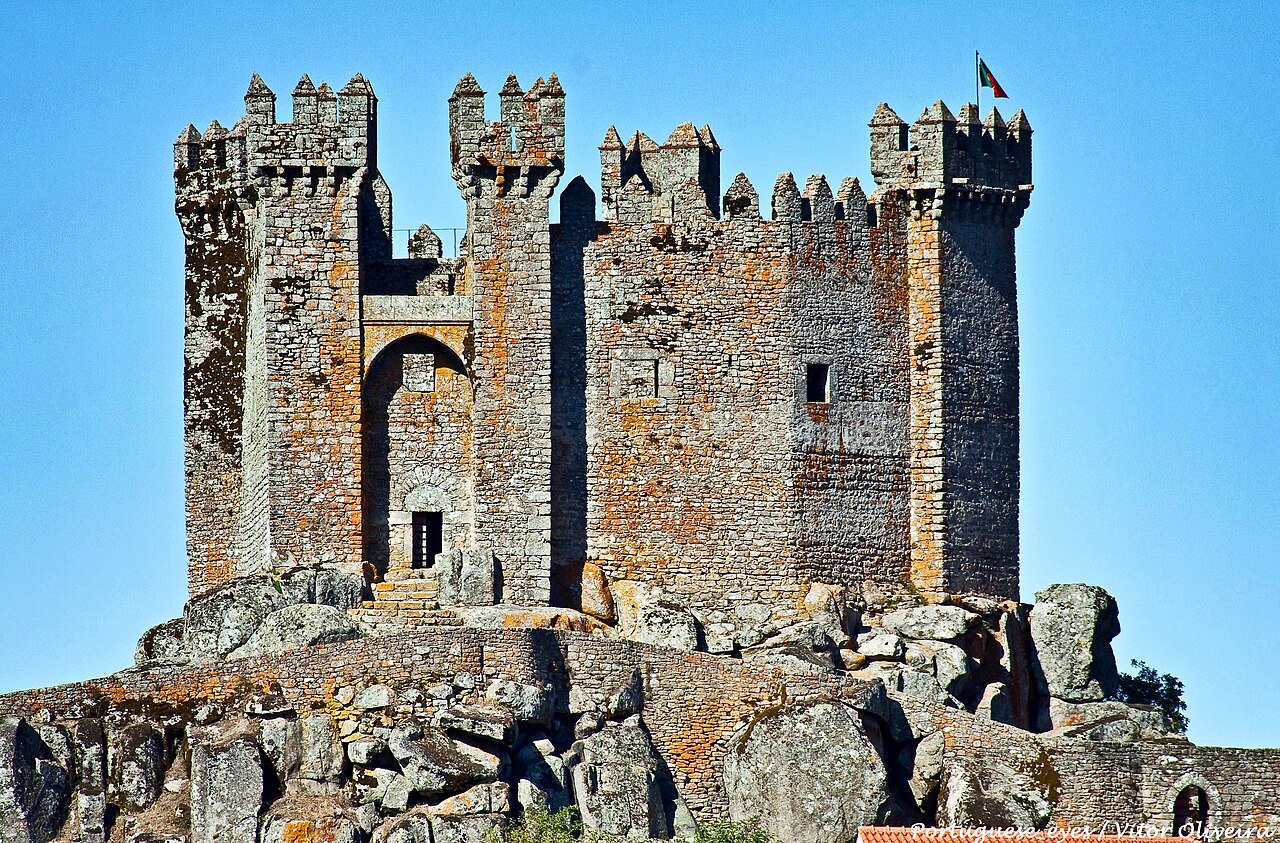
Castle of Penedono
The Castle of Penedono is a remarkable high medieval hill castle located in the municipality of Penedono e Granja, within the Viseu district of Portugal. Its strategic position atop a rocky hill approximately 930 meters above sea level in the Serra de Serigo granite range has made it a significant military and administrative site throughout its long history. The castle's origins date back to the early medieval period, with records as early as 960 AD when it was donated to the Monastery of Guimarães by D. Flâmula, linking it to noble lineages and the Christian Reconquest efforts on the Iberian Peninsula.
During the turbulent 11th century, the Castle of Penedono was situated on the volatile frontier between the Christian kingdoms and Muslim-controlled territories. This location caused the fortress to change hands multiple times, reflecting the shifting power dynamics of the era. The decisive Christian conquest of the area by King Fernando Magno of León in 1064 firmly placed the castle under Christian control. Subsequently, the castle and its surrounding lands were integrated into the emerging Portuguese kingdom under Afonso I of Portugal.
Early medieval origins and strategic importance
The castle's initial construction was part of the broader Christian Reconquest, aimed at securing the frontier against Muslim incursions. The victory at the Battle of Simancas in 939 allowed the repopulation of the region, but the fortress remained contested. In 987, the Muslim leader Almanzor recaptured the site, only for it to be retaken by Ferdinand I of León between 1055 and 1057. Following this, Ferdinand entrusted Rodrigo Tedoniz with the castle's reconstruction, emphasizing its military significance as a border stronghold.
By 1059, the Monastery of São Salvador de Guimarães held possession of the castle, underscoring the intertwining of religious and military authority in the region. The castle's name evolved from Pena de Domus to Penedono, reflecting its gradual development into a settled community.
Medieval development and royal charters
In 1195, King Sancho I of Portugal granted the first Foral Charter to the settlement, encouraging repopulation and fortification of the area. This charter was reaffirmed in 1217 by King Afonso II, reinforcing the town's role as a strategic border post. The castle's configuration largely dates from the reign of King Ferdinand (1367-1383), during which significant fortification works were undertaken.
During the late 14th century, the castle's ownership was transferred to the nearby town of Trancoso. Plans by Trancoso's lords to demolish the fortress were thwarted by the determined resistance of the local inhabitants, who valued the castle's autonomy and protective role. This episode highlights the castle's importance not just militarily but also as a symbol of local identity and governance.
Architectural features and structural elements
The Castle of Penedono features an irregular polygonal plan, described as heptagonal or hexagonal, with a perimeter of approximately 70 meters. Its walls, constructed of granite and schist, are topped with rectangular merlons capped by distinctive pyramid-shaped tops, some pierced with narrow arrow slits for archery defense. The fortress is reinforced by five rectangular buttresses at the corners, enhancing its stability and defensive capability.
The castle is surrounded by a low barbican that traces the contours of the hill, interrupted only by a staircase and landing at the southwest entrance. This entrance is notable for its large rounded arch framed by a tympanum and flanked by two slender towers connected by a walkway with a guardrail. Access is gained via a curved staircase, emphasizing the defensive design.
Defensive features include balconies with machicolations—openings through which defenders could drop projectiles on attackers—and gargoyles serving both functional drainage and ornamental purposes. The northwest wall is further strengthened by a projecting cubelo, a small defensive tower that allowed flanking fire along the curtain wall.
Inner fortress and residential adaptations
Within the walls, remnants of the alcazaba or inner fortress remain, including staircases leading to battlements and tower platforms. Some windows with varied shapes suggest the presence of an intermediate floor, indicating residential or administrative use. The largest tower contains a vaulted dome with a rectangular window, illustrating the blend of military and domestic architecture.
A polygonal cistern covered by a cross vault lies in front of this tower, historically used for water storage, a critical feature for sustaining the castle during sieges. The small interior courtyard, or praça de armas, reveals bases of wooden floor structures and walls pierced by square windows with stone benches beneath, further indicating the castle's adaptation for noble residence.
Notable historical figures and events
The castle is traditionally considered the birthplace of D. Álvaro Gonçalves Coutinho, known as "o Magriço," one of the twelve legendary knights immortalized by the Portuguese poet Luís de Camões. The fortress underwent partial rebuilding under D. Vasco Fernandes Coutinho, with his son Gonçalo Vasques Coutinho later defending it in military actions, underscoring the site's ongoing martial significance.
Between 1471 and 1530, D. Francisco Coutinho, Count of Marialva, transformed the castle into a noble residence, shifting its function from a purely military fortress to a symbol of aristocratic power and domestic comfort. This transformation reflects broader trends in castle architecture during the Renaissance, where fortifications were adapted to accommodate residential needs.
Decline, restoration, and preservation
By the 18th century, the castle had fallen into disuse and partial ruin, as noted in the 1758 Memórias Paroquiais, which described its construction from small stones and mortar. The 19th century saw further decline, with historian Alexandre Herculano recording its dilapidated state in 1812.
Restoration efforts commenced in the 20th century, culminating in the castle's designation as a National Monument in 1910. Extensive conservation work between 1940 and 1983 included masonry repairs, structural reinforcements, and stabilization projects. A risk assessment conducted in 2005 ensured ongoing preservation, allowing the castle to remain a significant cultural and historical landmark.
Visitor experience and cultural significance
Today, the Castle of Penedono stands as a testament to Portugal's medieval heritage and the complex history of the Iberian Peninsula's borderlands. Visitors can explore its well-preserved walls, towers, and battlements, gaining insight into medieval military architecture and the evolution of noble residences. The castle's panoramic hilltop location offers stunning views of the surrounding landscape, enhancing its appeal as a cultural tourism destination.
The fortress not only embodies centuries of military and political history but also serves as a symbol of local identity and resilience, reflecting the community's historic attachment to this enduring monument.
Frequently asked questions (FAQ)
- What is the historical significance of the Castle of Penedono?
- The Castle of Penedono is a remarkable example of medieval military architecture in Portugal, dating back to the 12th century. It served as a strategic fortress during the Reconquista, playing a key role in the defense against Moorish invasions. Today, it stands as a symbol of the region's rich history and cultural heritage.
- When was the Castle of Penedono built?
- Construction of the Castle of Penedono began in the late 12th century, specifically around the year 1200. It was built by the Templar Knights and later expanded in the following centuries, reflecting the architectural styles of different periods. The castle's well-preserved structure allows visitors to glimpse its historical evolution.
- What are the opening hours for the Castle of Penedono?
- The Castle of Penedono is typically open to the public from 9:00 AM to 7:00 PM from April to September, and from 9:00 AM to 6:00 PM from October to March. It's advisable to check the official website for any seasonal changes or special holiday hours. This ensures that visitors can plan their trip accordingly and make the most of their visit.
- Can I visit the Castle of Penedono year-round?
- Yes, the Castle of Penedono is open to visitors throughout the year, making it accessible for those interested in exploring its historical significance. However, certain events or maintenance activities may affect access on specific days. It's best to check in advance to ensure a smooth visit.
- Is it possible to access the Castle of Penedono with mobility issues?
- The Castle of Penedono is situated on a hill and features stone pathways that may pose challenges for individuals with mobility issues. While there are some accessible areas, it's recommended to contact the site in advance to inquire about specific accommodations available for visitors with disabilities.
- What is the best time to visit the Castle of Penedono?
- The best time to visit the Castle of Penedono is during the spring (April to June) and fall (September to October) when the weather is mild and pleasant. These seasons also see fewer crowds, allowing for a more enjoyable experience as you explore the castle and its surroundings. Additionally, the stunning views from the castle are particularly beautiful during these times.
- Are there any nearby attractions to visit while at the Castle of Penedono?
- Yes, there are several nearby attractions worth visiting, including the charming village of Penedono, known for its traditional architecture and local cuisine. Additionally, the surrounding natural landscapes provide opportunities for hiking and exploring the scenic beauty of the region. These attractions complement your visit to the castle and enhance your overall experience.
- What are the ticket prices for the Castle of Penedono?
- Ticket prices for the Castle of Penedono are generally affordable, with discounts available for students, seniors, and groups. As of the latest information, adult tickets typically cost around €2, while children under a certain age may enter for free. Always check the official site for the most current pricing and any special promotions.
Information
Website
Visit websiteSources & official resources
Verify the information above using these authoritative references.
Loading map...
Visitor reviews
No reviews yet. Been here? Write the first review and help other travelers!
Write the first reviewVisited this castle? Share your experience
Your review helps other travelers and adds first-hand knowledge to our encyclopedia.