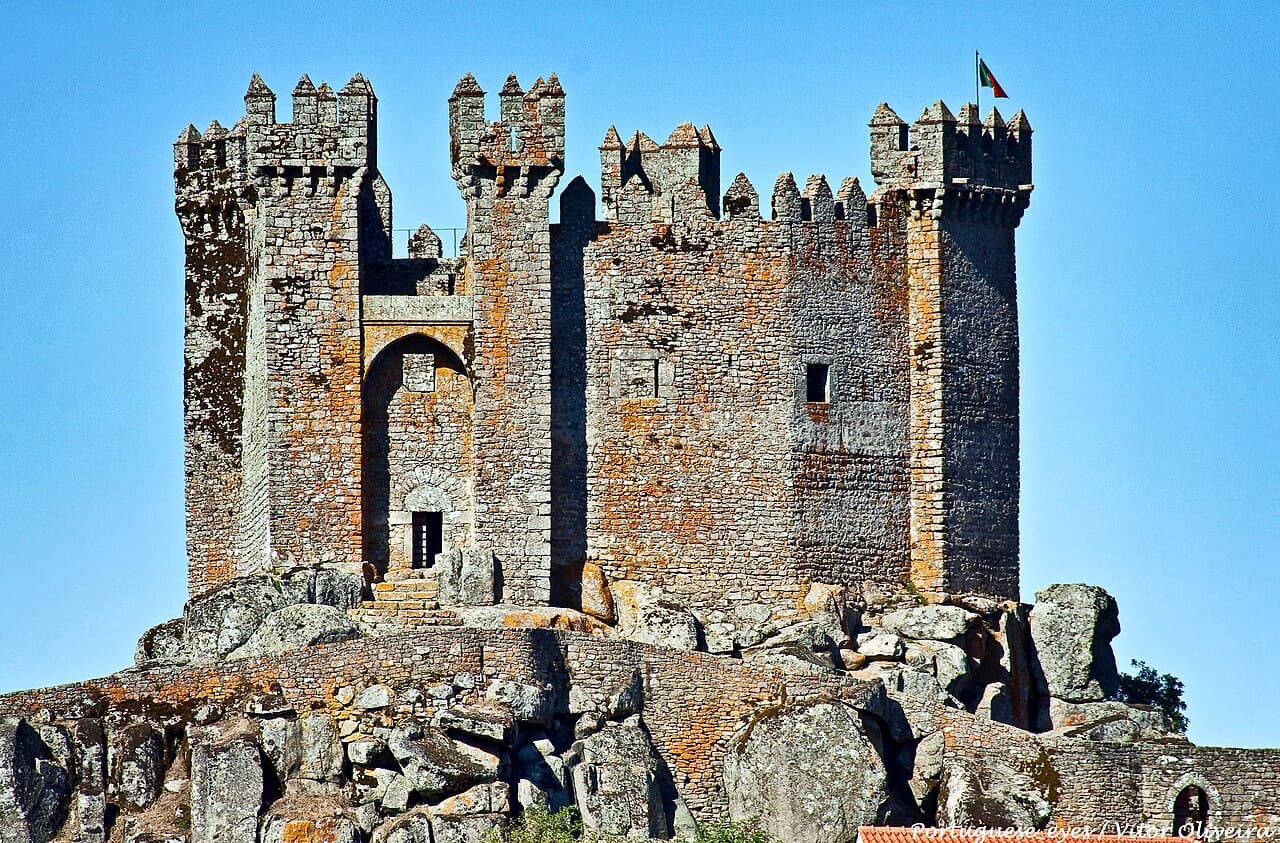
Castelo de Penedono — Portugal castle

Castelo de Penedono

Castle of penedono
Penedono, Viseu, Portugal
High Medieval (11th–13th c.)
Partially Preserved

The Castle of Penedono (Castelo de Penedono) is a prominent medieval hill castle situated in the civil parish of Penedono e Granja, within the municipality of Penedono in the Portuguese district of Viseu. This fortress, perched atop a strategic hill, exemplifies the defensive architecture typical of the High to Late Medieval period in Portugal, serving as a military stronghold and symbol of feudal authority in the region.

Constructed primarily during the 12th and 13th centuries, the castle was part of a broader network of fortifications designed to secure the territory during the turbulent times of the Reconquista and the consolidation of the Portuguese kingdom. Its location on elevated terrain allowed for commanding views over the surrounding landscape, facilitating early warning against invasions and control over local settlements.

Architectural features and layout

The Castle of Penedono is characterized by its robust stone walls and a compact irregular plan adapted to the contours of the hilltop. The fortification includes a prominent keep tower (donjon), which served as the last line of defense and the residence of the lord. The curtain walls are punctuated by several towers that enhanced the defensive capabilities by allowing flanking fire against attackers.

The entrance is fortified with a gatehouse that likely included a portcullis and defensive mechanisms typical of medieval military architecture. Surrounding the castle, remnants of a moat or ditch may have existed to hinder enemy approach, though much of this feature has been lost or obscured over time.

Construction materials and techniques

Local granite was predominantly used in the construction, providing durability and resistance against siege engines and natural erosion. The masonry exhibits characteristics of Romanesque and early Gothic styles, with solid, thick walls and relatively small window openings designed to minimize vulnerabilities.

Historical context and significance

During the 12th and 13th centuries, the Castle of Penedono played a crucial role in the defense and administration of the region. It was part of the frontier fortifications during the Christian reconquest of the Iberian Peninsula, helping to secure the northern border against Moorish incursions and rival noble factions.

The castle was granted a foral charter (municipal charter) by King Afonso Henriques, the first king of Portugal, which helped to establish the town of Penedono as a recognized administrative center. Over the centuries, the castle witnessed various phases of occupation, decline, and restoration, reflecting the shifting political and military landscape of Portugal.

Later modifications and preservation

In the late medieval period, adaptations were made to reinforce the castle's defenses, possibly including the addition of artillery platforms as gunpowder weapons emerged. However, like many medieval fortresses, it gradually lost military importance and fell into partial ruin.

Today, the Castle of Penedono remains a significant cultural landmark. It is partially preserved, with ongoing efforts to maintain its structure and promote its historical value to visitors and scholars interested in medieval Portuguese architecture and history.

Visitor information and cultural heritage

The castle is accessible to the public and offers panoramic views of the surrounding countryside, making it a popular destination for tourists and history enthusiasts. Its location within the municipality of Penedono places it near other historical sites and natural attractions, enriching the cultural experience of visitors.

Interpretive signage and guided tours provide insights into the castle's architectural features and historical background, enhancing visitor understanding of its role in Portugal's medieval past.

Frequently asked questions (FAQ)

How do I get to Castelo de Penedono?
Castelo de Penedono is located in the village of Penedono in Portugal, easily accessible by car via the A25 highway. Public transportation options may be limited, so it is recommended to plan your visit by checking local bus schedules or considering a taxi service.
What is the historical significance of Castelo de Penedono?
Castelo de Penedono, a well-preserved medieval castle, dates back to the 12th century and played a crucial role in the defense against Moorish invasions. It is a symbol of the region's heritage and offers insights into Portugal's feudal past, making it a fascinating destination for history enthusiasts.
When was Castelo de Penedono built?
The construction of Castelo de Penedono began in the late 12th century, around the time of the Reconquista when Christian kingdoms were reclaiming territory from the Moors. Its strategic location and robust architecture were vital for its defensive purpose during that turbulent period.
Can I take guided tours of Castelo de Penedono?
Yes, guided tours are available at Castelo de Penedono, providing visitors with in-depth historical context and architectural insights. It is advisable to check the official website or contact the castle's visitor center for tour schedules and availability.
Why is the architecture of Castelo de Penedono noteworthy?
The architecture of Castelo de Penedono is notable for its impressive granite walls, towers, and well-preserved structures that reflect the military engineering of the medieval period. Its design showcases a blend of Romanesque and Gothic styles, making it an excellent example of historical Portuguese architecture.
Is it possible to visit Castel de Penedono with children?
Absolutely! Castelo de Penedono is a family-friendly destination where children can explore the castle grounds and learn about its fascinating history. The open spaces and unique structures provide a fun and educational experience for visitors of all ages.
What are the opening hours for Castelo de Penedono?
Castelo de Penedono typically opens to visitors from 9:00 AM to 7:00 PM during the summer months and from 9:00 AM to 5:00 PM in the winter. It's best to check the official website for any seasonal changes or special holiday hours before planning your visit.
What are the ticket prices for Castelo de Penedono?
Ticket prices for Castelo de Penedono are quite affordable, with discounts available for students and seniors. Children under a certain age may enter for free, making it a budget-friendly option for families and history lovers alike.
When is the best time to visit Castelo de Penedono?
The best time to visit Castelo de Penedono is during the spring and fall months when the weather is mild and pleasant for exploring. Additionally, these seasons tend to have fewer tourists, allowing for a more enjoyable and intimate experience of the castle and its surroundings.
Are there any nearby attractions to visit while at Castelo de Penedono?
Yes, nearby attractions include the charming village of Penedono itself, where you can explore local shops and restaurants, as well as the picturesque Douro Valley. Nature lovers may also enjoy hiking in the surrounding hills and enjoying the scenic views of the landscape.

Photo gallery

Castelo de Penedono
Click to view

Photo by Vitor Oliveira from Torres Vedras, PORTUGAL•CC BY-SA 2.0

1 photo • Click any image to view in full screen

Information

Hill Castle

Loading map...

Visitor reviews

No reviews yet. Been here? Write the first review and help other travelers!

Write the first review

Visited this castle? Share your experience

Your review helps other travelers and adds first-hand knowledge to our encyclopedia.

Write a review

(5/5)

0/2000 characters

Your review will be visible after admin approval

Nearby castles

0.3 km

Penedono Castle

Penedono, Portugal

Penedono Castle stands as a remarkable example of medieval military architecture in the Viseu district of west-central Portugal. This fortress is notable for its distinctive triangular layout and four imposing jagged towers, a design that sets it apart from more common rectangular or circular castles of the period. Situated on a rocky hill overlooking the small town of Penedono, the castle offers commanding views of the surrounding Douro region, a landscape renowned for its natural beauty and viticulture. Historical context and origins The lands around Penedono have a history of human occupation dating back to Roman times, though the castle itself is first documented during the Reconquista period. By the 11th century, a fortification existed on the site, serving as a strategic defensive point during the Christian reconquest of the Iberian Peninsula. The castle underwent significant development and expansion through the late 14th century, evolving into a robust stronghold that reflected the military needs and architectural styles of the high medieval period. Architectural features and design Penedono Castle is constructed primarily from large blocks of gray stone, giving it a sturdy and austere appearance. Its triangular plan is unusual among Portuguese castles, and the four jagged towers positioned at each corner enhance both its defensive capabilities and its visual impact. These towers were designed to provide overlapping fields of fire, allowing defenders to cover the castle walls effectively. The fortress is surrounded by high, thick walls that enclose a courtyard and various internal structures typical of medieval castles, including dungeons and prisons. The castle's gatehouse and battlements were built to withstand sieges and assaults, reflecting the turbulent history of the region during the Middle Ages. Decline and restoration efforts Following its medieval heyday, Penedono Castle experienced periods of decline, particularly by the 18th century, when its condition deteriorated significantly. Recognizing its historical and cultural value, the Portuguese government declared it a national monument in 1910. This designation marked the beginning of concerted efforts to preserve and restore the castle. Restoration work commenced in 1940, focusing on strengthening the structure and repairing the facades and towers. Further restoration phases took place in 1943 and 1953, resulting in the castle's current well-preserved state. Although the exterior and defensive elements have been stabilized and restored, the interior spaces remain less developed, preserving an authentic sense of medieval ruin. Cultural significance and tourism Today, Penedono Castle is a prominent cultural landmark in the region, attracting visitors interested in medieval history and architecture. The castle's unique design and commanding hilltop position make it a compelling destination for tourists exploring the Douro region. Nearby, several small hotels offer comfortable accommodations with scenic views of the castle and surrounding vineyards. The region is also famous for its wine production, and visitors often combine castle tours with tastings at local vineyards, enjoying the rich cultural and natural heritage of the area. The castle serves as a focal point for understanding the medieval history of Portugal and the strategic importance of fortifications during the Reconquista and subsequent centuries. Access and visitor information Penedono Castle is accessible from major cities such as Lisbon, approximately four hours away by road, and Porto, less than two hours distant. The castle's location on a rocky hill provides not only historical intrigue but also panoramic views that enhance the visitor experience. While the castle itself offers a glimpse into medieval fortification techniques, the surrounding town and countryside provide additional cultural and recreational opportunities.

High Medieval (11th–13th c.)
Details
0.8 km

Castle of Penedono

Penedono e Granja, Portugal

The Castle of Penedono is a remarkable high medieval hill castle located in the municipality of Penedono e Granja, within the Viseu district of Portugal. Its strategic position atop a rocky hill approximately 930 meters above sea level in the Serra de Serigo granite range has made it a significant military and administrative site throughout its long history. The castle's origins date back to the early medieval period, with records as early as 960 AD when it was donated to the Monastery of Guimarães by D. Flâmula, linking it to noble lineages and the Christian Reconquest efforts on the Iberian Peninsula. During the turbulent 11th century, the Castle of Penedono was situated on the volatile frontier between the Christian kingdoms and Muslim-controlled territories. This location caused the fortress to change hands multiple times, reflecting the shifting power dynamics of the era. The decisive Christian conquest of the area by King Fernando Magno of León in 1064 firmly placed the castle under Christian control. Subsequently, the castle and its surrounding lands were integrated into the emerging Portuguese kingdom under Afonso I of Portugal. Early medieval origins and strategic importance The castle's initial construction was part of the broader Christian Reconquest, aimed at securing the frontier against Muslim incursions. The victory at the Battle of Simancas in 939 allowed the repopulation of the region, but the fortress remained contested. In 987, the Muslim leader Almanzor recaptured the site, only for it to be retaken by Ferdinand I of León between 1055 and 1057. Following this, Ferdinand entrusted Rodrigo Tedoniz with the castle's reconstruction, emphasizing its military significance as a border stronghold. By 1059, the Monastery of São Salvador de Guimarães held possession of the castle, underscoring the intertwining of religious and military authority in the region. The castle's name evolved from Pena de Domus to Penedono, reflecting its gradual development into a settled community. Medieval development and royal charters In 1195, King Sancho I of Portugal granted the first Foral Charter to the settlement, encouraging repopulation and fortification of the area. This charter was reaffirmed in 1217 by King Afonso II, reinforcing the town's role as a strategic border post. The castle's configuration largely dates from the reign of King Ferdinand (1367-1383), during which significant fortification works were undertaken. During the late 14th century, the castle's ownership was transferred to the nearby town of Trancoso. Plans by Trancoso's lords to demolish the fortress were thwarted by the determined resistance of the local inhabitants, who valued the castle's autonomy and protective role. This episode highlights the castle's importance not just militarily but also as a symbol of local identity and governance. Architectural features and structural elements The Castle of Penedono features an irregular polygonal plan, described as heptagonal or hexagonal, with a perimeter of approximately 70 meters. Its walls, constructed of granite and schist, are topped with rectangular merlons capped by distinctive pyramid-shaped tops, some pierced with narrow arrow slits for archery defense. The fortress is reinforced by five rectangular buttresses at the corners, enhancing its stability and defensive capability. The castle is surrounded by a low barbican that traces the contours of the hill, interrupted only by a staircase and landing at the southwest entrance. This entrance is notable for its large rounded arch framed by a tympanum and flanked by two slender towers connected by a walkway with a guardrail. Access is gained via a curved staircase, emphasizing the defensive design. Defensive features include balconies with machicolations—openings through which defenders could drop projectiles on attackers—and gargoyles serving both functional drainage and ornamental purposes. The northwest wall is further strengthened by a projecting cubelo, a small defensive tower that allowed flanking fire along the curtain wall. Inner fortress and residential adaptations Within the walls, remnants of the alcazaba or inner fortress remain, including staircases leading to battlements and tower platforms. Some windows with varied shapes suggest the presence of an intermediate floor, indicating residential or administrative use. The largest tower contains a vaulted dome with a rectangular window, illustrating the blend of military and domestic architecture. A polygonal cistern covered by a cross vault lies in front of this tower, historically used for water storage, a critical feature for sustaining the castle during sieges. The small interior courtyard, or praça de armas, reveals bases of wooden floor structures and walls pierced by square windows with stone benches beneath, further indicating the castle's adaptation for noble residence. Notable historical figures and events The castle is traditionally considered the birthplace of D. Álvaro Gonçalves Coutinho, known as "o Magriço," one of the twelve legendary knights immortalized by the Portuguese poet Luís de Camões. The fortress underwent partial rebuilding under D. Vasco Fernandes Coutinho, with his son Gonçalo Vasques Coutinho later defending it in military actions, underscoring the site's ongoing martial significance. Between 1471 and 1530, D. Francisco Coutinho, Count of Marialva, transformed the castle into a noble residence, shifting its function from a purely military fortress to a symbol of aristocratic power and domestic comfort. This transformation reflects broader trends in castle architecture during the Renaissance, where fortifications were adapted to accommodate residential needs. Decline, restoration, and preservation By the 18th century, the castle had fallen into disuse and partial ruin, as noted in the 1758 Memórias Paroquiais, which described its construction from small stones and mortar. The 19th century saw further decline, with historian Alexandre Herculano recording its dilapidated state in 1812. Restoration efforts commenced in the 20th century, culminating in the castle's designation as a National Monument in 1910. Extensive conservation work between 1940 and 1983 included masonry repairs, structural reinforcements, and stabilization projects. A risk assessment conducted in 2005 ensured ongoing preservation, allowing the castle to remain a significant cultural and historical landmark. Visitor experience and cultural significance Today, the Castle of Penedono stands as a testament to Portugal's medieval heritage and the complex history of the Iberian Peninsula's borderlands. Visitors can explore its well-preserved walls, towers, and battlements, gaining insight into medieval military architecture and the evolution of noble residences. The castle's panoramic hilltop location offers stunning views of the surrounding landscape, enhancing its appeal as a cultural tourism destination. The fortress not only embodies centuries of military and political history but also serves as a symbol of local identity and resilience, reflecting the community's historic attachment to this enduring monument.

High Medieval (11th–13th c.)
Details
5.3 km

Castelo de Ranhados

Mêda, Portugal

Castelo de Ranhados is a medieval hill castle located in the municipality of Mêda, Portugal. This fortress occupies a strategic position on a mountaintop approximately 840 meters above sea level, overseeing the surrounding village and the confluence of the Torto River and the Teja stream. Its location on a ridge, reflected in its name derived from "ranh," meaning crest or ridge of a hill, was chosen for its commanding views and defensive advantages. Origins and early history The site of Castelo de Ranhados has a history extending back to proto-historic times, initially serving as a castro, a type of fortified settlement common in the Iberian Peninsula before Roman occupation. Archaeological findings, including ceramic artifacts, attest to Roman influence during their occupation, indicating the site’s long-standing strategic importance. Medieval construction and ownership The castle’s medieval phase began under the reign of King Dinis (1279–1325). In 1286, the king granted a charter to the local settlement to encourage growth and fortify the area. During this period, it is believed that the Knights Templar and Knights Hospitaller, both holding lands nearby, contributed to the castle’s construction, reflecting their military and religious influence in the region. Later, during the reign of King Ferdinand I (1367–1383), the village and castle were granted in 1381 to two brothers from the noble House of Távoras. This gift was confirmed in 1384 by the Master of Avis, an important figure in Portuguese history. Some historians suggest that the castle’s simple design and the lack of a keep tower protecting the main gate may indicate that the main construction occurred during this late 14th-century period. Architecture and defensive features The castle’s layout is irregular and oval-shaped, typical of Gothic architectural influence. It is primarily constructed from granite ashlar masonry, a durable material that has helped preserve the walls despite their incomplete state and the loss of original battlements. Two square towers reinforce the defensive walls. One tower stands at the southeast corner, opposite the main entrance, serving as a key defensive feature of the perimeter. The second tower is located within the courtyard near a smaller eastern gate known as the "Porta da Traição" or Traitor’s Gate. This gate is protected by a double layer of walls, emphasizing its role as a secondary access point. The inner tower features a pointed arch doorway leading into a vaulted chamber with ribbed cross vaulting, a ceiling construction where intersecting rib arches form a structural framework. The curtain wall once included a walkway, locally called an adarve, accessible by stairs near the main gate, allowing defenders to patrol the ramparts. Notably, the absence of a keep tower at the entrance suggests the castle may have functioned as a secondary fortification rather than a primary stronghold. This architectural detail distinguishes Castelo de Ranhados from many contemporaneous castles that featured prominent keeps as central defensive structures. Later history and decline Despite its initial strategic importance, the castle and surrounding village experienced a gradual decline over the centuries. Although King Manuel I renewed the settlement’s charter in 1512, the area had already begun to lose inhabitants and significance. By the 18th century, the village was incorporated into the Casa do Infantado, serving as a rectory under royal oversight and functioning as a commandery of the Order of Christ. These changes reflect the shifting political and religious landscape of Portugal during this period. The process of abandonment continued, culminating in the dissolution of the municipality of Ranhados in 1836, when it was absorbed into Mêda. Following the suppression of religious orders in 1834, the castle’s courtyard was repurposed as the village cemetery, a function it maintains to this day. Preservation and current condition In recognition of its cultural and historical value, Castelo de Ranhados was officially designated a Site of Public Interest in 1977. Structural reinforcements have been applied to one of the outer walls due to its continuous use as a burial ground. These interventions have partially altered the original medieval fabric but have been necessary to maintain the castle’s integrity. Today, the castle remains a significant historical monument, offering insight into medieval military architecture and the complex history of the region. Its surviving walls, towers, and architectural features provide a tangible connection to Portugal’s medieval past and the roles played by religious military orders and noble families in shaping local fortifications.

Late Medieval (14th–15th c.)
Details

