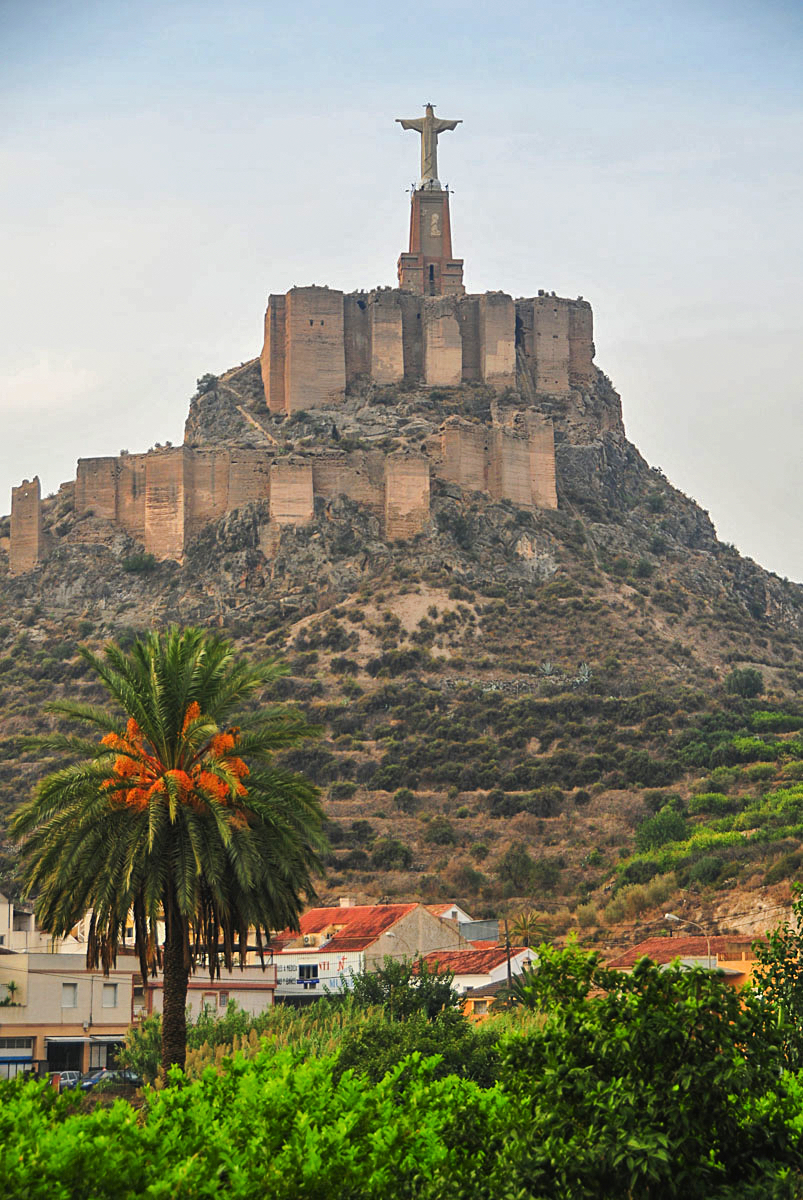
Castle of Orihuela
The Castle of Orihuela stands prominently on Monte de San Miguel, a hill approximately 240 meters above sea level near the town of Orihuela in Spain. This hill castle has a rich history that dates back to the Visigothic era, with documented references as early as the reign of King Teodomiro. The fortress's strategic location provided commanding views over the surrounding terrain, allowing it to serve as a vital defensive stronghold throughout centuries of conflict.
Historical records from 713 and 859 AD confirm the castle's early significance in the region, marking it as an important military installation during the turbulent early medieval period. Its origins are rooted in the need for protection against both internal and external threats during the decline of Visigothic rule and the subsequent Muslim conquest of the Iberian Peninsula.
Medieval significance and military role
During the medieval period, the Castle of Orihuela played a critical role in the defense and control of the surrounding territory, particularly following the Christian Reconquest of the Iberian Peninsula. The fortress was repeatedly maintained and fortified by various monarchs who recognized its strategic importance in securing key routes and regional stability.
The war of the two peters and the castle's resilience
One of the most notable episodes in the castle's history occurred during the 14th century War of the Two Peters, a protracted conflict between the kingdoms of Castile and Aragon. The castle endured a remarkable twelve-year siege during this war, demonstrating its formidable defensive capabilities. Despite continuous assaults, the fortress remained unconquered by force, only capitulating due to the defenders' starvation. This event solidified the castle's reputation as a nearly impregnable fortress and a symbol of resilience.
Architectural features and fortress design
The original design of the Castle of Orihuela is characterized by its impressive seven concentric walls that encircle the fortress. This layered defensive system was a sophisticated architectural solution aimed at maximizing protection against invaders. The highest level of the fortress was reserved exclusively for senior military commanders, indicating a clear hierarchy in the use of space within the castle.
Remnants of several towers remain visible today, strategically placed along the walls to enhance defense and provide vantage points for surveillance and archery. These towers, along with the extensive walls, reveal various construction techniques and architectural styles that evolved as the fortress was remodeled over centuries to adapt to changing military technologies and threats.
Strategic location and natural defenses
Situated on Monte de San Miguel, the castle's elevated position offered natural defensive advantages. The hilltop location allowed the garrison to monitor approaching forces from a distance, control key access routes, and use the terrain to their advantage during sieges and battles. The natural topography complemented the man-made fortifications, making the castle a formidable obstacle for attackers.
Decline and destruction in the early modern period
The castle's fortunes declined significantly in the early 18th century during the War of Spanish Succession. A catastrophic event occurred when a bolt of lightning struck the powder magazine, causing a massive explosion that devastated much of the fortress. The damage was so severe that authorities ordered the castle's demolition, considering it beyond repair.
Following this destruction, the ruins suffered further from natural disasters, including severe storms and a powerful earthquake in 1829. These events accelerated the deterioration of the already damaged structure, leaving only fragments of the original fortress intact.
Modern recognition and preservation challenges
Despite its ruined state, the Castle of Orihuela was officially recognized for its historical and cultural significance in the 20th century. In 1931, it was declared a Historic Ruin and granted protection as a Cultural Interest Asset with Monument status. This designation acknowledges the castle's importance as a heritage site and aims to safeguard its remains.
Today, the castle remains largely a ruin, with significant portions of its walls and towers still standing. However, it faces ongoing threats from natural weathering and human impact. Preservation efforts are essential to stabilize the structure and prevent further loss, ensuring that the castle's rich history and architectural legacy endure for future generations.
Frequently asked questions (FAQ)
- When was the castle of orihuela originally built?
- The Castle of Orihuela dates back to the Visigothic era, with documented references from the early 8th century during King Teodomiro's reign.
- What is the architectural layout of the castle?
- The castle features seven concentric defensive walls and several towers, designed to maximize protection and provide strategic vantage points.
- Why is the castle historically significant?
- It is notable for its resilience during the 14th century War of the Two Peters, enduring a twelve-year siege and symbolizing medieval military strength.
- What caused the castle's destruction in the 18th century?
- A lightning strike on the powder magazine caused a massive explosion, leading to extensive damage and subsequent ordered demolition.
- Is the castle accessible to visitors today?
- The castle remains largely a ruin and is recognized as a historic site, though specific visiting hours and facilities may be limited due to preservation concerns.
Information
Loading map...
Visitor reviews
No reviews yet. Been here? Write the first review and help other travelers!
Write the first reviewVisited this castle? Share your experience
Your review helps other travelers and adds first-hand knowledge to our encyclopedia.