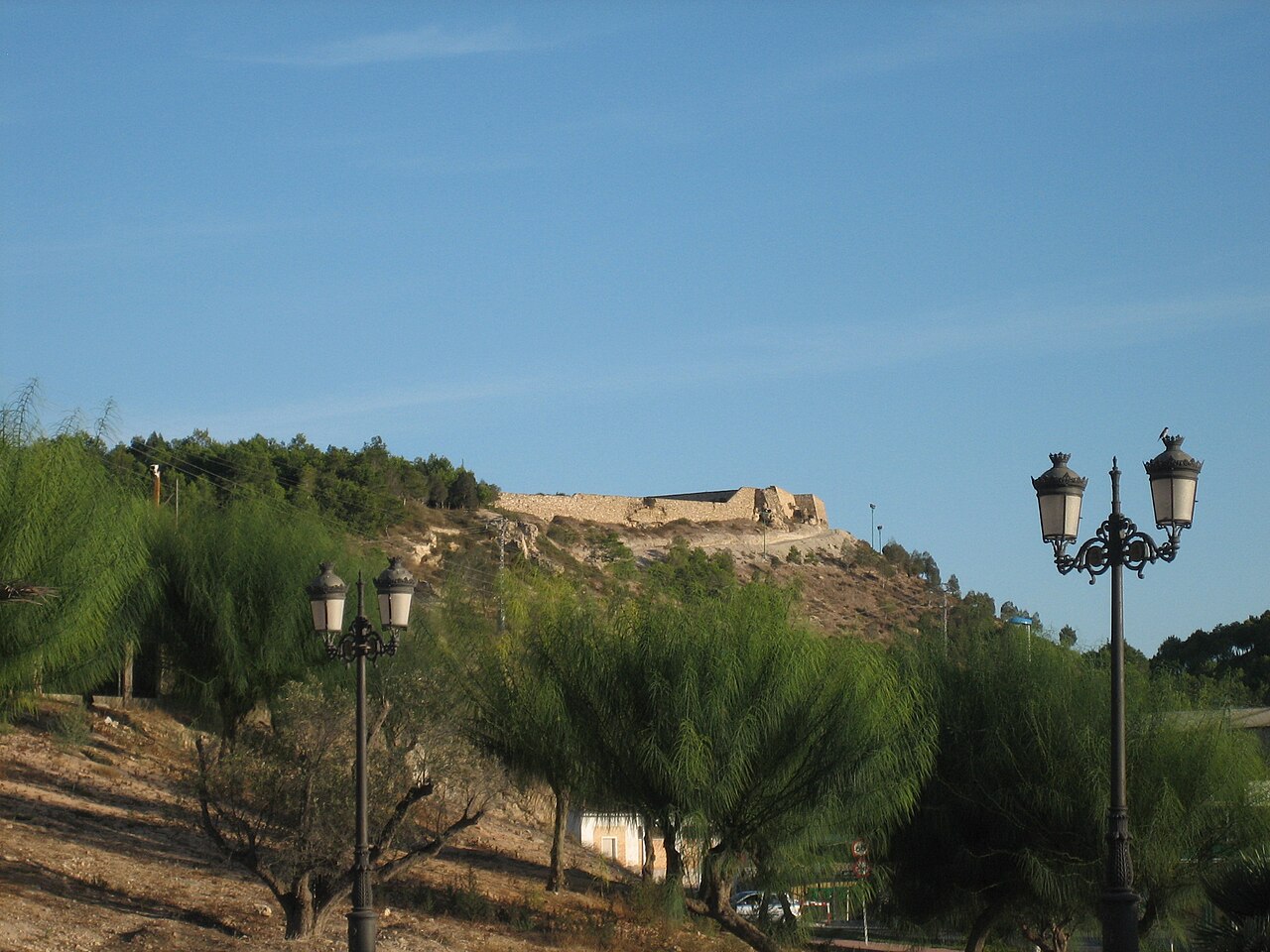
Ayala Castle
Ayala Castle, also known locally as Castillo de Ayala, Castillo de Santa Bárbara, or Castillo de Cox, is a historic medieval fortress situated in the town of Cox in the province of Alicante, Spain. This castle stands on a prominent rocky spur in the northern foothills of the Sierra de Callosa de Segura, a strategic location that afforded control and protection over the surrounding rural landscape. Its origins date back to the early 12th century, during the period of Muslim rule in the Iberian Peninsula.
The early history and Muslim origins
Constructed as a defensive stronghold, Ayala Castle was part of a network of fortifications designed to secure the territory under Muslim control. Its position on elevated rocky terrain allowed for surveillance of the surrounding area, making it a vital military asset for protecting the village of Cox and its environs. The castle's initial architectural features likely included typical Islamic military elements such as thick walls, battlements, and possibly a keep or tower for lookout purposes, though much of this early structure has been altered or lost over time.
Transition to Christian rule and feudal ownership
In 1226, the castle and the surrounding area were conquered by Alfonso X of Castile during the Christian Reconquista. Despite this conquest, the estate continued to be managed by local Muslim lords known as the Ra'is de Crevillente until the early 14th century, when their lineage ended. By 1304, the territory was officially incorporated into the Kingdom of Valencia. Around 1318, the castle was granted by James II of Aragon to Arardo de Mur, marking the beginning of its transition into a feudal possession under Christian nobility. The property changed hands again in 1339 when it was sold to the Vidal family.
Reconstruction and transformation in the 15th century
During the 15th century, the castle came under the ownership of the prominent Dávalos family. Around 1446, Juan Ruíz Dávalos undertook significant reconstruction work, transforming the fortress into a fortified manor house. This renovation reflected changing needs from purely military defense to residential comfort combined with security. The modifications likely included the addition of domestic quarters, improved living spaces, and possibly ornamental features, while retaining defensive elements such as thick walls and towers.
Decline and present condition
By the end of the 16th century, the castle ceased to be a primary residence for its owners and gradually fell into disuse and decay. Over the centuries, the loss of battlements and other defensive structures has diminished its appearance as a traditional castle. Today, the castle's interior is not open to the public, and its exterior no longer strongly resembles a fortified castle due to the removal or collapse of key architectural features. Despite this, its historical significance remains, and it is part of the cultural heritage of Cox.
Architectural features and nearby landmarks
The castle's location on a rocky spur is a defining characteristic, typical of hill castles designed for defense and visibility. Although much of its original military architecture has been lost or altered, the remaining structure hints at its medieval origins and subsequent adaptations. Nearby, the Mora Tower is another historical site that contributes to the understanding of the area's defensive network and medieval history.
Visiting Ayala Castle
Currently, Ayala Castle is closed to visitors, and access to its interior is restricted. The lack of battlements and the castle's state of preservation mean that it does not offer the typical castle experience many visitors seek. However, its exterior and the surrounding landscape provide a glimpse into the region's medieval past. Visitors interested in medieval architecture and Spanish history may find the nearby Mora Tower and other local sites worth exploring.
Frequently asked questions (FAQ)
- When was Ayala Castle built and by whom?
- Ayala Castle was built in the early 12th century during Muslim rule in the Iberian Peninsula, serving as a defensive fortress.
- Can I visit the interior of Ayala Castle?
- Currently, the interior of Ayala Castle is not open to the public, and access is restricted.
- What architectural style characterizes Ayala Castle?
- While originally a Muslim fortress, the castle was transformed into a fortified manor house in the 15th century, reflecting a mix of military and residential architectural features.
- Where is Ayala Castle located?
- Ayala Castle is located in the town of Cox, in the province of Alicante, Valencian Community, Spain, on a rocky spur in the Sierra de Callosa de Segura foothills.
- What is the current condition of Ayala Castle?
- The castle is partially preserved but has lost many of its battlements and defensive structures, diminishing its traditional castle appearance.
Information
Address
Behind Calle Portichuelo 11, Cox, Alicante, Spain
Loading map...
Visitor reviews
No reviews yet. Been here? Write the first review and help other travelers!
Write the first reviewVisited this castle? Share your experience
Your review helps other travelers and adds first-hand knowledge to our encyclopedia.