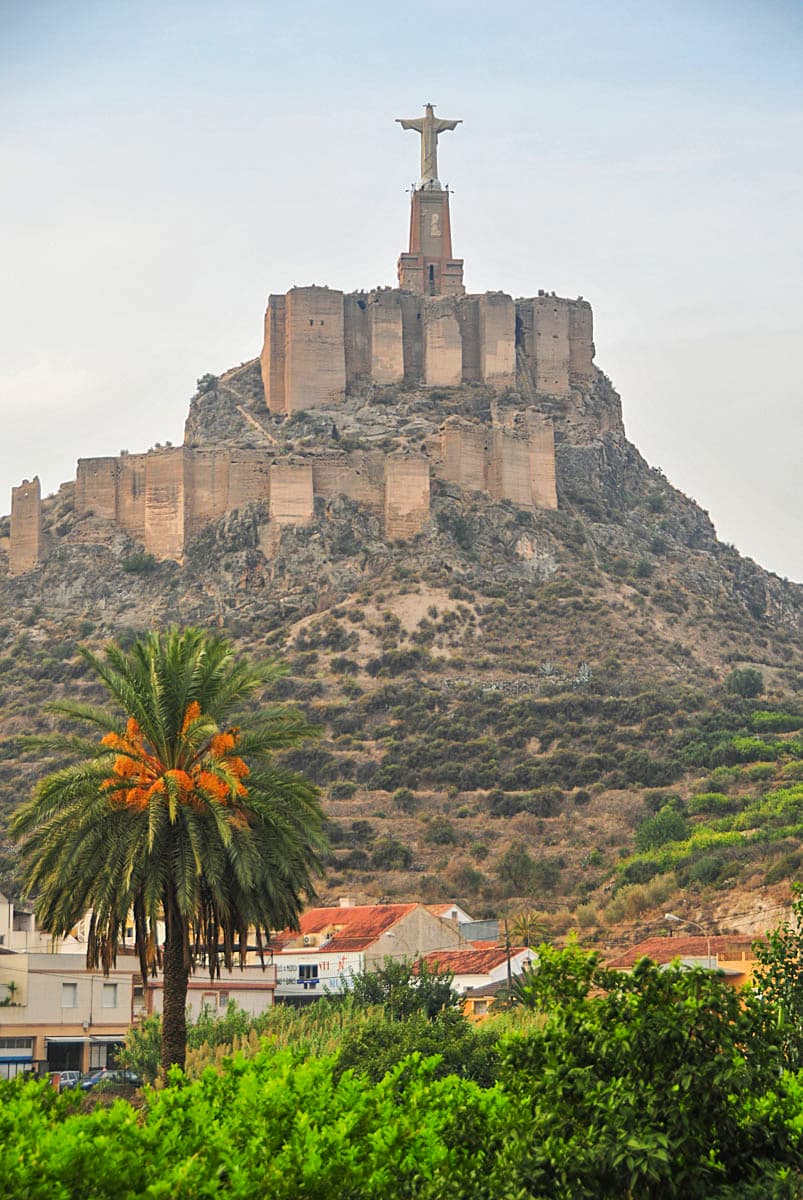
Monteagudo Castle
Monteagudo Castle, locally known as Castillo de Monteagudo, is a striking historic fortress perched atop a rocky hill near the town of Monteagudo in the Region of Murcia, Spain. This castle is a significant example of medieval military architecture with origins tracing back to the Moorish period. It played a crucial role in the defense and control of the surrounding territory, particularly the city of Murcia.
The castle was first mentioned in historical records around 1078-1079, when Abu Abd al-Rahman ibn Tahir, the Emir of the Taifa of Murcia, was dethroned and imprisoned within its walls. However, the present structure is primarily attributed to Abu ʿAbd Allāh Muḥammad ibn Mardanis, known as "the Wolf King," who ruled Murcia from 1147 to 1172. Ibn Mardanis constructed Monteagudo alongside two other nearby fortifications, Castillejo and Larache, to protect the city of Murcia and assert his control over the region.
Architectural features and construction
Monteagudo Castle is built predominantly of rammed earth, a technique involving compacted layers of earth mixed with mortar, which was common in Moorish fortifications. The castle's design follows the natural contours of the rocky hill, consisting of two main enclosures or terraces at different heights. This adaptation to the terrain allowed for effective defense and use of the space.
The southern flank of the castle reveals several functional spaces including wells, granaries, and other rooms that supported the garrison and stored provisions such as grain. The castle also featured large water cisterns, vital for sustaining its occupants during sieges. The walls are thick and robust, constructed to withstand attacks and the elements over centuries.
Strategic location and defensive role
Situated on a prominent hill, Monteagudo Castle commanded extensive views over the surrounding countryside, allowing early detection of approaching enemies. Its position was strategic in controlling access to Murcia and served as a key defensive stronghold during the Moorish period and later under Christian rule.
Historical significance and ownership changes
Following the Christian reconquest, Murcia became a protectorate of the Kingdom of Castile in 1243. The castle transitioned to Christian hands and was used as a royal residence by King Alfonso X of Castile during his reign from 1252 to 1284. Alfonso X gifted Monteagudo Castle, along with Castillejo and Larache, to Violant of Aragon upon their marriage in 1249. Later, the castle passed to Maria de Molina, Alfonso's daughter-in-law, and in 1311 it was granted to the Bishop of Cartagena by Ferdinand IV of Castile.
Throughout the late medieval period, Monteagudo Castle remained a vital border fortress between the kingdoms of Aragon and Castile, maintaining its military importance until the 15th century. However, by the 16th century, its strategic value declined, and it gradually fell into disrepair.
Later history and restoration efforts
During the War of the Spanish Succession in the early 18th century, partial restoration efforts were made to reinforce the castle's defenses, but these were short-lived, and the fortress soon returned to ruin. In the 20th century, the castle gained renewed attention due to the installation of a monumental statue.
Christ of Monteagudo statue
In 1926, a large statue of Christ was erected atop the castle, symbolizing religious and cultural significance. This statue stood 14 meters tall and became a prominent landmark. Unfortunately, during the Spanish Civil War in 1936, the statue was destroyed, and parts of the castle suffered damage.
The statue was rebuilt in 1951 as a faithful replica of the original and remains a defining feature of the site today, crowning the castle and visible across the surrounding landscape.
Current condition and accessibility
Monteagudo Castle today is classified as partially preserved. While the castle retains significant architectural elements such as its rammed earth walls, terraces, wells, and granaries, it is not currently open to public visitation due to safety concerns and ongoing preservation challenges.
The castle's location offers spectacular views of the Murcia region, and the imposing Christ of Monteagudo statue continues to attract interest from visitors and locals alike. Despite limited access, Monteagudo Castle remains an important cultural and historical monument, reflecting the rich heritage of the region and the complex history of medieval Spain.
Archaeological findings and cultural heritage
Excavations at Monteagudo Castle have uncovered artifacts and structural remains dating back to its Moorish origins, confirming its use as a fortification and prison. The castle's granaries and wells illustrate the logistical planning necessary for sustaining a medieval garrison. Its role as a defensive bastion and royal residence highlights the castle's multifaceted significance over several centuries.
Monteagudo Castle is a testament to the military ingenuity of the Moors and the evolving political landscape of medieval Spain, embodying the transition from Islamic to Christian rule and the shifting alliances and conflicts that shaped the region.
Frequently asked questions (FAQ)
- How do I get to Monteagudo Castle?
- Monteagudo Castle is located on a hill near the town of Monteagudo in the Region of Murcia, Spain. Visitors typically reach the site by car or local transport to the town, but note the castle itself is not currently open for public tours.
- What is the historical significance of Monteagudo Castle?
- Monteagudo Castle was a key defensive fortress during the Moorish period and later under Christian rule. It served as a royal residence for King Alfonso X and was strategically important as a border castle between Aragon and Castile.
- Can I visit Monteagudo Castle today?
- Currently, Monteagudo Castle is not open to the public due to preservation and safety concerns. Visitors can view the castle and the Christ of Monteagudo statue from nearby vantage points.
- When was the Christ of Monteagudo statue built and rebuilt?
- The original Christ of Monteagudo statue was erected in 1926 but was destroyed during the Spanish Civil War in 1936. It was rebuilt in 1951 as a replica and remains a prominent landmark today.
- What materials were used to build Monteagudo Castle?
- Monteagudo Castle was primarily constructed using rammed earth and mortar, a typical building technique in Moorish fortifications, allowing the walls to adapt to the rocky hill terrain.
Photo gallery

Information
Website
Visit websiteSources & official resources
Verify the information above using these authoritative references.
Loading map...
Visitor reviews
No reviews yet. Been here? Write the first review and help other travelers!
Write the first reviewVisited this castle? Share your experience
Your review helps other travelers and adds first-hand knowledge to our encyclopedia.


