Castle of Mertola
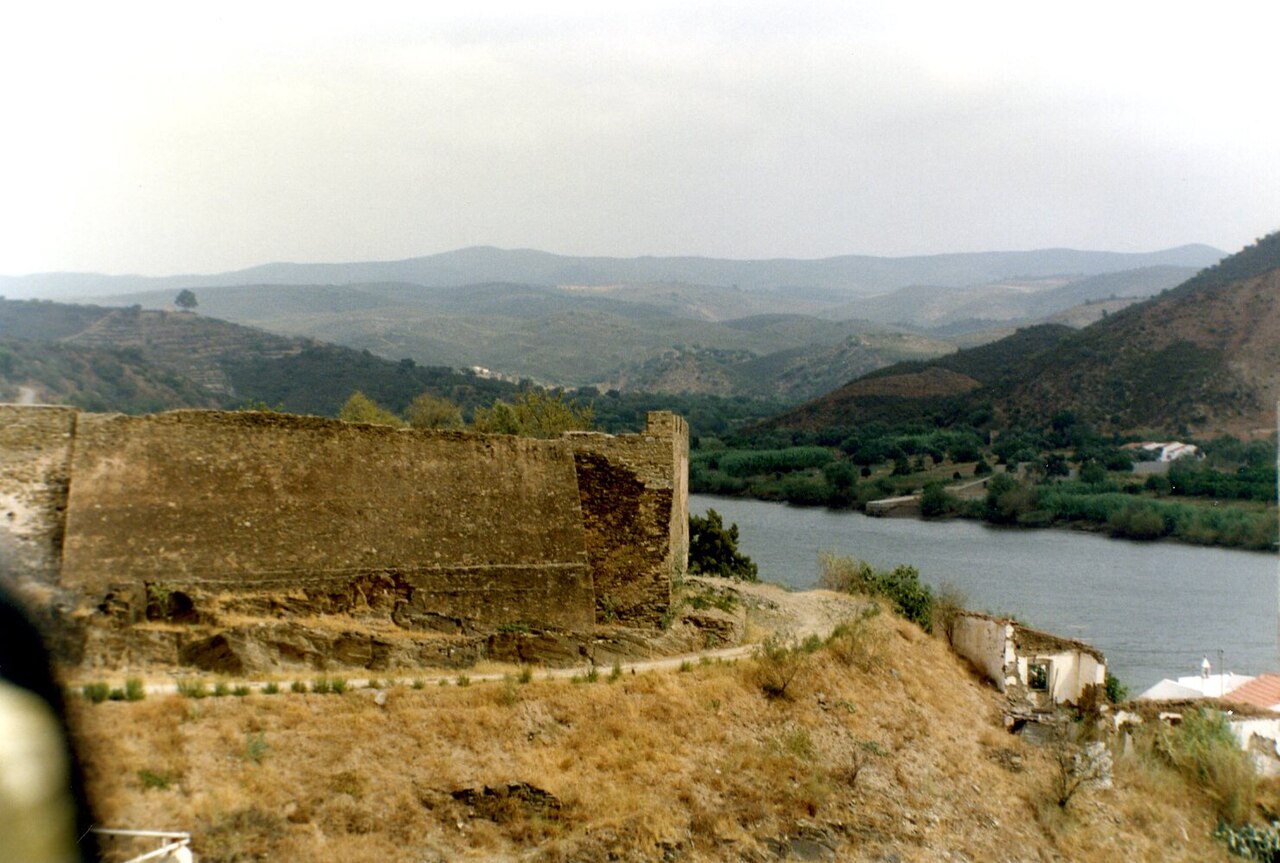
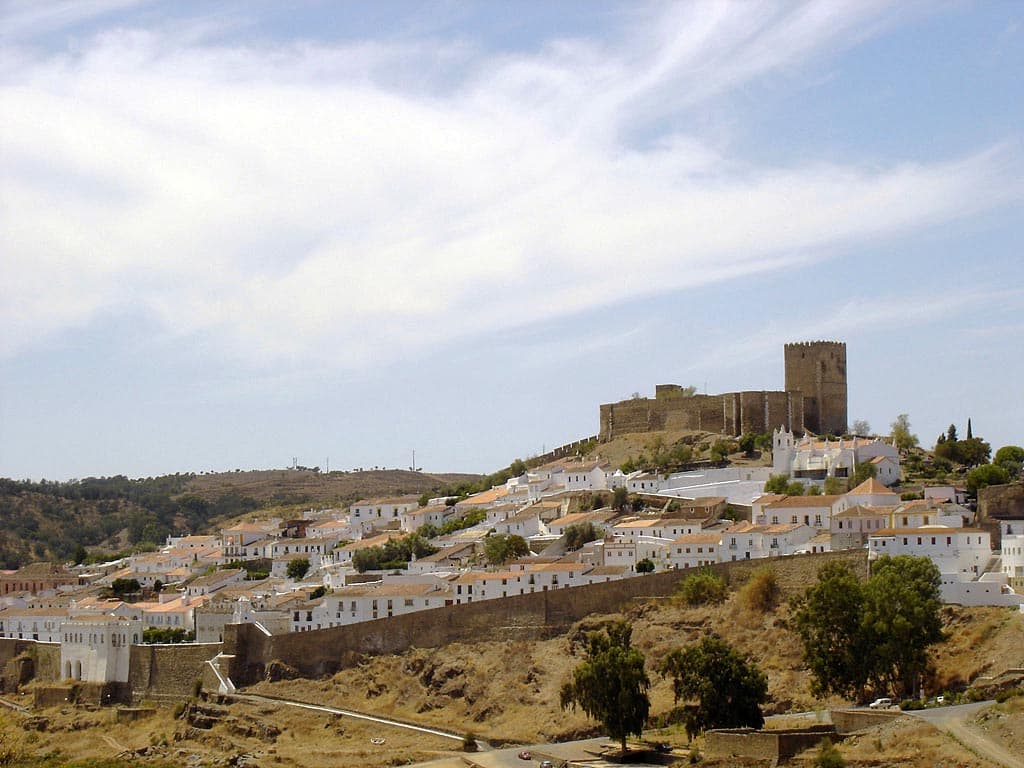
The Castle of Mertola stands prominently on a rocky hilltop in the town of Mertola, Portugal, commanding views over the confluence of the Guadiana River and the Ribeira de Oeiras. This hill castle is an exceptional example of layered architectural and historical evolution, reflecting centuries of occupation from the Phoenician era through Roman, Islamic, and Christian periods. Its strategic location made it a vital military and trading post throughout southern Iberia's turbulent history.
The fortress's irregular rectangular layout, enclosed by sturdy walls and punctuated by multiple towers, bears witness to the successive phases of construction and renovation. The nearby former Islamic mosque, now the Church of Nossa Senhora da Assuncao, further illustrates the cultural transformations that shaped the site. The castle's most dominant feature is its imposing rectangular keep tower, rising approximately 30 meters, with architectural details such as machicolations, prismatic merlons topped by pyramid-shaped decorations, and a cross-vaulted weapons hall inside.
Early settlement and roman influence
The origins of the Castle of Mertola trace back to a Phoenician settlement established around 318 B.C. during the era of Alexander the Great’s campaign against Tyre. Originally named Myrtilis or New Tyre, the settlement was strategically positioned to control river and land trade routes across southern Iberia. This early foundation set the stage for the site's enduring significance.
Under Roman rule, the town was renamed Myrtilis Julia by Julius Caesar in 44 B.C. and flourished as a regional center for mining and agriculture within the Baixo Alentejo region. The Romans fortified the settlement with extensive walls, parts of which survive integrated into the castle's current defenses. This period marked the beginning of the site's transformation into a formidable fortress.
Medieval transformations under islamic rule
Following the decline of Roman authority, the area was occupied by Germanic tribes such as the Swabians and Visigoths. The original fortifications suffered destruction during barbarian invasions but were later rebuilt under Umayyad Muslim rule. The town's name evolved to Martula during this period.
Ibn Qasi, ruler of the Taifa of Mértola from 1144 to 1151, initiated significant defensive enhancements to the castle. In the mid-12th century, a ribat—a fortified religious retreat—was constructed atop the south tower of the central keep, blending spiritual and military functions. The Almohad dynasty later undertook further repairs and expansions in the late 12th century, including the construction of enclosing walls and a distinctive semi-cylindrical tower. The fortress was notably strengthened by the order of Abu Háfece in 1171, underscoring its importance in regional defense.
Christian conquest and military order control
In 1238, the castle was captured by King Sancho II of Portugal, marking the end of centuries of Islamic control. Subsequently, from approximately 1240 to 1316, the castle served as the headquarters for the Military Order of Santiago. This period saw significant construction, including the erection of the prominent keep tower in 1292 under the command of João Fernandes, the order’s master.
The dungeons were rebuilt in the late 13th or early 14th century, incorporating elements of the older Carocha gate and tower. Additional fortifications were completed by 1373, enhancing the castle's defensive capabilities. After the Treaty of Monção in 1386, control reverted to the Portuguese Crown, which prompted further strengthening efforts in 1404.
Later modifications and decline
By the late 15th century, the residence of the castle’s alcalde (governor) was constructed next to the keep tower, resulting in the partial demolition of the northwest battlements. The castle continued to receive maintenance into the early 16th century, with documented repairs in 1513 including lime provision for restoration works. Despite these efforts, the fortress gradually lost its military importance.
Throughout the 17th and 18th centuries, the castle remained part of Portugal’s first line of defense along the Spanish border but was increasingly abandoned. By the mid-18th century, records from 1758 describe it as partially ruined and without a garrison. The local economy shifted focus to mining activities near Mértola, further diminishing the castle's strategic role.
Modern preservation and museum conversion
The castle was designated a Property of Public Interest in 1943. An earthquake in 1969 caused damage, prompting preservation efforts beginning in 1992 under the Portuguese Institute for Architectural Patrimony. These efforts have revitalized the site, which now functions as a museum showcasing archaeological collections spanning Roman, Visigothic, Christian, and Islamic periods. The museum highlights important works of Portuguese Islamic art, reflecting the castle's diverse cultural heritage.
Architectural features and layout
Fortress walls and towers
The castle's irregular rectangular enclosure is defined by fortified walls reinforced with multiple rectangular towers. The northern wall is extensive, while the southern boundary runs alongside the Guadiana River from the Carocha Tower at the southwest corner. The Carocha Tower itself is a cubic stone structure approximately 4.7 meters wide, accessible from the battlements and crowned by a terrace. Its interior features a hemispherical dome resting on pedestals, demonstrating advanced vault construction techniques.
The main eastern entrance is flanked by two smaller defensive towers: a prismatic tower on the left and a semi-circular tower on the right. Both remain no taller than the battlements, emphasizing their defensive role without dominating the skyline. The Traitors’ Gate on the northwest wall near the keep tower is protected by a barbican, a fortified gateway designed to enhance security.
The keep tower
The rectangular keep tower is the fortress's most prominent feature, oriented towards the north with an angular placement. Rising about 30 meters, it has a smooth base supporting two floors. Access is via a staircase attached to the southeast face. Architecturally, it is adorned with ornamental friezes on the northwest façade, machicolations, parapets, and prismatic merlons topped by pyramid-shaped decorations.
Inside, the first floor houses a weapons hall with a cross-vaulted ceiling, a hallmark of medieval military architecture. A stairway along the southern interior wall leads to the upper floor. Adjacent to the tower is a white marble relief bearing the coat-of-arms of António Rodrigues Bravo, a former high-ranking postal official of Mértola, symbolizing the castle’s continued significance into later historical periods.
Courtyard features and gates
Within the courtyard lies a covered cistern with a vaulted ceiling supported by three arches, essential for water storage during sieges or droughts. The old Misericórdia Gate still stands, historically providing access to the river and underscoring the importance of waterways for transportation and supply.
The castle's fortifications and architectural elements reflect a complex history of adaptation to evolving military technologies and political changes. The blending of Islamic and Christian architectural features, alongside remnants from the Roman and Visigothic periods, offers an invaluable insight into the cultural and strategic significance of the site.
Frequently asked questions (FAQ)
- How do I get to the Castle of Mertola?
- The Castle of Mertola is easily accessible by car or public transport. If you are driving, there is parking available near the castle. For those using public transport, regular bus services connect Mertola to major cities in Portugal.
- What is the historical significance of the Castle of Mertola?
- The Castle of Mertola dates back to the 12th century and was a strategic fortress during the Moorish period. It played a crucial role in the defense of the region and reflects the rich cultural heritage of the Algarve. Today, it stands as a testament to the historical interactions between different civilizations in Portugal.
- When was the Castle of Mertola built?
- Construction of the Castle of Mertola began in the 12th century, during the time of the Reconquista. Over the centuries, it has undergone various modifications and restorations, particularly under the influence of both Moorish and Christian architecture. Its structure showcases this blend of historical styles.
- Can I take guided tours of the Castle of Mertola?
- Yes, guided tours are available for visitors interested in learning more about the castle's history and architecture. These tours typically provide in-depth information and insights that enhance the overall experience. Check the castle's official website for schedule details and booking options.
- Why is the Castle of Mertola a popular tourist attraction?
- The Castle of Mertola is popular for its stunning views of the surrounding landscape and its well-preserved historical architecture. It offers visitors a glimpse into Portugal's rich past while providing beautiful photo opportunities. Moreover, its location in the charming town of Mertola adds to its appeal.
- Is it possible to visit the Castle of Mertola year-round?
- Yes, the Castle of Mertola is open to visitors year-round, although specific opening hours may vary by season. It's advisable to check the official website for current hours and any potential seasonal closures. This allows visitors to plan their trips accordingly and enjoy the castle at their convenience.
- What are the ticket prices for the Castle of Mertola?
- Ticket prices for the Castle of Mertola are generally affordable, with discounts available for students and seniors. Children under a certain age may enter for free. For the most accurate and up-to-date pricing, it’s recommended to visit the castle's official website before your visit.
- What is the best time to visit the Castle of Mertola?
- The best time to visit the Castle of Mertola is during the spring and fall when the weather is mild and pleasant. These seasons also tend to attract fewer tourists, allowing for a more relaxed exploration. Summer can be quite hot, making early morning or late afternoon visits preferable.
- Are there any nearby attractions to the Castle of Mertola?
- Yes, the Castle of Mertola is surrounded by several attractions, including the picturesque town of Mertola itself, with its charming streets and local shops. Additionally, visitors can explore the nearby Mertola Museum and the scenic Guadiana River, which offers opportunities for hiking and boat tours.
Photo gallery

Information
Website
Visit websiteSources & official resources
Verify the information above using these authoritative references.
Loading map...
Visitor reviews
No reviews yet. Been here? Write the first review and help other travelers!
Write the first reviewVisited this castle? Share your experience
Your review helps other travelers and adds first-hand knowledge to our encyclopedia.