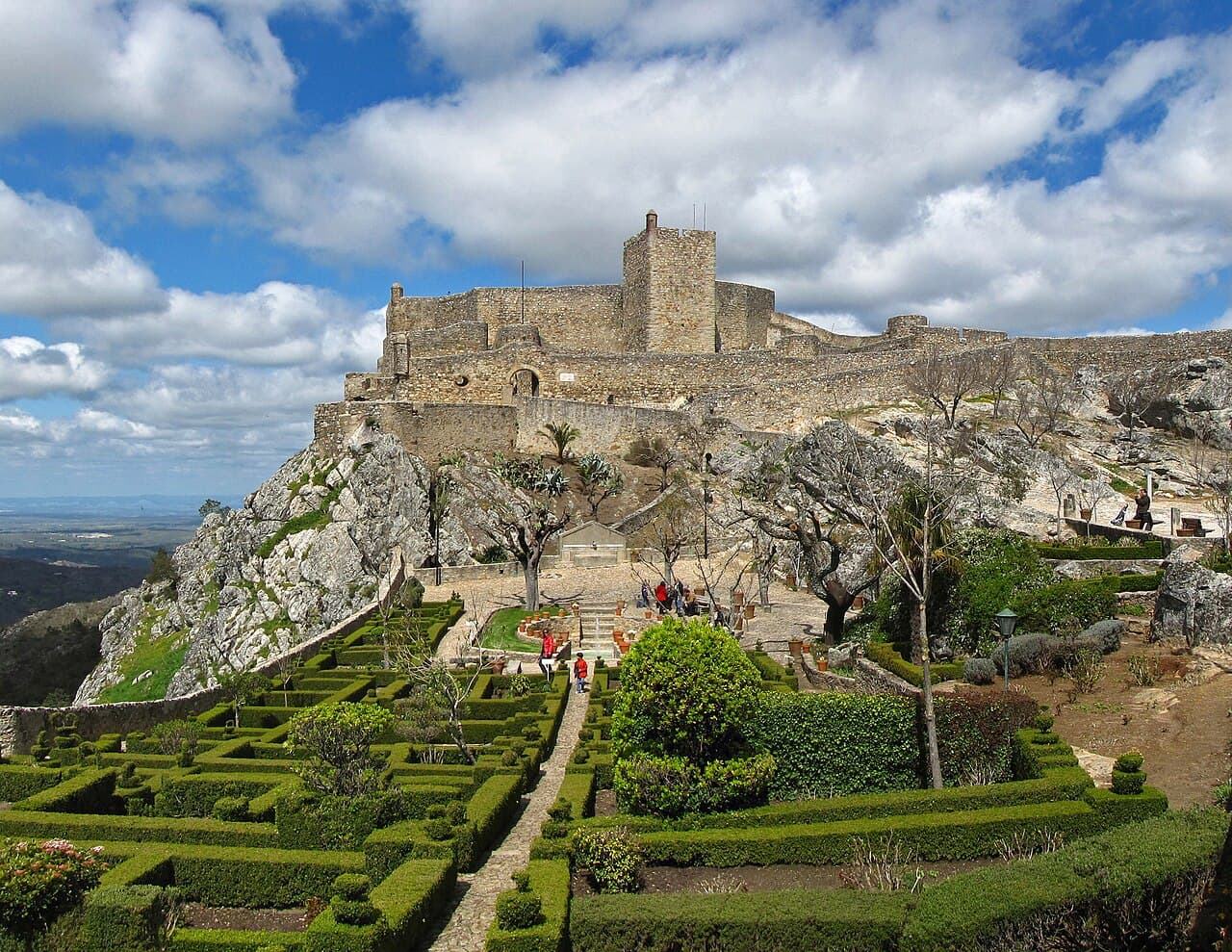
Castle of Marvao
The Castle of Marvão is a striking example of medieval military architecture perched atop a quartzite hill in the Portalegre district of Portugal. Its origins trace back to the 8th century, credited to the Islamic commander Ibn Marwan, who established the fortress as a strategic stronghold during the early Middle Ages. Over the centuries, the castle witnessed a complex history of conquest, defense, and restoration, reflecting the turbulent dynamics between Islamic and Christian forces in the Iberian Peninsula.
Constructed on a site originally fortified by the Romans, the castle occupies a commanding position overlooking key routes and the Sever River, underscoring its military significance. The Roman fortification laid the foundation for later expansions and adaptations by successive rulers. The settlement, initially known as Amaya de Ibn Marwan in the 10th century, became a vital Islamic outpost before falling under Christian control in the mid-12th century, during the reign of King Afonso I.
Early history and islamic origins
The castle's foundation is attributed to Ibn Marwan, a Swabian Islamic knight who settled in the region around 876–877 AD. His establishment of the fortress marked a significant phase in the area's defense against Christian reconquest efforts. The castle's early role was to secure the territory and oversee vital communication and trade routes.
By the 10th century, the fortress and surrounding settlement were known as Amaia de Ibn Maruan, highlighting Ibn Marwan's influence. The castle's position on a high hill provided natural defensive advantages, which were enhanced by early fortifications.
Medieval christian conquest and fortification
Between 1160 and 1166, Christian forces loyal to King Afonso I captured the castle from Moorish control, marking a turning point in the region's history. Although briefly retaken by the Almohads in the 1190s, the castle was soon reclaimed by the Portuguese Christians. The 1214 Treaty of Castelo Branco formally incorporated Marvão into Portuguese territory.
In 1226, King Sancho II issued a charter to encourage settlement and bolster defenses against Castilian incursions. Later, in 1271, the castle was granted to the Knights of the Order of Malta, who managed several fortresses in the region. However, by 1299, royal forces expelled the knights, and King Denis I assumed direct control, issuing a new charter and expanding the castle's fortifications.
Architectural features from the crusader era
The castle's structure prominently features elements typical of crusader-era fortifications. A tall central keep with a raised entrance on the first floor served as the last line of defense and residence for the lord. Surrounding this keep are multiple lower towers, some semicircular, designed to provide overlapping fields of fire.
Defensive features include high-placed arrow slits for archers, bent entrances to slow attackers, and machicolated parapets for dropping projectiles on assailants. The castle's walls are battlemented with sloped parapets, enhancing protection while allowing defenders to repel sieges effectively.
Later medieval and early modern military significance
Throughout the late medieval period, the castle remained strategically important. During the reign of King Ferdinand I, the local church was declared a sanctuary in 1378, reflecting the castle's role as a community center as well as a military fortress. Control passed to the Order of Aviz during the 1383–1385 Portuguese interregnum, who further reinforced the castle and promoted settlement through royal privileges.
From the 17th to 19th centuries, the castle played a key role in several conflicts. It was extensively repaired and upgraded during the Portuguese Restoration War (1640–1662), successfully resisting Spanish sieges in 1641 and 1648. Despite brief Spanish occupation in the early 18th century, Portuguese forces recaptured it, maintaining control through subsequent attacks.
During the Peninsular Wars, the castle was occupied by French and Spanish forces but was retaken by Portuguese troops in 1808. In 1833, it endured a year-long siege by Spanish republican forces, marking the last significant military action at the fortress.
Architectural layout and defensive design
The castle crowns a hill 867 meters above sea level, commanding extensive views of the surrounding landscape. It consists of two walled courtyards arranged in a typical medieval fortress layout. The main courtyard to the northwest is enclosed by a ring wall featuring two towers and a large cistern carved into the rock, essential for collecting rainwater during sieges.
The water system includes a reservoir above the vaulted cistern, channeling water inside through three openings. The southern corner houses a rectangular tower with vaulted ceilings and a spacious hall, containing the main gate characterized by rounded arches and drum-shaped battlements above a concave window sill.
The southeastern courtyard contains buildings that historically served as a kitchen, barracks, forge, and armory, along with a second cistern. Many structures date from the late 13th century, showcasing typical crusader-era features such as the elevated keep entrance and multiple defensive towers.
Defensive elements are sophisticated, including several bent entrances designed to slow attackers, narrow killing zones near triple gates, large battlemented walls, and machicolated parapets. All towers feature battlemented walls and sloped parapets, enhancing their defensive capabilities.
Within the first courtyard, three single-story buildings with gun ports and tiled roofs served as bunkers and armories. The castle's internal corridors are narrow and twisting, creating complex pathways to hinder enemy movement if outer defenses were breached. A garden in front of the fortress adds to the site's character and charm.
Preservation and modern management
The Castle of Marvão is remarkably well preserved, retaining much of its original medieval military architecture. Restoration efforts began in 1938, focusing on walls, towers, battlements, and interiors. These efforts continued through the mid-20th century, with further work in the 1990s and early 2000s, including rebuilding the southern barbican and upgrading lighting and infrastructure.
Since 2013, the castle has been managed by the Cultural Center of Marvão, which oversees its preservation and promotes its cultural heritage. The castle remains a prominent tourist attraction, celebrated for its blend of natural terrain and carefully designed fortifications, offering visitors a vivid glimpse into Portugal's defensive history.
Frequently asked questions (FAQ)
- How do I get to the Castle of Marvao?
- The Castle of Marvao is located in Santa Maria de Marvao, Portugal, and can be accessed by car or public transport. The nearest major city is Portalegre, from where you can take a bus or drive to the castle. Parking is available near the entrance, but it's advisable to arrive early during peak tourist seasons.
- What is the historical significance of the Castle of Marvao?
- The Castle of Marvao, built in the 13th century, is a remarkable example of medieval military architecture and played a crucial role in the defense against invasions. It has witnessed several historical events, particularly during the Reconquista and the Portuguese Restoration War. Today, it stands as a symbol of the region's rich history and cultural heritage.
- When was the Castle of Marvao built?
- Construction of the Castle of Marvao began in the late 13th century, specifically around 1280, under the rule of King Afonso III of Portugal. Over the centuries, it has undergone various renovations and restorations to preserve its structure and historical significance. The castle's robust walls and towers showcase the architectural styles of different periods.
- Can I visit the Castle of Marvao with a disability?
- Yes, the Castle of Marvao is accessible to visitors with disabilities, although some areas may present challenges due to the castle's historical structure and uneven terrain. The main pathways are paved, and there are designated viewing points that provide beautiful scenery. It is advisable to check in advance for any specific accessibility features and assistance.
- Why is the Castle of Marvao a popular tourist attraction?
- The Castle of Marvao is popular due to its stunning panoramic views over the surrounding landscape and its well-preserved medieval architecture. Visitors are drawn to its historical significance and the opportunity to explore the charming village that surrounds the castle. It offers a unique insight into Portugal's past and is a favorite spot for photography and sightseeing.
- Is it possible to take guided tours of the Castle of Marvao?
- Yes, guided tours of the Castle of Marvao are available and provide an in-depth look at its history and architecture. Knowledgeable guides offer fascinating stories and insights about the castle's past and significance in Portuguese history. Tours are usually conducted in English and Portuguese, and it's recommended to book in advance during peak seasons.
- What are the opening hours of the Castle of Marvao?
- The Castle of Marvao is typically open to visitors daily, with opening hours varying by season. Generally, it opens at 9 AM and closes at 7 PM during the summer months, while winter hours may be reduced. It's best to check the official website or local tourist information for the most current hours before your visit.
- What are the ticket prices for visiting the Castle of Marvao?
- Ticket prices for the Castle of Marvao are quite reasonable, with discounts available for seniors and children. As of the latest updates, general admission is around €2, while reduced tickets are available for €1. Entry is often free on certain national holidays, making it an accessible attraction for all.
- What are some nearby attractions to the Castle of Marvao?
- Nearby attractions include the picturesque village of Marvao, which features traditional whitewashed houses and local shops, as well as the Natural Park of Serra de São Mamede for nature enthusiasts. The historic town of Portalegre, known for its museums and beautiful churches, is also just a short drive away. Exploring these areas can enhance your visit to the Castle of Marvao.
Photo gallery

Information
Website
Visit websiteSources & official resources
Verify the information above using these authoritative references.
Loading map...
Visitor reviews
No reviews yet. Been here? Write the first review and help other travelers!
Write the first reviewVisited this castle? Share your experience
Your review helps other travelers and adds first-hand knowledge to our encyclopedia.



