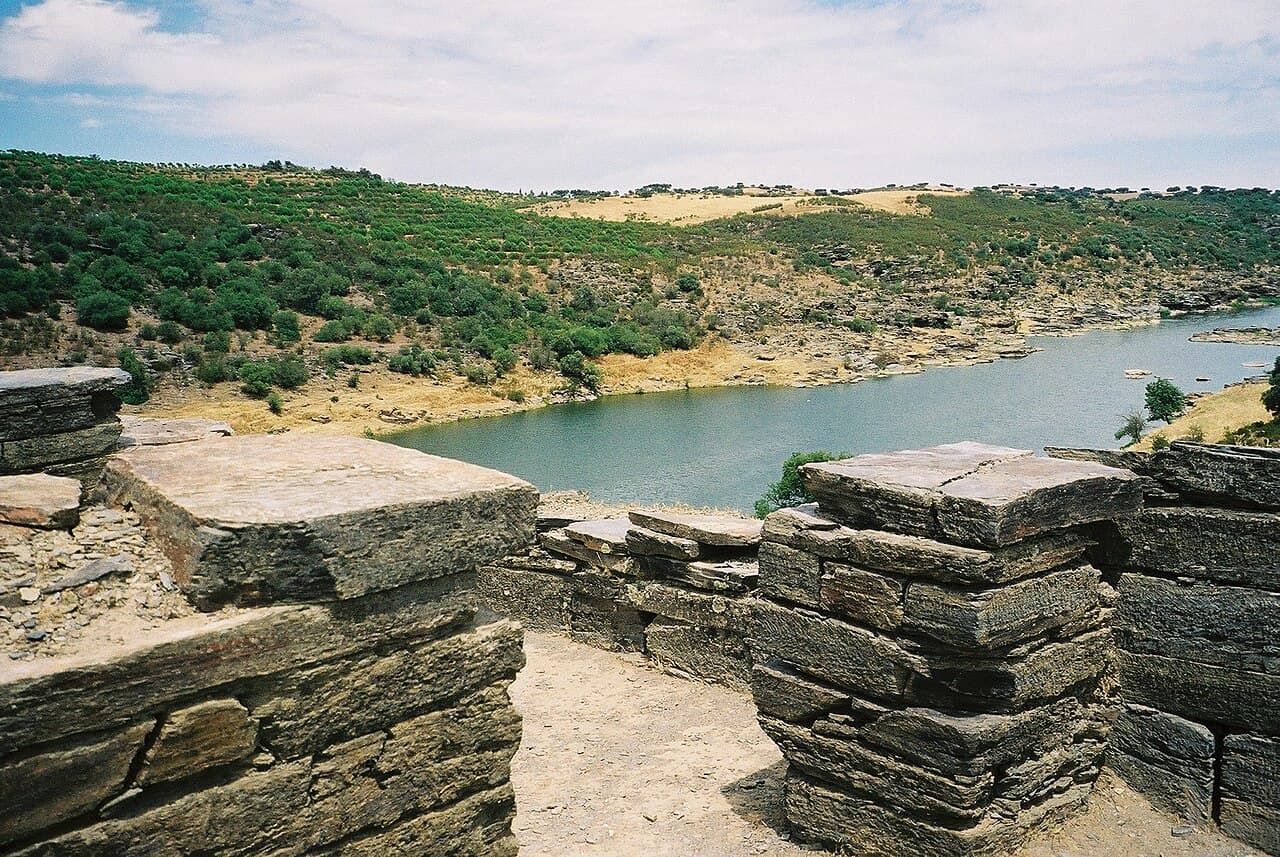
The Castle of Lousã is a significant medieval fortress located in the municipality of Lousã, Portugal. This hill castle was constructed during the turbulent period of the Reconquista, when Christian kingdoms sought to reclaim Iberian territories from Muslim rule. Its origins trace back to the 10th century, with the earliest documented mention of a fortification at the site occurring in 943 under the name Arauz. The castle's strategic position atop a hill provided commanding views over the surrounding landscape, essential for defense and regional control.
The castle’s primary construction or major rebuilding phase is attributed to the latter half of the 11th century, likely under the direction of Count Sesnando Davides, who governed Coimbra after its conquest from the Moors in 1064 by King Ferdinand I of León and Castile. This period marked a phase of consolidation for Christian forces, and the castle served as a key military stronghold securing the frontier. In 1124, the fortress briefly fell back into Moorish hands but was soon reclaimed and restored by Teresa of León, mother of Portugal’s first king, reinforcing its importance in the region's defense.
Historical significance and political role
Following Portugal’s declaration of independence, the Castle of Lousã became a vital part of the defensive line along the Mondego River. This frontier shifted southwards after King Afonso I captured Santarém and Lisbon in 1147, moving the border to the Tagus River. During this era, the castle was notable not only for its military function but also as a residence; Queen Mafalda of Savoy, wife of King Afonso I, used it as a summer retreat with her court, highlighting its dual role in defense and royal habitation.
The castle is referenced in the 1136 charter for Miranda do Corvo and was granted its own charter in 1151, reflecting its growing administrative importance. By 1160, the differentiation between the villages of Lousã and Arouce indicated the region's increasing stability and development. The settlement of Lousã was further elevated in status with a new charter issued by King Afonso II in 1207. The addition of the imposing keep tower in the 14th century enhanced the castle’s defensive capabilities, adapting to evolving military needs.
Architectural features and construction details
The Castle of Lousã occupies a small, irregular hexagonal footprint, combining elements of Romanesque and Gothic architectural styles. Its robust walls are constructed from locally quarried schist stone, assembled with precise masonry techniques to withstand sieges. The curtain walls are reinforced by three cubelos (towers): a larger one to the southwest and two smaller ones on the western side, providing enhanced defensive coverage and vantage points.
The main entrance, located on the southeastern side, is fortified by two semi-circular towers forming a formidable gateway. This entrance would have been heavily guarded to control access. Beyond the gate lies the place-of-arms, an open courtyard approximately 130 square meters in size, serving as a gathering place for troops and a central area within the fortress.
Encircling the top of the walls is a chemin de ronde, a narrow patrol path for guards, protected by chamfered merlons. These stone projections with beveled edges provided cover for defenders firing arrows or other projectiles at attackers. The castle’s defensive design reflects medieval military architecture principles aimed at maximizing visibility and protection.
The keep tower, added in the 14th century, stands attached to the northern wall. It features a square plan and crenellated battlements consistent with the curtain walls. A pointed arch doorway connects the keep to the wall-walk, facilitating movement for defenders. The tower includes several arrow slits and multiple doors on different facades, likely designed to optimize defense and internal access.
Later history and preservation efforts
In the early 16th century, under King Manuel I, the castle received formal recognition with a new charter issued in 1513. The lordship of the castle was held by the Dukes of Aveiro until 1759, when ownership reverted to the Crown. Over subsequent centuries, the fortress experienced gradual deterioration due to natural decay and vandalism, partly fueled by local legends of hidden treasures. This damage was particularly severe to the keep tower.
Public preservation efforts began in 1925, initiating a series of restoration campaigns throughout the 20th century. Notable conservation work occurred in 1950, 1956, 1964, 1971, and 1985, which stabilized the structure and prevented further ruin. Since 1957, the municipality of Lousã has managed the site, underscoring its cultural and historical significance to the local community.
Environmental context and visitor experience
The castle is set within a forested landscape that closely resembles the natural environment at the time of its construction. This setting enhances the visitor experience, providing a sense of the medieval landscape and strategic positioning. The well-preserved walls, towers, and courtyard allow visitors to explore the castle’s military architecture and appreciate its role in the region’s history.
Visitors can observe the interplay between Romanesque and Gothic architectural elements, including the fortified gateway, battlements, and the keep tower. The site offers insights into medieval defensive strategies, noble residences, and the shifting political landscape of Portugal during the Middle Ages.
Frequently asked questions (FAQ)
- How do I get to the Castle of Lousã?
- The Castle of Lousã is easily accessible by car, with parking available nearby. Public transport options include local buses that connect to Lousã from larger cities such as Coimbra.
- What is the historical significance of the Castle of Lousã?
- The Castle of Lousã dates back to the 12th century and played a crucial role in the defense against Moorish invasions. It is an important symbol of the region's medieval heritage and showcases the historical evolution of Portuguese architecture.
- When was the Castle of Lousã built?
- The construction of the Castle of Lousã began in the late 12th century, specifically around 1170. It was completed shortly after, serving as a fortress and residence for local nobility.
- Can I visit the Castle of Lousã during the winter months?
- Yes, the Castle of Lousã is open to visitors year-round, including the winter months. However, it is advisable to check specific opening hours as they may vary during the off-peak season.
- Why is the architecture of the Castle of Lousã unique?
- The architecture of the Castle of Lousã features a blend of Romanesque and Gothic styles, reflecting the influences of different periods in Portuguese history. Its strategic location on a hilltop also enhances its defensive design, making it a fascinating study for architecture enthusiasts.
- Is it possible to take guided tours of the Castle of Lousã?
- Yes, guided tours are available at the Castle of Lousã, providing visitors with detailed insights into its history and architecture. These tours are typically conducted in Portuguese, but multilingual guides may be available upon request.
- What are the ticket prices for the Castle of Lousã?
- Tickets for the Castle of Lousã are reasonably priced, with discounts available for students and seniors. Children under a certain age may enter for free, making it an affordable option for families.
- What are the opening hours of the Castle of Lousã?
- The Castle of Lousã is generally open from 9 AM to 7 PM during the summer months and from 9 AM to 5 PM in the winter. It's advisable to check the official website for any seasonal changes or special closure days.
- What nearby attractions can I visit while in Lousã?
- While visiting the Castle of Lousã, you can also explore the charming village of Lousã, known for its picturesque streets and traditional architecture. Additionally, the nearby Serra da Lousã offers beautiful hiking trails and natural scenery.
Photo gallery

Information
Website
Visit websiteSources & official resources
Verify the information above using these authoritative references.
Loading map...
Visitor reviews
No reviews yet. Been here? Write the first review and help other travelers!
Write the first reviewVisited this castle? Share your experience
Your review helps other travelers and adds first-hand knowledge to our encyclopedia.



