Castle of Hasznos
The Castle of Hasznos stands as a significant medieval fortress located in the municipality of Pásztó within present-day Hungary. Constructed in the early 14th century, this hill castle was strategically positioned to protect the vital Kövecses-patak valley, a key passage through the Mátra Mountains. Its origins trace back to between 1300 and 1320, when it was built under the auspices of Domokos of the Rátót family, a powerful noble lineage whose members held important offices such as the palatine (nádor), one of the highest-ranking officials in the Kingdom of Hungary.
The castle first appears in historical records in 1304, with a notable mention in 1329 referring to the "Castellanus de Hasnos," indicating the fortress's role as a military stronghold governed by a castellan. Alongside the nearby castles of Ágasvár and Óvár, Hasznos formed part of a defensive network securing the Mátra Mountains and controlling access through the valley. This network was crucial for regional defense during a period marked by feudal conflicts and external threats.
Historical significance and ownership
Originally, the fortress was under the control of the Hasznosi family, who derived their name from the site itself. They also held dominion over the adjacent settlements of Tarnak and Pásztó. The Hasznosi lineage became extinct by the time of the Battle of Mohács in 1526, a pivotal event that led to the fragmentation of many noble estates. Subsequently, the castle's ownership passed through female descendants and partly reverted to the royal treasury, reflecting the complex inheritance practices of medieval Hungary.
Throughout its history, the castle attracted visits from prominent figures such as Vencel and King Charles Robert, who sought alliances with the Rátót family, underscoring the fortress's political and military importance in the early 14th century. By the mid-15th century, the Pásztói family had taken possession of the castle and maintained its defensive and administrative functions alongside the local village.
The castle during the ottoman era
The mid-16th century brought significant upheaval as the Ottoman Empire expanded into Hungarian territories. In 1552, during the Ottoman campaign targeting the nearby Eger Castle, the village of Hasznos paid tribute to Eger, signaling its submission to Ottoman influence. That same year, Ottoman forces led by Ali Pasha occupied the fortress without resistance, suggesting either a strategic withdrawal by defenders or insufficient military readiness.
During the subsequent Ottoman occupation, the castle's fortifications were deliberately dismantled to reduce its military threat. Despite this, the fortress remained structurally intact enough to be reinforced again after Christian forces recaptured the area. Unlike many other castles in the region that fell into ruin earlier, Hasznos retained its defensive structures well into the 15th century and beyond.
Architectural features and layout
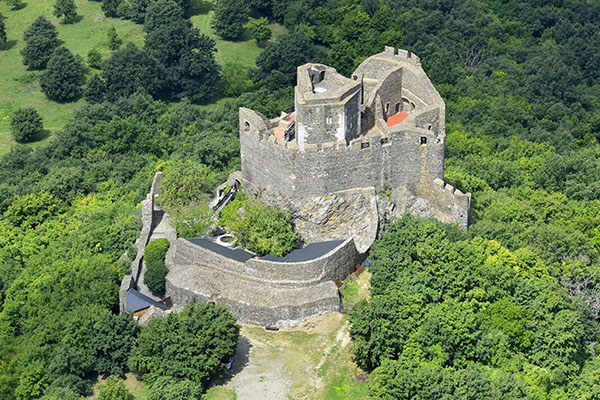
The Castle of Hasznos was modest in scale, occupying approximately three hectares atop a rocky hill rising 383 meters above the nearby Hasznosi reservoir. The fortress was divided into two main sections: a lower castle and an upper castle, separated by a dry moat, a defensive trench designed to impede attackers without the use of water. This feature enhanced the castle's defensive capabilities by creating an additional barrier within the complex.
Architectural remains include portions of the former palace building and the foundational elements of a square tower, which served as a lookout and stronghold within the castle. The construction predominantly utilized local stone, meticulously shaped and assembled to form robust defensive walls and internal structures. The rocky terrain provided a natural foundation, contributing to the fortress's durability over centuries.
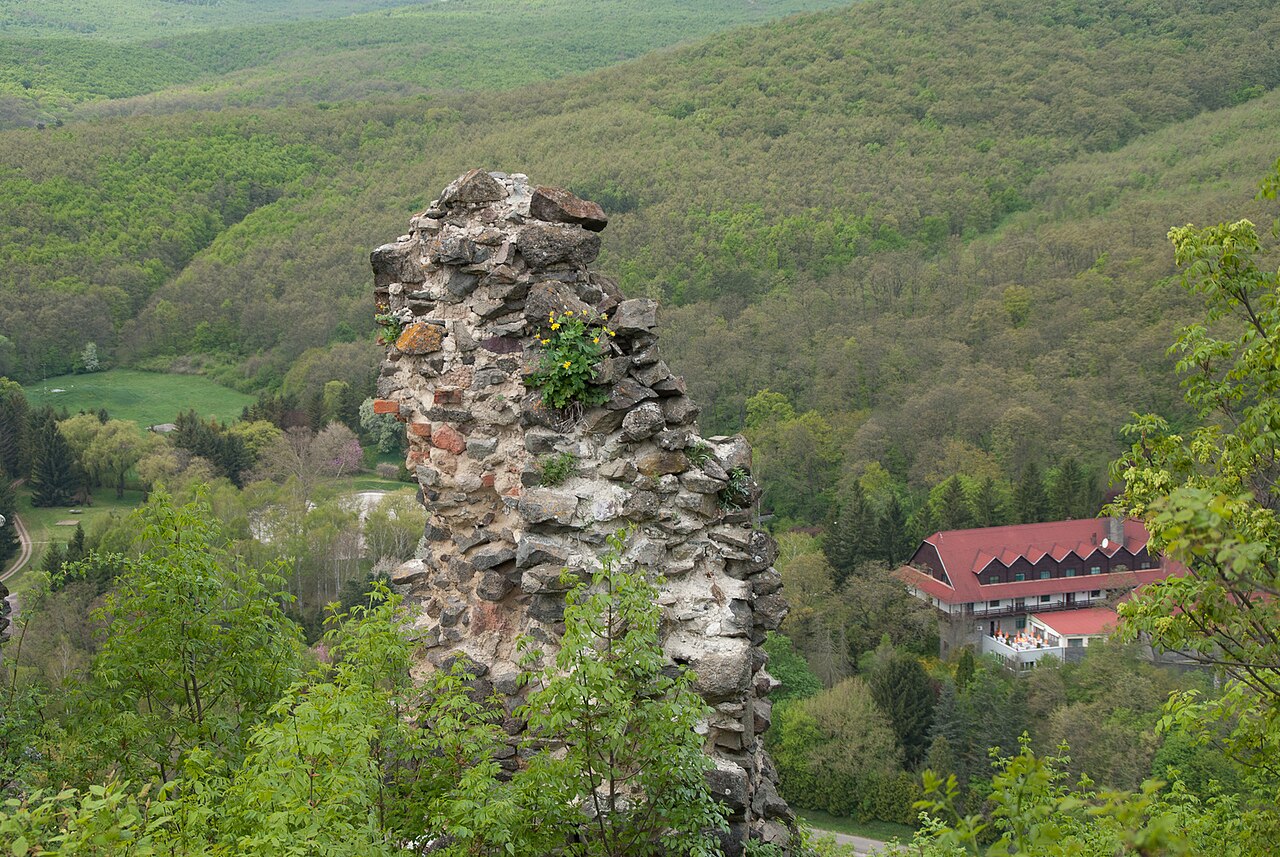
Today, the ruins are partially concealed by dense vegetation that thrives on the warm, sheltered slopes of the hill. Only two taller fragments of the original walls rise clearly above the tree line, marking the fortress's location. The eastern side of the hill features a distinctive layer of diatomaceous earth, a sediment rich in fossilized remains of microscopic algae, which has preserved a variety of paleontological specimens.
Paleontological significance
The diatomaceous earth deposits near the castle have yielded fossils of turtles, deer, and several small mammals such as shrews and dormice. Notably, a new prehistoric hamster species was identified here, named Democricetodon hasznosensis in honor of the site. This discovery highlights the area's importance not only for medieval history but also for paleontology and natural history.
Later history and preservation
Following the Ottoman period, the castle changed hands multiple times. After 1720, the lands were owned by prominent families such as the Koháry, Fáy, and Szalay. Post-1848, ownership passed to the Almássy, Platthy, Zay, Orczy, and Gosztonyi families. Despite these changes, the fortress gradually fell into ruin during the 18th century, accelerated by local inhabitants repurposing its stones for construction.
Today, the Castle of Hasznos ruins offer valuable insights into medieval Hungarian defensive architecture and regional history. The site’s rocky hilltop location and partial preservation provide a tangible connection to the past, even as natural overgrowth conceals much of the original structure. The remaining walls and foundations allow visitors and scholars to appreciate the castle's historical role and architectural characteristics.
Visiting the castle ruins
The ruins are accessible to visitors interested in medieval history, architecture, and natural heritage. The site’s setting within the Mátra Mountains offers scenic views and a glimpse into Hungary’s feudal past. While the fortress is not fully restored, the visible remains and surrounding landscape create an evocative atmosphere for exploration and study.
Frequently asked questions (FAQ)
- When was the castle of Hasznos built and by whom?
- The castle of Hasznos was constructed between 1300 and 1320 by members of the Rátót family, a powerful noble clan in medieval Hungary.
- What is the historical significance of the castle of Hasznos?
- The castle played a key military role guarding the Kövecses-patak valley in the Mátra Mountains and was involved in regional defense during the 14th to 16th centuries.
- Can visitors explore the ruins of the castle of Hasznos today?
- Yes, visitors can explore the ruins situated on a rocky hill in the Mátra Mountains, though only partial walls and foundations remain visible.
- How did the Ottoman occupation affect the castle of Hasznos?
- During the Ottoman occupation, the castle was occupied without resistance in 1552, and its walls were deliberately dismantled to reduce its military threat.
- What notable architectural features remain at the castle site?
- Remnants include parts of the palace building, foundations of a square tower, defensive walls, and a dry moat separating the upper and lower castle sections.
Information
Loading map...
Visitor reviews
No reviews yet. Been here? Write the first review and help other travelers!
Write the first reviewVisited this castle? Share your experience
Your review helps other travelers and adds first-hand knowledge to our encyclopedia.