Buják Castle
Buják Castle stands as a significant medieval fortress located near the village of Buják in Hungary. Constructed originally in the 13th century during the reign of the Kingdom of Hungary, the castle served as a royal stronghold designed to secure the northern frontier of the kingdom. Its strategic position atop a hill rising between 283 and 310 meters above sea level allowed for commanding views over the surrounding forested mountains, providing both military advantage and regional control.
Early construction and medieval significance
The earliest surviving part of the castle is a tower dating from 1303, marking the initial phase of its fortification. In the early 14th century, Buják Castle played a notable role in the turbulent period of Hungarian history marked by the rebellion of Máté Csák against King Charles Robert of Hungary. During the 1315 siege, royal forces successfully relieved the fortress, preventing its capture and underscoring its strategic importance.
By 1386, the castle came under the control of the influential Garai family, a powerful noble house in Hungary. However, by 1394, ownership reverted to the crown under King Sigismund, who initiated significant expansions of the fortress in 1393. The castle's importance continued into the early 15th century when it was granted to Queen Barbara in 1424, alongside the nearby Szanda Castle.
Ownership changes and military engagements
Following the death of King Sigismund in 1439, Buják Castle passed through several hands, including King Albert and the noble István Báthory. The fortress endured a Hussite siege in the 1440s, successfully resisting capture, which highlighted its robust defensive capabilities.
In the 16th century, as the Ottoman Empire expanded into Central Europe, the castle's defensive role intensified. András Báthory undertook extensive fortification efforts around 1551, adapting the fortress to withstand artillery and infantry assaults characteristic of the period. Despite these improvements, Ottoman forces captured Buják Castle in 1552, maintaining a small garrison during the mid-1550s.
During the Fifteen Years’ War, control of the castle oscillated, returning to the Báthory family in 1593. It was briefly occupied by forces aligned with Bocskai in 1605 but restored to royal possession the following year. Later owners included the Várady family and Captain Tamás Bosnyák. The Ottomans recaptured the castle briefly in 1663, but Hungarian troops led by Captain Imre Balassa regained it the same year. Around 1666, the castle was likely destroyed by an explosion, ending its military significance and initiating its decline into ruin.
Architectural features and fortifications
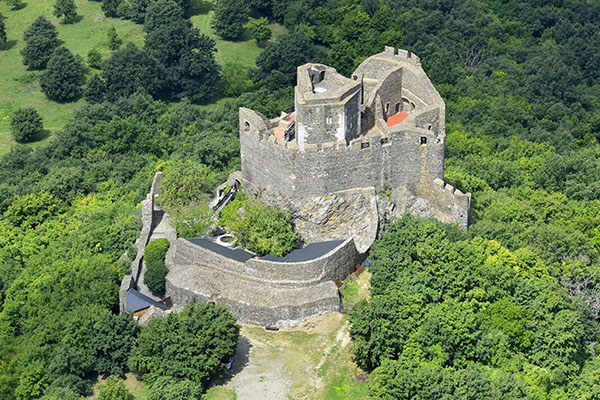
Buják Castle exemplifies the design of a hill castle with a central stronghold positioned at the summit, surrounded by an outer courtyard or bailey. The entire complex was enclosed by a ring wall, providing layered defense. The primary entrance was situated at the lower part of the site, leading through a fortified gate into a zwinger, a narrow enclosed defensive courtyard designed to trap and expose attackers.
In the 16th century, under András Báthory’s direction, significant enhancements were made to the castle’s defenses. These included the construction of a fortified outer gate, expansion of the zwinger area, and the addition of a large circular bastion known as a rondel on the northern side. This bastion was designed to provide improved fields of fire against artillery and infantry, reflecting contemporary military architectural trends responding to the Ottoman threat.
Within the ruins, remnants of walls from a former Turkish mosque remain, a testament to the castle’s period under Ottoman control when it was adapted for religious as well as military use. This unique feature highlights the layered cultural and historical influences that shaped the site.
Current condition and preservation challenges
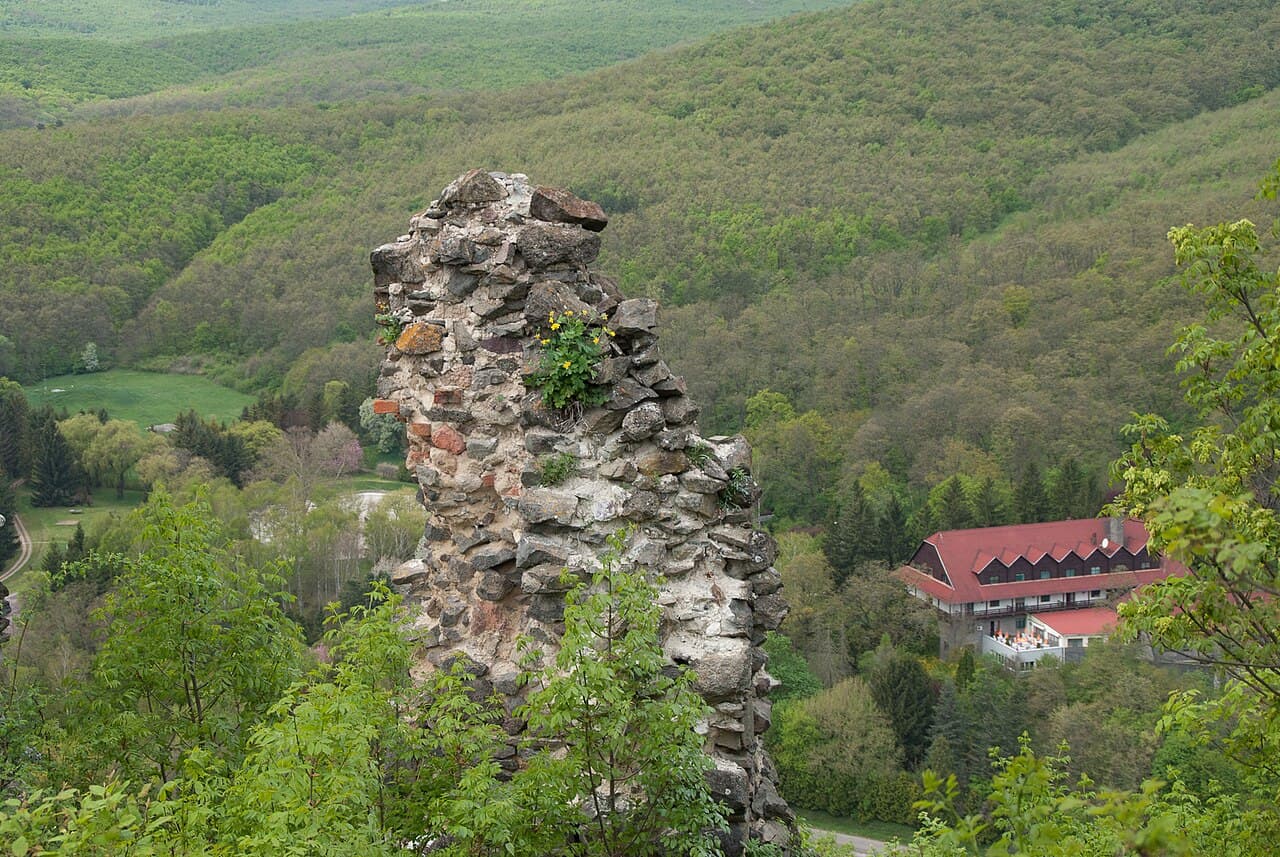
Today, Buják Castle exists as heavily weathered ruins, with large portions of its walls showing significant deterioration and risk of collapse. The site includes a small, decaying brick building just outside the castle walls, while internally, visitors encounter unstable stone structures, deep drops, and scattered debris. Access to the summit is via a narrow, poorly preserved staircase that once connected the fortress levels.
The castle’s location about one kilometer northwest of Buják village places it within the Novohrad–Nógrád UNESCO Global Geopark, emphasizing its cultural and natural heritage significance. Despite its ruinous state, the castle remains an evocative monument to the region’s medieval and early modern military history, reflecting the complex political and military struggles that shaped Hungary’s borderlands.
Historical context and regional importance
Buják Castle’s history is intertwined with the broader geopolitical dynamics of Central Europe, particularly the conflicts between the Kingdom of Hungary and the Ottoman Empire. Its repeated sieges, changes in ownership, and architectural adaptations illustrate the castle’s role as a frontline fortress during periods of warfare and political upheaval.
The castle’s association with notable historical figures such as Máté Csák, King Sigismund, and the Báthory family underscores its importance in Hungarian noble and royal history. Its military resilience during sieges and its eventual destruction around 1666 mark the transition from medieval fortress warfare to the changing military technologies and political realities of the early modern period.
Frequently asked questions (FAQ)
- When was Buják Castle originally constructed?
- Buják Castle was originally constructed in the 13th century as a royal stronghold by the Kingdom of Hungary to secure the region.
- What role did Buják Castle play during the 14th century?
- In the early 14th century, Buják Castle was involved in the rebellion led by Máté Csák and was relieved from siege by royal forces in 1315, highlighting its strategic importance.
- How did the castle's defenses change in the 16th century?
- In the 16th century, András Báthory enhanced the castle's defenses by adding a fortified outer gate, expanding the zwinger, and constructing a large rondel bastion to resist Ottoman attacks.
- Can visitors access the castle ruins today?
- Yes, visitors can access the ruins of Buják Castle, but should exercise caution due to unstable stone structures, deep drops, and a poorly preserved staircase.
- What remains of the Ottoman presence at Buják Castle?
- Remnants of walls from a former Turkish mosque remain within the castle ruins, reflecting its period under Ottoman control and adaptation for religious use.
Photo gallery

Information
Website
Visit websiteSources & official resources
Verify the information above using these authoritative references.
Loading map...
Visitor reviews
No reviews yet. Been here? Write the first review and help other travelers!
Write the first reviewVisited this castle? Share your experience
Your review helps other travelers and adds first-hand knowledge to our encyclopedia.