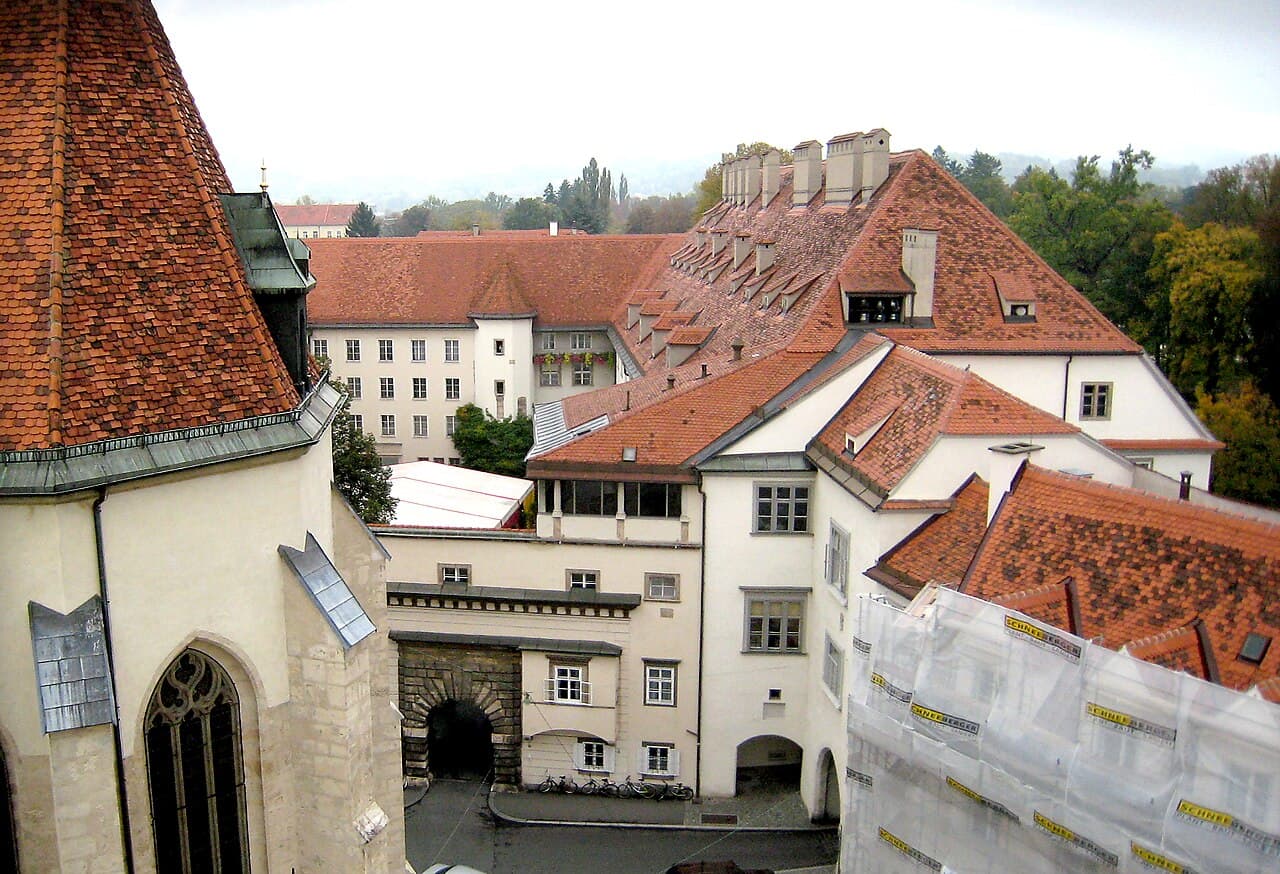
The Castle of Graz, located in the heart of Graz, Austria, stands as a remarkable testament to the region's medieval and Renaissance history. Established by the influential Habsburg dynasty, this hill castle was constructed between 1438 and 1453 under the direction of Duke Frederick V of Habsburg, who later became Emperor Frederick III. The castle was built on the site of an earlier late medieval ducal manor first recorded in 1349, integrating into the larger Schlossberg castle estate, a strategic fortified hill dominating the city.
Originally conceived as a ducal residence, the castle's design reflects both its administrative importance and defensive needs within the urban fabric of Graz. It was physically connected to the adjacent Graz Cathedral by a two-story gallery, underscoring its role as a center of both secular and spiritual power. Due to its relatively limited defensive capabilities against direct military assault, the castle was linked by a covered passage to the more formidable fortress on Schlossberg hill, forming an integrated defensive system that protected the city from external threats.
Historical development and significance
During the period from 1564 to 1619, when Graz was designated the capital of Inner Austria, the castle gained prominence as the official seat of the Inner Austrian archdukes. This era saw significant expansion and architectural enhancement, including the construction of the Karlsbau palace between 1570 and 1571. The castle's spiritual importance was also augmented by the commissioning of a new court chapel by Maria Anna of Bavaria, further elevating its status within the Habsburg domains.
The castle's role as a princely residence diminished after Archduke Ferdinand II ascended to the imperial throne in 1619 and relocated to Vienna. Subsequently, the complex was repurposed for various functions, including serving as an imperial lodging and later, from 1783 onward, housing government administrative offices. This transition marked a shift from a royal residence to a center of civil administration.
Architectural features and structural components
Overall layout and defensive elements
The Castle of Graz is a sprawling complex composed of two- to four-story buildings arranged around three courtyards. It was originally integrated into the medieval city fortifications, reflecting its strategic urban position. The main entrance, dating from 1554, is a fine example of Renaissance architecture featuring a vaulted passage and robust iron-bound doors, blending defensive strength with aesthetic refinement.
The friedrichsbau
The Friedrichsbau is the oldest surviving section of the castle, a three-story irregular building aligned with the former city walls. Its smooth facades are punctuated by a projecting chapel constructed in 1447. Visitors enter through a prominent late Gothic gatehouse with a wide arch, complemented by a rectangular oriel window with paired arched openings. The eastern facade features a chamfered round-arched gate, while the western side displays three bricked-up pointed arches supported by polygonal pillars, indicative of the building's evolving functions.
Within the Friedrichsbau lies the Friedrich Hall, originally an open Gothic hall divided into two aisles. This hall is notable for its star-shaped vault, supported by a polygonal central pillar that was later reinforced with concrete during restoration. Above the hall is the Kammerkapelle chapel, a two-story chapel now divided by a 19th-century intermediate floor. The upper chapel, dedicated to Saints Mary and George, features a four-bay design with double choir niches and a net rib vault with pointed arches. Stone tablets dated to 1447 bearing Emperor Frederick III's motto connect the chapel to its original patron and highlight its historical significance.
Maximilianbau and its unique staircase
The Maximilianbau, constructed between 1494 and 1500, is a slender four-story building with smooth facades and late Gothic portals. Its most remarkable feature is the polygonal stair tower housing an exceptional double spiral staircase, considered a masterpiece of late Gothic stone craftsmanship. Uniquely, this tower incorporates Roman gravestones from the first and second centuries, repurposed as building materials, which adds an archaeological dimension to the castle's fabric.
The karlsbau palace
Built in 1570–1571 by architect Pietro Ferrabosco, the Karlsbau is a Renaissance-style building rising between two and four stories with smooth facades and a high hipped roof. Architectural highlights include stone window frames and a grand round-arched portal with bossed stonework and a metal-bound door. A late Gothic painted wall niche discovered in 2013 inside the Karlsbau features floral and bird motifs, which have been preserved under protective glazing, showcasing the blend of Gothic and Renaissance artistic influences.
Registraturtrakt and decorative elements
The Registraturtrakt, constructed between 1581 and 1585 by Marco Antonio Tadei, is a long northern wing originally spanning 15 bays over two stories. It incorporates parts of the medieval city walls and features two-story Renaissance arcades supported by columns, some of which were later enclosed. The upper floor was decorated with sgraffito portraying stylized foliage and a blind balustrade, combining artistic expression with functional design elements.
The neue burg addition
The Neue Burg, a modern addition completed between 1950 and 1952, occupies the space left after the mid-19th century partial demolitions. This three- to four-story building is adorned with sandstone reliefs and frescoes illustrating scenes from the city of Graz and its landmarks, linking contemporary art with the castle's historic setting and continuing its cultural narrative.
Gardens and cultural heritage
The castle's garden, originally a former bastion converted into a pleasure garden in 1568 by court gardener Hans Richter, remains a notable feature despite its reduced size. It contains statues dating from the 17th to 19th centuries, including figures representing Samson, Heracles, Justice, and the Graz Panther. Additionally, modern artworks such as the Liberation Monument from 1960 and a dragonfly sculpture from 1961 contribute to the garden's artistic collection.
Within the castle complex is the Styrian Hall of Fame, which displays busts of prominent Styrian figures crafted by various 20th-century sculptors. This collection extends the cultural heritage preserved within the castle grounds and celebrates the region's historical personalities.
Preservation and archaeological discoveries
Since 1922, the Castle of Graz has served as the seat of the Styrian Landeshauptmann (governor), maintaining its administrative significance. Restoration efforts from 2003 to 2008 focused on renewing key interiors such as the Friedrich Hall and restoring the Kammerkapelle chapel to its original religious function. Archaeological investigations have revealed medieval human remains in 2010, and the discovery of the late Gothic painted wall niche in the Karlsbau in 2013 has been preserved as an important artistic find.
The castle's condition today reflects a combination of well-preserved and partially restored elements, with ongoing efforts to balance conservation with its role as a government and cultural site. The complex stands as a significant monument to the architectural, political, and cultural history of Graz and the wider region of Styria.
Frequently asked questions (FAQ)
- How do I visit the Castle of Graz?
- The Castle of Graz is open daily from 09:00 to 17:00. Visitors can explore the historic courtyards and selected interiors, with free admission available.
- What is the historical significance of the Castle of Graz?
- The Castle of Graz was a key residence of the Habsburg dynasty and served as the seat of the Inner Austrian archdukes. It played an important role in the region's political and cultural history from the 15th century onward.
- Can I see the Renaissance and Gothic architectural features at the castle?
- Yes, the castle showcases a blend of late Gothic and Renaissance architecture, including the Friedrichsbau with its Gothic chapel and the Renaissance Karlsbau palace, as well as the unique double spiral staircase in the Maximilianbau.
- Is the castle accessible for visitors with mobility issues?
- While some areas of the castle are accessible, certain historic sections with stairs and uneven surfaces may pose challenges. Visitors with mobility concerns are advised to check accessibility options in advance.
- When is the best time to visit the Castle of Graz?
- Spring through early autumn offers pleasant weather for exploring the castle and its gardens. Visiting during weekdays can provide a quieter experience.
- Are there any nearby attractions to visit after the castle?
- The castle is centrally located in Graz, close to landmarks such as the Graz Cathedral, the Schlossberg hill fortress, and the historic old town, making it easy to combine visits.
- What are the ticket prices for the Castle of Graz?
- Admission to the Castle of Graz is free, allowing visitors to enjoy its historic courtyards and selected interior spaces without charge.
Photo gallery

Information
Opening hours
09:00-17:00, daily
Ticket prices
Free
Current owner
State government of Styria
Website
Visit websiteSources & official resources
Verify the information above using these authoritative references.
Loading map...
Visitor reviews
No reviews yet. Been here? Write the first review and help other travelers!
Write the first reviewVisited this castle? Share your experience
Your review helps other travelers and adds first-hand knowledge to our encyclopedia.



