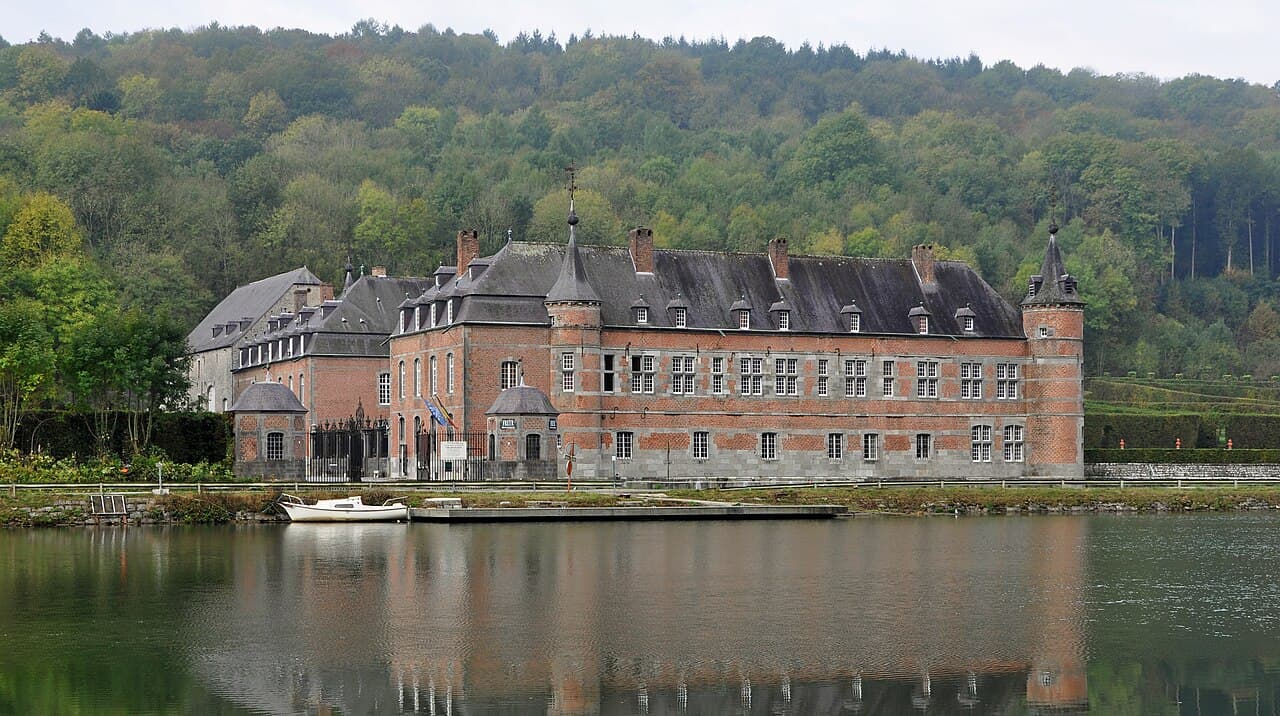
Castle of Freyr — Belgium castle

Castle of Freyr

Castle of freyr: renaissance masterpiece on the meuse river
Hastiere, Namur, Belgium
Renaissance (15th–17th c.)
Well Preserved

The castle of Freyr is a remarkable example of Renaissance Mosane architecture situated on the left bank of the Meuse River, nestled between the villages of Waulsort and Dinant in the Namur region of Belgium. This location is renowned for its spectacular natural beauty, making the castle not only a significant historical monument but also a stunning landmark within one of Belgium's most picturesque landscapes.

Historical development and architectural evolution

The castle's origins trace back to the 16th century, with the east wing constructed in 1571. This wing stands as one of the earliest and finest examples of the Renaissance Mosane style, a regional interpretation of Renaissance architecture characterized by elegant stonework, balanced proportions, and intricate detailing influenced by the cultural exchanges along the Meuse valley.

In the 17th century, the castle underwent significant expansion with the addition of three more wings, which together with the original east wing, formed a quadrangular layout enclosing a central courtyard. This design not only enhanced the castle's defensive capabilities but also reflected the evolving tastes and social functions of aristocratic residences during that period.

By around 1760, the south wing was demolished and replaced by an ornate wrought iron gate that now closes off the inner courtyard. This modification contributed to the castle's present-day appearance, blending functionality with aesthetic refinement typical of the late Renaissance and early Enlightenment era.

Gardens inspired by André Le Nôtre

One of the castle's most celebrated features is its extensive terraced gardens, designed in the style of the renowned French landscape architect André Le Nôtre, famous for his work on the Palace of Versailles. Created around 1760, these gardens are set on walled terraces overlooking the Meuse River, offering breathtaking views to the east and towards the surrounding forested hills to the north.

The gardens exemplify the principles of formal French garden design, including symmetry, carefully clipped hedges, geometric flower beds, and tree-lined avenues. This landscaping not only enhances the castle's grandeur but also integrates the natural beauty of the Meuse valley with the cultivated elegance of Renaissance and Baroque garden traditions.

Architectural features and interior highlights

The castle's architectural ensemble includes stone facades adorned with Renaissance decorative motifs, steeply pitched roofs, and finely crafted mullioned windows. The use of local limestone contributes to the castle's harmonious integration with its natural surroundings.

Inside, the castle contains richly decorated rooms with period furnishings, tapestries, and artworks that reflect its noble heritage. The layout includes spacious halls, private chambers, and service areas arranged around the central courtyard, demonstrating the multifunctional nature of such estates.

Cultural significance and preservation

The castle of Freyr is not only a testament to the architectural and cultural history of the Renaissance period in Belgium but also an important heritage site that attracts visitors interested in history, architecture, and landscape design. Its preservation allows for the appreciation of regional interpretations of Renaissance styles and the influence of French garden design on Belgian estates.

Today, the castle continues to be maintained with respect to its historical authenticity, offering guided tours and hosting cultural events that highlight its historical and aesthetic values.

Frequently asked questions (FAQ)

How do I get to the Castle of Freyr?
The Castle of Freyr is located in Hastiere, Belgium, and can be accessed by car or public transport. If you are driving, you can follow the main roads from Namur or Dinant. The nearest train station is in Anseremme, from where you can take a taxi or enjoy a scenic walk to the castle.
What is the historical significance of Castle of Freyr?
The Castle of Freyr dates back to the 15th century and is known for its stunning Renaissance architecture. It has served as a residence for various noble families over the centuries and played a role in the region’s history. Today, it stands as a symbol of Belgium's rich cultural heritage.
When was the Castle of Freyr built?
Construction of the Castle of Freyr began in the early 15th century, with significant renovations occurring in the 16th century. The castle reflects various architectural styles, showcasing the evolution of design and construction techniques over the centuries. Its historical layers provide insight into the life of the nobility during that era.
Can I visit the Castle of Freyr?
Yes, the Castle of Freyr is open to the public for visits. Guests can explore the beautiful gardens and the stunning architecture of the castle. It is advisable to check the official website for any special events or guided tours that may enhance your experience.
Why is the Castle of Freyr popular among tourists?
The Castle of Freyr is popular due to its picturesque setting along the Meuse River and its well-preserved Renaissance architecture. Visitors are drawn to its beautiful gardens and the scenic landscapes surrounding the castle. Additionally, its fascinating history adds to its appeal as a cultural destination.
Is it possible to hold events at the Castle of Freyr?
Yes, the Castle of Freyr offers facilities for hosting private events such as weddings, receptions, and corporate gatherings. The enchanting atmosphere and stunning surroundings make it an ideal venue for memorable occasions. It is recommended to contact the castle management to inquire about availability and services.
What are the opening hours for the Castle of Freyr?
The Castle of Freyr is typically open from Tuesday to Sunday, with specific hours varying by season. During peak tourist season, the castle may have extended hours to accommodate visitors. Be sure to check the official website for the most current opening times before planning your visit.
What are the ticket prices for visiting the Castle of Freyr?
Ticket prices for the Castle of Freyr vary based on age and the type of tour selected. Typically, there are discounts for children, students, and seniors. Visitors can check the official website for detailed pricing and any special promotions that may be available during your visit.
What are some nearby attractions to the Castle of Freyr?
Nearby attractions include the picturesque village of Hastiere, the Meuse River, and several hiking trails that offer stunning views of the countryside. Visitors can also explore the nearby town of Dinant, known for its historic sites and vibrant culture. These attractions make for a perfect day trip combined with a visit to the castle.

Photo gallery

Castle of Freyr
Click to view

Photo by Marc Ryckaert (MJJR)•CC BY 3.0

1 photo • Click any image to view in full screen

Information

Lowland Castle

Sources & official resources

Verify the information above using these authoritative references.

Loading map...

Visitor reviews

No reviews yet. Been here? Write the first review and help other travelers!

Write the first review

Visited this castle? Share your experience

Your review helps other travelers and adds first-hand knowledge to our encyclopedia.

Write a review

(5/5)

0/2000 characters

Your review will be visible after admin approval

Nearby castles

3.3 km

Thierry Castle

Near Rue Haute, Belgium

Thierry Castle, locally known as Château de Thierry, is a striking medieval ruin situated on a high rocky plateau overlooking the Meuse river valley near Rue Haute in the province of Namur, within Belgium's Wallonia region. This strategic location provided commanding views and control over river traffic, a vital trade route during the Middle Ages. The castle's origins are deeply intertwined with the protection of the nearby Waulsort Abbey, reflecting its significant military and economic role in the region. Early history and foundation The earliest fortification on this site was established in the 10th century AD by a lord named Thierry, the Lord of Faing. This initial castle was primarily constructed to safeguard the Waulsort Abbey located on the opposite bank of the Meuse River. Unfortunately, no physical remains of this original structure have survived to the present day, leaving only historical records to attest to its existence. Medieval reconstruction and ownership Archaeological excavations have revealed that the existing ruins date from just before 1262, indicating a significant reconstruction or new castle built during the high medieval period. This phase of construction is attributed to Gilles de Rochefort and his wife Héluide de Faing. The castle's name, "Thierry," likely honors multiple family connections: Héluide was the heiress of her father Thierry de Faing, Gilles inherited lordships from his father, also named Thierry, and their son was named Thierry as well. Familial and feudal significance In 1221, Héluide transferred the responsibility of protecting the abbeys of Waulsort and Hastière to her husband, further cementing the castle's role as a defensive stronghold. Over subsequent centuries, the castle passed through the hands of several noble families including the Looze de Agimonts, Boulans, Brandebourgs, and the Spontins de Freyr. Despite these changes in ownership, Thierry Castle never served as a primary residence. Instead, it functioned mainly as a military outpost and a means to control and profit from river commerce, sometimes through less lawful means such as robbing merchants navigating the Meuse. Architectural features and current state The castle ruins today are fenced off to protect the site, and public access is prohibited. However, visitors can enjoy a scenic forest trail leading to the site, which offers a rewarding experience even without entering the ruins. Within the remains, notable features include a well, several sections of cobblestone floors, and remnants of an oven, which hint at the castle's domestic and defensive functions. Strategic location and views One of the castle's most remarkable attributes is its panoramic view over the Meuse river valley, underscoring its strategic importance for surveillance and defense. The elevated position on a rocky plateau provided natural fortification advantages, typical of hill castles from the medieval period. Destruction and decline The castle's decline began after it was destroyed in 1675 by the French army during the conflicts of that era. Following its destruction, Thierry Castle was abandoned and gradually fell into ruin, a fate common to many medieval fortifications rendered obsolete by advances in military technology and changing political landscapes. Historical context and legacy The foundation of the castle by Thierry, bishop of Metz, who received the Waulsort Abbey in 969 AD, highlights the intertwined nature of ecclesiastical power and feudal military authority in the Middle Ages. Thierry Castle stands as a testament to the medieval efforts to protect religious institutions and control vital trade routes along the Meuse River. Today, the ruins of Thierry Castle serve not only as a historical monument but also as a cultural landmark that reflects the complex feudal history of the Namur region. Its preservation, despite being in a ruined state, allows visitors and historians alike to explore the layered history of medieval fortifications in Belgium.

Early Medieval (5th–10th c.)
Details
4.6 km

Freÿr Castle

Hastière, Belgium

Freÿr Castle, located in Hastière, Belgium, is a remarkable example of Renaissance architecture combined with a rich medieval heritage and some of the most exquisite gardens in Wallonia. Its history stretches back to the Middle Ages when it began as a fortified keep. The estate has been continuously owned by the descendants of the original noble family since the 14th century, making it a rare example of enduring aristocratic lineage in Belgium. The medieval origins and Renaissance transformation The site of Freÿr Castle was originally a medieval keep granted in fief in 1378 by the Count of Namur to Jean de Rochefort Orjol. This early fortification was part of the feudal landscape, serving military and administrative purposes. The keep was destroyed in 1554 during the wars involving Emperor Charles V, when French forces attacked the region. The castle as it stands today began with the construction of the east wing in 1571, which is one of the earliest examples of the Renaissance Mosane style. This architectural style is characterized by its use of local stone, elegant proportions, and classical details that blend Flemish and Italian Renaissance influences. The 16th-century rebuilding marked a shift from purely defensive architecture to a residence emphasizing comfort and status. Throughout the 17th century, the castle was expanded with the addition of three more wings, creating a square courtyard that enclosed the original east wing. This layout reflected the evolving tastes and needs of the noble family, balancing grandeur with domestic functionality. Around 1760, the south wing was removed to open the courtyard and replaced with a wrought iron gate inspired by the work of Jean Lamour in Nancy, enhancing the castle's aesthetic appeal and providing a grand entrance. Interior features and historical significance The interior of Freÿr Castle exemplifies the style of an 18th-century noble summer residence. The main hall is particularly notable for its wall paintings by Frans Snyders, a Flemish Baroque painter renowned for his detailed animal and still-life scenes. The ceiling features Louis XV frescoes that add an air of elegance and reflect the rococo tastes of the period. The castle chapel retains its Regency wooden panelling and a Baroque altar, showcasing the blend of artistic styles that evolved over the centuries. The rooms are furnished with antique pieces belonging to the Dukes of Beaufort-Spontin, the noble family that has preserved the estate through generations. Freÿr Castle has hosted several prominent historical figures, including Louis XIV of France, who stayed as a guest of Jeanne d'Harscamp, the Dowager Duchess of Beaufort-Spontin. Other notable visitors include Archduchess Maria-Christina, daughter of Empress Maria Theresa, and King Stanislas I. These visits underscore the castle's importance as a political and social hub in the region. The castle was the site of significant diplomatic events, such as the signing of the Coffee Treaty (Treaty of Freÿr) in 1675 between France and Spain, and the negotiation of the Treaty of the Borders in 1772 between France and the Prince-Bishopric of Liège. These treaties highlight Freÿr's role in European diplomacy during the early modern period. Gardens designed in André Le Nôtre style The gardens of Freÿr Castle are among its most celebrated features. Created in the style of André Le Nôtre, the famed French landscape architect known for the gardens of Versailles, they were designed around 1760 by Canon Guillaume de Beaufort-Spontin and later expanded by his brother Philippe in 1770. Set on walled terraces overlooking the Meuse River, the gardens offer stunning views of the surrounding woods and cliffs. The design incorporates formal elements such as hedge mazes spanning six kilometers, geometric patterns inspired by card games, and terra cotta statues by Cyfflé that add artistic interest. The lower terraces feature ponds and fountains, alongside some of the oldest orange trees in Europe, dating back over 350 years. These trees were imported from Lunéville, the residence of the Duke of Lorraine, and are housed in wooden cases built according to their original 18th-century design. The orangery at Freÿr is the oldest in the Low Countries and combines both elegance and simplicity. At the garden's summit stands a Rococo pavilion decorated with delicate stucco work featuring fertility motifs such as cornucopias and tritons. This pavilion commands a panoramic view of the Meuse and the dramatic cliffs on the river's opposite bank, which rise over 100 meters and provide a striking natural backdrop. Architectural and cultural importance Freÿr Castle is classified as one of Wallonia's major heritage sites, reflecting its architectural, historical, and cultural significance. The estate is a rare surviving example of a noble residence that has retained its original family ownership and many of its authentic furnishings and artworks. The castle's blend of medieval origins, Renaissance rebuilding, and 18th-century enhancements illustrates the evolution of aristocratic residences in Belgium. Its gardens represent a masterful adaptation of French formal garden principles to the local landscape, creating a harmonious balance between nature and design. Today, Freÿr Castle continues to attract visitors interested in history, architecture, and horticulture. Its well-preserved interiors and extensive gardens offer insight into the lifestyle of European nobility across several centuries, making it a valuable cultural asset.

Renaissance (15th–17th c.)
Details
4.6 km

Fontaine Castle

Anthée, Belgium

Fontaine Castle, also known as Château de Fontaine, is a remarkable historic castle located in the municipality of Onhaye, south of the village of Anthée in the province of Namur, Wallonia, Belgium. This castle stands as a testament to centuries of architectural evolution and regional history, blending medieval origins with later neo-traditional renovations. It occupies a strategic position near the crossroads of important medieval trade routes connecting Namur to Luxembourg and Dinant to Liège. The medieval origins and strategic significance The castle was originally constructed in the 13th century during the high medieval period. It served as the seat of the seignory of Fontaine, a lordship that governed the villages of Anthée, Morville, and Miavoye. This territory was part of the County of Namur and the adjacent region of Agimont, which fell under the jurisdiction of the Prince-Bishopric of Liège. The castle's location near major roads provided both defensive advantages and control over trade and travel routes in the region. Historical records mention that in 1289, the castle was owned by a noblewoman named Lady Yde de Fontaine, indicating the site's longstanding importance in local feudal society. The surviving square tower on the northeast corner is a significant remnant of this medieval fortress, offering insights into the defensive architecture of the time. Architectural evolution from the 16th to 17th centuries During the 16th and 17th centuries, Fontaine Castle underwent extensive reconstruction and expansion. The present castle structure incorporates elements of the original medieval fortress, particularly the northeastern square tower, which remains a prominent feature. Around the outer courtyard, buildings were added primarily for agricultural use, reflecting the castle's role not only as a noble residence but also as a center of estate management and farming. The castle's layout is characterized by a U-shaped plan open to the south, constructed mainly from limestone. Towers are positioned at each corner, enhancing both the defensive capabilities and the aesthetic symmetry of the complex. The two-story main building, likely built in phases throughout the 16th century, exemplifies the transitional architectural styles of the late Renaissance period in the region. Adjacent to the main castle, a farm complex was established to the east, mirroring the castle's U-shaped design with its open side facing the château, underscoring the integrated nature of noble residence and agricultural enterprise. 19th and early 20th-century ownership and neo-traditional restoration In 1840, Fontaine Castle changed hands from the family of Jacquier de Rosée to the Count of Ribiano. Subsequently, through marriage, it passed to Baron Gustave de Senzeille via his wife Jeanne, the Count's daughter. After Jeanne's death without heirs, the property was bequeathed to Count Fernand de Beaufort. In 1907, Count Beaufort sold the castle to Viscount Eugène de Jonghe, who initiated a significant restoration project between 1907 and 1909. This restoration embraced a neo-traditional architectural style, a movement that sought to revive and harmonize traditional forms with modern needs. The restoration involved raising the castle's towers, adding numerous windows, and unifying the exterior's aesthetic to create a cohesive appearance. These changes enhanced both the castle's grandeur and its functionality as a residence. Current status and adaptive reuse Today, Fontaine Castle remains private property and has been sensitively adapted to contemporary use. The castle buildings have been converted into several luxury apartments, allowing the historic structure to retain its architectural integrity while serving modern residential purposes. This adaptive reuse ensures the preservation of the castle's cultural heritage and offers a unique living experience within a historic setting. Architectural features and cultural significance The castle's most notable architectural feature is its medieval square tower, which anchors the northeast corner and serves as a visible link to its original defensive role. The limestone construction provides durability and a distinctive regional character, common in Wallonian castles. The U-shaped layout and corner towers reflect both practical defense strategies and aesthetic considerations typical of the Renaissance period's noble residences. Fontaine Castle's history encapsulates the shifting political and social landscapes of the Namur region, from feudal lordship through Renaissance estate management to modern private ownership and restoration. Its location at a crossroads of important medieval routes highlights its historic role in regional control and communication. As a well-preserved example of a castle that evolved over centuries, Fontaine Castle offers valuable insights into the architectural trends and historical developments of Wallonia. Its blend of medieval remnants and later neo-traditional modifications exemplifies the layered history common to many European castles. Visiting and accessibility While Fontaine Castle is private and not generally open to the public, its exterior can be admired from nearby public roads and paths. The surrounding natural landscape and proximity to the village of Anthée make it a point of interest for those exploring the cultural heritage of the Namur province. Visitors interested in castle architecture and Belgian history will find Fontaine Castle an intriguing subject for study and photography.

High Medieval (11th–13th c.)
Details