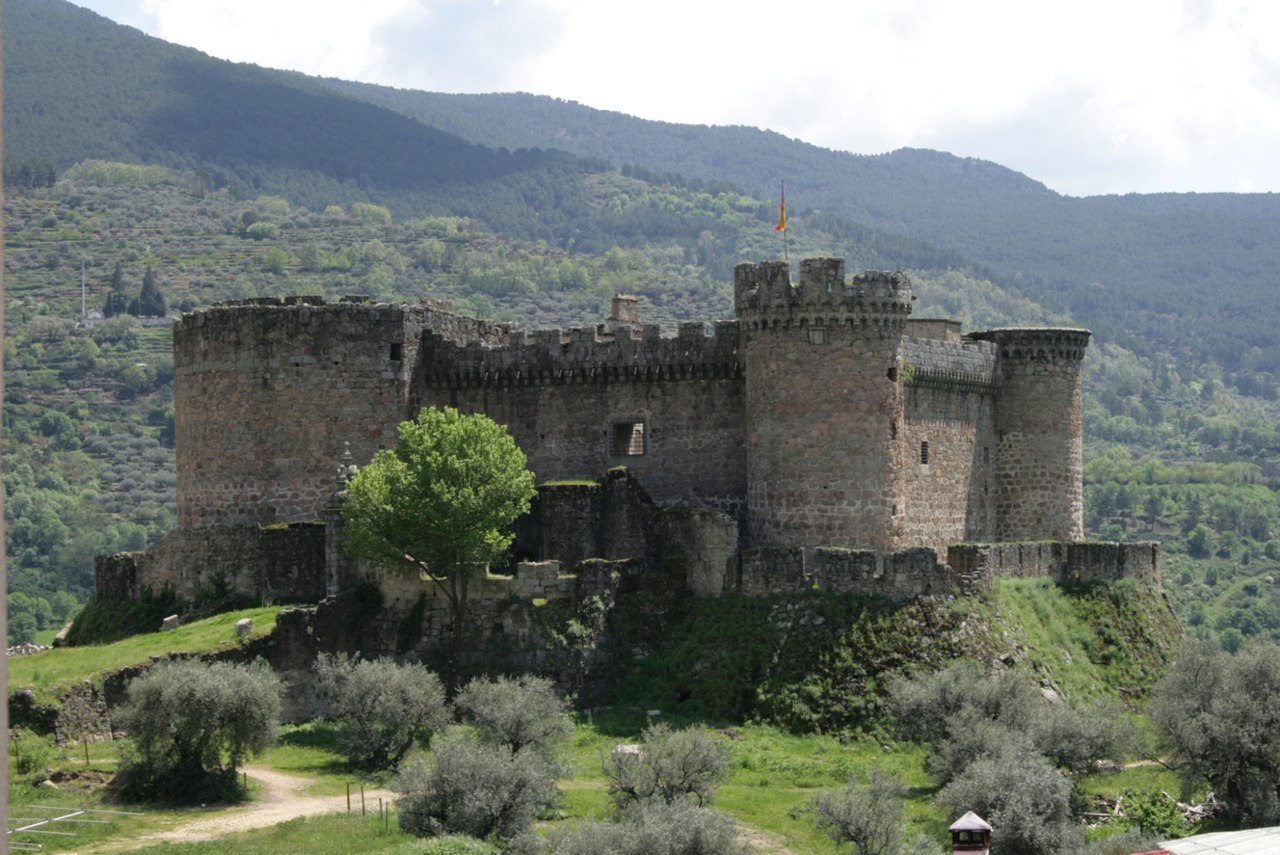
Castle of Don Álvaro de Luna
The castle of Don Álvaro de Luna, located in Arenas de San Pedro, Spain, stands as a remarkable example of 15th-century Gothic military architecture and noble residence design. Commissioned by the High Constable Ruy López Dávalos at the turn of the 15th century, this fortress reflects the complex socio-political dynamics of late medieval Castile and the evolution of defensive structures adapted to both military and residential needs.
Situated unusually on a low-lying site within the urban core of Arenas de San Pedro, the castle deviates from the typical elevated placement favored for fortifications of the era. This choice was influenced by local opposition to the originally planned location in Colmenar (modern Mombeltrán), underscoring the tensions between nobility and local populations. The construction was financially supported by levies on neighboring villages, highlighting the feudal lordship’s economic reach.
Historical context and ownership
The castle's origins date to around 1400, following Arenas de San Pedro’s elevation to town status by King Enrique III in 1393. This political change granted the settlement independence from the Ávila council, prompting the need for a fortified noble residence. By 1422, the fortress was reportedly completed, coinciding with the exile of Ruy López Dávalos and the transfer of ownership to Rodrigo Alonso Pimentel, second Count of Benavente.
In 1430, the castle entered the possession of the influential nobleman Álvaro de Luna through his marriage to Juana Pimentel, whose somber nickname "the Sad Countess" lent the fortress its enduring popular name. Álvaro de Luna, a prominent figure in Castilian politics, occasionally resided in the castle until his execution in 1453.
The fortress later passed to the Mendoza family through the marriage of María de Luna, daughter of Juana and Álvaro, to Íñigo López de Mendoza, second Duke of the Infantado, in a ceremony held at the castle in 1460. Their son Diego Hurtado de Mendoza was born there in 1461. The castle remained a noble residence for the ducal family through the 16th and 17th centuries, although its condition gradually declined.
Architectural features and layout
The castle occupies a roughly square footprint measuring 51 meters on each side, constructed primarily from granite, a durable local stone. Each corner is fortified with circular towers approximately 16 meters tall, some featuring battlements that provided defensive cover for archers and lookouts.
The most prominent architectural element is the large rectangular keep near the main entrance, rising to four stories and approximately 26 meters in height. This keep served as both a stronghold and the main living quarters of the noble family, embodying the dual military and residential functions typical of late medieval castles.
Within the castle, the central courtyard or patio de armas was surrounded by service rooms including stables, storage areas, kitchens, and servant quarters on the ground floor. The upper floor housed the noble family’s residence, reflecting a clear spatial hierarchy between functional and residential spaces.
Architectural details throughout the castle include a variety of door and window arch styles—pointed, semicircular, and flat—that illustrate the stylistic transitions of the late medieval period. Defensive features such as machicolations (matacanes)—openings in projecting parapets—allowed defenders to drop objects or pour substances on attackers, enhancing the fortress’s defensive capabilities.
Defensive elements
The castle’s design integrates traditional medieval fortification elements adapted to the evolving military technology and siege tactics of the 15th century. The battlements atop the towers and walls provided vantage points for archers and lookouts. The machicolations and thick granite walls were essential for repelling assaults and protecting the inhabitants.
Despite its low-lying position, the castle’s robust construction and strategic design compensated for the lack of natural elevation, ensuring effective defense within the urban context.
Historical uses and transformations
Throughout its history, the castle served various roles beyond its initial function as a noble residence. During the 19th century, it was proposed for use as a prison and a cemetery, reflecting changing social and municipal needs. The castle was spared direct damage during the Peninsular War and the First Carlist War, although the surrounding town suffered fires.
In 1853, ownership transferred to the local municipality, marking a shift from private noble possession to public stewardship. Plans in the 1960s to convert the castle into a Parador hotel were never realized, but from the 1970s onwards, the castle has functioned as a cultural venue and municipal auditorium.
Restoration efforts culminated in 2007 under the supervision of Lynn Margulis, an American biologist who oversaw the rehabilitation of the battlements and interior spaces of the keep. These restorations have stabilized the structure and made it accessible to visitors, housing exhibitions that preserve and interpret the castle’s rich history.
Preservation and cultural significance
Today, the castle of Don Álvaro de Luna stands as a well-preserved example of late medieval Gothic military architecture and noble residence design in Castile. Its unique location within the town, robust granite construction, and blend of defensive and residential features offer valuable insights into the architectural and social history of the period.
The castle’s transformation from a feudal fortress to a cultural landmark underscores its enduring significance in the heritage of Arenas de San Pedro and the broader region. It continues to attract visitors interested in medieval history, architecture, and the legacy of the noble families who shaped Castilian history.
Visitor experience
Visitors to the castle can explore the restored battlements and the interior of the keep, which now serves as an exhibition space. The castle’s location in the urban center makes it easily accessible, and its use as a municipal auditorium ensures ongoing community engagement and cultural programming.
The castle’s historical narrative, architectural features, and preservation efforts combine to offer a compelling destination for those interested in Spain’s medieval heritage and the evolution of castle architecture.
Frequently asked questions (FAQ)
- What is the historical significance of the Castle of Don Álvaro de Luna?
- The Castle of Don Álvaro de Luna is a remarkable example of medieval architecture in Spain, built in the 15th century. It served as the residence of the influential nobleman Don Álvaro de Luna, a key figure in the politics of Castile. The castle reflects the power and prestige of its time, making it an important site for understanding the history of the region.
- When was the Castle of Don Álvaro de Luna built?
- The construction of the Castle of Don Álvaro de Luna began in the year 1430 and was completed in 1440. It was designed to be both a fortress and a residence, showcasing the architectural styles of the late Gothic period. Its strategic location played a vital role in the defense and administration of the area.
- What are the opening hours for visiting the castle?
- The Castle of Don Álvaro de Luna is open to visitors from Tuesday to Sunday, with hours varying by season. Typically, the castle opens at 10 AM and closes at 6 PM during the winter months, and extends to 8 PM in the summer. It's advisable to check the official website for any changes in hours or special closures.
- Can I purchase tickets online for the castle?
- Yes, visitors can purchase tickets online through the official castle website, which is recommended to avoid long queues. Tickets are also available at the entrance, but online booking often provides discounts and guarantees entry during peak times. Make sure to check for any special events that may require advance reservations.
- Is the Castle of Don Álvaro de Luna accessible for visitors with disabilities?
- Yes, the castle has made efforts to be accessible for visitors with disabilities. There are designated pathways and ramps to facilitate access to the main areas. However, due to the historical nature of the site, some parts may still present challenges, so it’s wise to consult with staff for assistance.
- What is the best time to visit the Castle of Don Álvaro de Luna?
- The best time to visit the Castle of Don Álvaro de Luna is during the spring and fall when the weather is mild and pleasant for exploring. Additionally, visiting during weekdays can help you avoid the larger crowds typically present on weekends. Check the local calendar for any festivals or events that might enhance your experience.
- Are there any nearby attractions to visit after the castle?
- Yes, after visiting the Castle of Don Álvaro de Luna, you can explore the charming town of Arenas de San Pedro, which boasts beautiful parks and historical sites. The nearby Sierra de Villafranca offers stunning natural landscapes for hiking enthusiasts. Don't miss the chance to visit the local markets for unique crafts and regional delicacies.
- What are the ticket prices for the castle?
- Ticket prices for the Castle of Don Álvaro de Luna are generally affordable, with discounts available for students, seniors, and groups. Adult tickets typically cost around €5, while children under 12 can enter for free. Special rates may apply during holidays or for guided tours, so it's best to check the latest prices online before your visit.
Information
Website
Visit websiteSources & official resources
Verify the information above using these authoritative references.
Loading map...
Visitor reviews
No reviews yet. Been here? Write the first review and help other travelers!
Write the first reviewVisited this castle? Share your experience
Your review helps other travelers and adds first-hand knowledge to our encyclopedia.