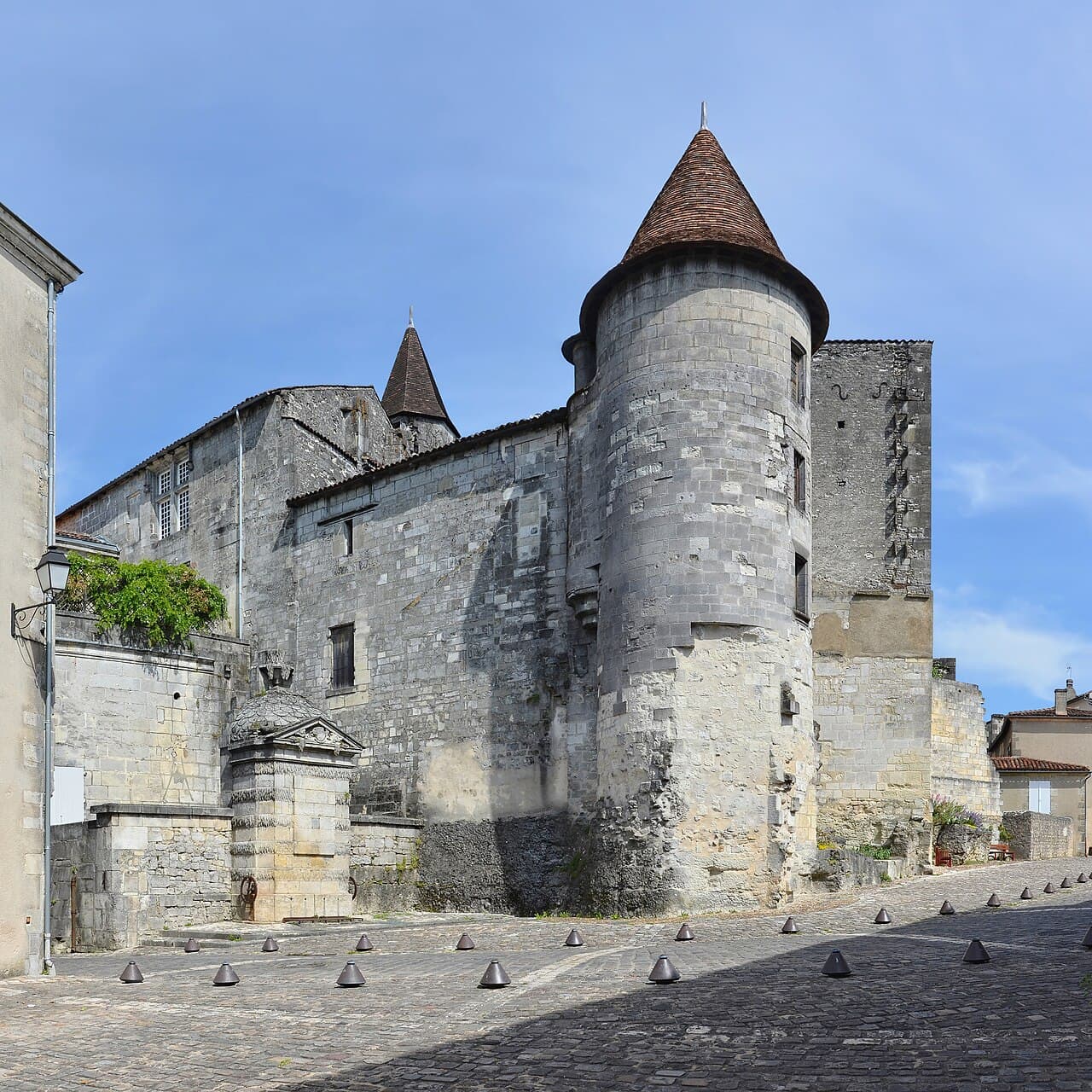
Castle of Cognac
The Castle of Cognac, located in the historic town of Cognac in southwestern France, stands as a remarkable testament to the region's medieval and Renaissance heritage. Its origins date back to around 950 AD when Hélie de Villebois, the first lord of Cognac, established a fortified enclosure known as a castrum. This early fortification laid the groundwork for a complex architectural evolution that spans over a millennium, reflecting the shifting tides of power, warfare, and culture in the region.
Situated along the banks of the Charente River, the castle's strategic riverside location was crucial for defense and trade. The site initially featured wooden and earthworks typical of early medieval fortifications, but it was transformed into a robust stone fortress by the Taillefer family, counts of Angoulême, around the 12th and 13th centuries. This period marked the construction of the first defensive walls encompassing the town of Cognac, emphasizing the castle's role not only as a noble residence but also as a military stronghold.
Medieval origins and the villebois lineage
The earliest documented references to the castle and its lords come from charters and Benedictine records in the early 11th century, highlighting the importance of the Villebois family in establishing the castle's initial prominence. By the year 1000, Itier and Arnaud de Villebois had solidified their control over the site, which functioned as a fortified center for the surrounding region.
The taillefer and plantagenet influence
By the turn of the 13th century, significant architectural advancements were made under the Taillefer family, who rebuilt the castle in stone, replacing earlier wooden structures. This stone reconstruction included formidable walls and towers designed to withstand sieges and assert dominance over the surrounding territory.
The castle's lordship eventually passed to the Plantagenet dynasty through marriage alliances. Notably, Richard the Lionheart arranged the marriage of Amélie de Jarnac, heiress of Cognac, to his illegitimate son Philippe de Falcombridge. This alliance brought Cognac under English influence during a period marked by territorial disputes between England and France. Subsequently, the lordship was sold to King John of England, further entrenching English control.
Following King John's death, his widow Isabella of Angoulême married Hugh X of Lusignan, who retained control of Cognac despite papal threats of excommunication. The Lusignan family's tenure saw continued fortification and expansion of the castle's defenses during the turbulent 13th century.
Hundred years' war and the black prince's residence
During the Hundred Years' War, the Castle of Cognac was a focal point of conflict between English and French forces. Between 1366 and 1370, it served as a principal residence for Edward, the Black Prince, son of King Edward III of England. This period underscored the castle's strategic importance as a military and administrative center.
The castle changed hands multiple times during the war, reflecting the shifting fortunes of the warring kingdoms. After the lengthy captivity of John, Count of Angoulême in England from 1415 to 1448, he returned to find the castle in disrepair and initiated extensive reconstruction efforts around 1450.
Renaissance expansion and the valois golden age
The 15th and 16th centuries marked a cultural renaissance for the castle under the Valois dynasty. Charles de Valois and Louise of Savoy transformed Cognac into a vibrant cultural hub. Their children, including Marguerite de Navarre and King Francis I, who was born at the castle in 1494, maintained close connections to the site.
Around 1517, King Francis I undertook significant expansions, adding a long riverside façade that combined defensive functionality with Renaissance aesthetics. This façade was later heightened in the 19th century but retains key features such as the prominent "balcon du roi" (king's balcony), adorned with sculpted medallions and salamander emblems representing Francis I.
Architectural features of the renaissance period
The castle's round towers, constructed between 1499 and 1500, replaced earlier square towers and featured distinctive trilobed machicolations. These openings in the parapet allowed defenders to drop projectiles or boiling substances on attackers below. These towers once faced a medieval bridge from the Saint-Jacques quarter, which was demolished in 1855.
The "Tour du comte Jean" (Count Jean's Tower), dating from the 13th century, was enhanced in the 15th century with a well accessible from all floors, fireplaces, mullioned windows, and a rare medieval heating system called étuves, which warmed rooms through heated air or steam.
The "Logis du Gouverneur" (Governor's residence) features a finely crafted Gothic doorway, a turret with an internal spiral staircase, and the notable "salle du casque" (helmet room), named after a monumental fireplace decorated with a plumed helmet above the Valois-Angoulême coat of arms. This building incorporates masonry and decorative elements from the 12th and 13th centuries, including Gothic arcatures and capitals adorned with palmette motifs.
Later history and preservation
In the late 17th and 18th centuries, the castle's importance declined, leading to neglect. During the Seven Years' War (1756–1757), it was repurposed as a prison for foreign detainees, with graffiti from this period still visible on its walls. In 1772, the then Count of Artois, the future King Charles X, sold parts of the property.
The French Revolution led to the castle's nationalization and plans for demolition. However, in 1795, local merchants Otard and Dupuy purchased the castle and converted it into storage cellars, initiating a new phase in the site's history.
The 19th century brought both modifications that partially damaged the original structure and restoration efforts led by the Otard company. Since 1925, the castle and associated features like the François I fountain have been officially protected as historic monuments, preserving their cultural and architectural legacy.
Notable architectural remnants and features
- The Saint-Jacques gate on the Charente River, a key defensive entrance.
- The king's balcony with its sculpted medallions and salamander emblems.
- The Count Jean tower with its medieval heating system and well.
- The François I fountain, rebuilt in the 17th century blending classical and baroque styles, relocated in the 19th century.
- The "Logis du Gouverneur" with its Gothic doorway, turret, and helmet room fireplace.
- Vaulted cellars and chambers dating back to the 12th century.
Today, the Castle of Cognac stands as a complex architectural ensemble that reflects its long and varied history. Its blend of medieval fortifications and Renaissance elegance offers invaluable insights into the region's past. The castle continues to attract visitors interested in history, architecture, and French heritage, serving as a cultural landmark in the town of Cognac.
Frequently asked questions (FAQ)
- How do I get to the Castle of Cognac?
- The Castle of Cognac is located in the heart of Cognac, France, and is easily accessible by car or public transport. If you're arriving by train, the Cognac train station is just a short distance away, and local buses can take you directly to the castle.
- What is the historical significance of the Castle of Cognac?
- The Castle of Cognac has a rich history dating back to the 10th century and is known for being the birthplace of François I, the King of France. It has played a pivotal role in French history and was a strategic military stronghold in its time.
- When was the Castle of Cognac built?
- The Castle of Cognac was originally constructed in the 10th century, with significant renovations and expansions occurring in the following centuries. Its architectural design reflects various styles, including medieval and Renaissance influences, showcasing the evolution of castle design over time.
- Can I take a guided tour of the Castle of Cognac?
- Yes, guided tours are available at the Castle of Cognac, allowing visitors to explore its rich history and architectural features. These tours provide in-depth insights into the castle's past and its significance in the region, making for an enriching experience.
- Why is the Castle of Cognac a popular tourist destination?
- The Castle of Cognac is popular due to its historical significance, stunning architecture, and its connection to the world-renowned cognac production. Visitors are drawn to its beautiful grounds, impressive interiors, and the opportunity to learn about the history of cognac and its makers.
- Is it possible to host events at the Castle of Cognac?
- Yes, the Castle of Cognac offers facilities for hosting various events, including weddings and corporate gatherings. The picturesque setting and historic ambiance make it a unique venue for any special occasion.
- What are the opening hours for the Castle of Cognac?
- The Castle of Cognac is typically open to visitors from 10 AM to 6 PM, with extended hours during the peak tourist season. It is advisable to check the official website for any seasonal changes or special event hours before planning your visit.
- What are the ticket prices for visiting the Castle of Cognac?
- Ticket prices for the Castle of Cognac vary depending on age and whether you choose a guided tour. Discounts are often available for students, seniors, and groups, so be sure to check the official website for the most up-to-date pricing information.
- When is the best time to visit the Castle of Cognac?
- The best time to visit the Castle of Cognac is during the spring and fall when the weather is mild and the surrounding gardens are in bloom. Additionally, visiting during the week can help you avoid large crowds, allowing for a more enjoyable experience.
- Are there any nearby attractions to visit alongside the Castle of Cognac?
- Yes, there are several nearby attractions, including the historic town of Cognac itself, famous for its cognac houses and beautiful riverfront. Visitors can also explore the Musée des Arts du Cognac and enjoy local vineyards offering tastings and tours.
Photo gallery

Information
Website
Visit websiteSources & official resources
Verify the information above using these authoritative references.
Loading map...
Visitor reviews
No reviews yet. Been here? Write the first review and help other travelers!
Write the first reviewVisited this castle? Share your experience
Your review helps other travelers and adds first-hand knowledge to our encyclopedia.



