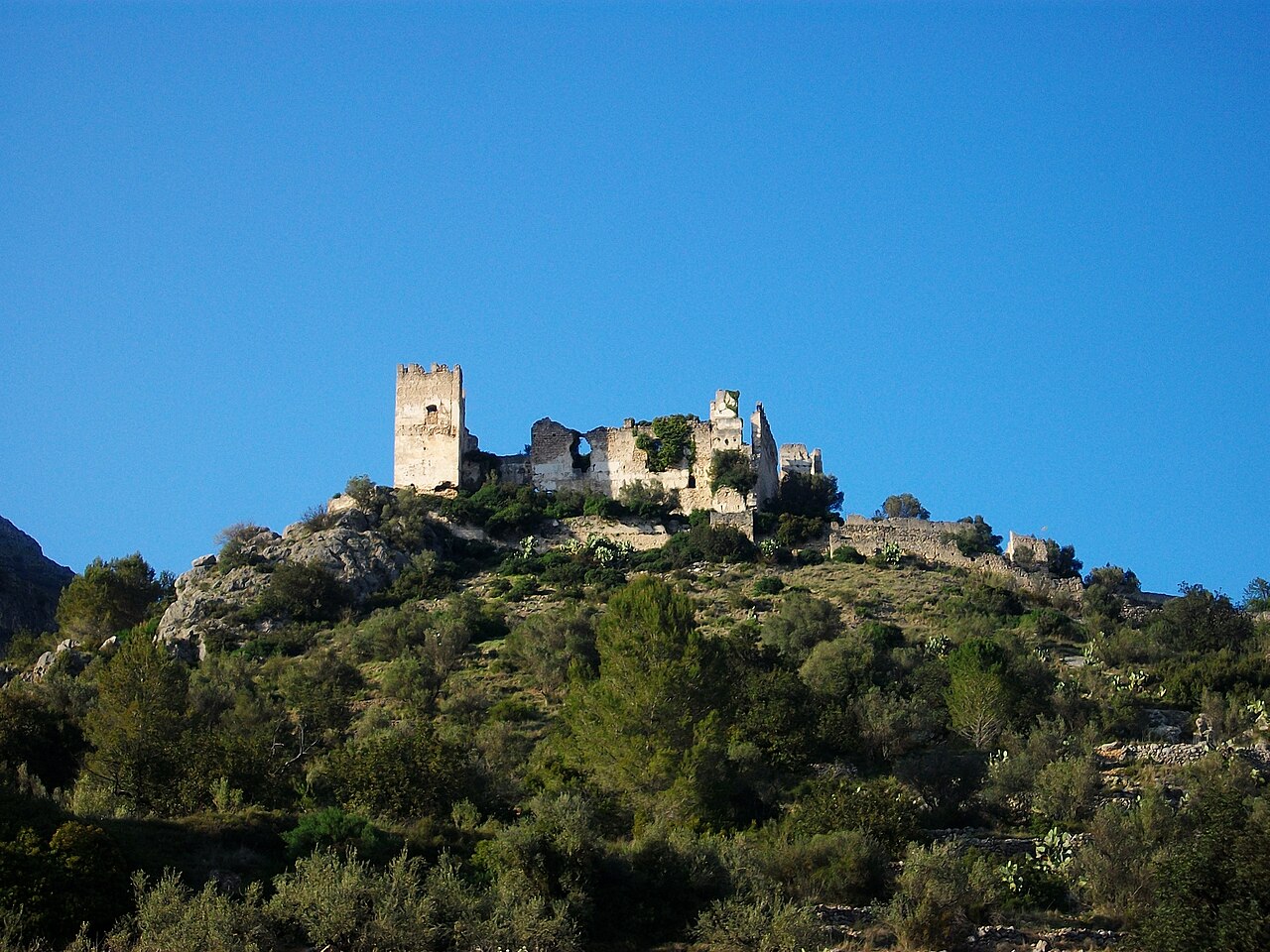
Castle of Chio
The Castle of Chio, locally known as Castell de Xiu, is a remarkable example of a hill castle situated near Llutxent in the Valencia region of Spain. Established in the 12th century during the rule of the Almohad dynasty, this fortress played a vital role as a rural refuge and strategic military site during the turbulent period of the Reconquista.
Its location atop a rocky outcrop approximately 280 meters above sea level provided natural defenses with steep slopes on three sides, making it a formidable stronghold. The castle's position commanded the Coll del Llautó passage, a critical route linking the coastal cities to the interior, facilitating communication and control between key towns such as Xàtiva, Alcoi, and Dènia. This strategic importance is underscored by the castle's visual contact with neighboring fortresses at Rugat, Bèlgida, Albaida, and Vilella, enabling signal communication across the landscape.
Historical context and military significance
The Castle of Chio originated as a hisn, a term used for fortified rural refuges during Muslim rule, serving scattered agricultural communities known as alqueries. These communities sought shelter within its walls during periods of conflict, reflecting the castle's dual function as both a defensive and residential site.
During the 13th century, the castle was a focal point in the Christian reconquest of Valencia. It witnessed military engagements, including the notable 1248 siege of Llutxent. Key historical figures such as the Christian monarch Jaume I and the Muslim leader Al-Azraq were involved in the conflicts surrounding the fortress. After the Christian conquest, the castle continued to provide refuge for new settlers but gradually lost prominence as a newer fortress was built above the town of Llutxent.
Ownership of the castle transitioned through prominent families, including the Pròxida family in the mid-13th century and later Pere Maça de Lizana in the late 15th century. The castle's importance further declined following the 1609 expulsion of the Moriscos, Muslim converts to Christianity, which significantly altered the demographic and political landscape of the region.
In the 20th century, legal disputes over the castle's ownership culminated in its designation as public property protected under national heritage laws in 1949. Its status was reinforced when it was declared a Bien de Interés Cultural in 1972, ensuring its preservation as a cultural and historical monument. Today, the Castle of Chio is part of the Route of the Monasteries of Valencia, an itinerary inaugurated in 2008 that highlights significant historical and religious sites, including the nearby Monastery of Corpus Christi.
Architectural features and layout
The castle occupies an area of approximately 3,481 square meters and follows a distinctive triangular layout that maximizes the natural topography for defense. Its fortifications consist of a double wall system with an inner fortified enclosure on the highest ground serving as the main residential and defensive area, and an outer enclosure on the terraces formed by the terrain. This outer area likely included an albacar, a fortified yard used for protecting livestock and housing villagers during attacks.
Within the inner enclosure stand four towers, including a notable albarrana tower at the southwest corner. This type of tower is detached from the main curtain walls, providing enhanced defensive capabilities by allowing defenders to cover blind spots and delay attackers. The other three towers are rectangular, with two still standing and one eastern tower preserving original features such as four arrow-slit openings designed for archers to defend the castle while remaining protected.
The main entrance was likely located on the southern side, identified by a distinctive opening aligned with the enclosure walls. Elevated doorways with removable ladders were typical defensive measures to prevent easy access by invaders, a tactic likely employed here.
Construction materials and techniques
The castle's walls were primarily constructed using tapia, or rammed earth, a traditional technique involving compacting a mixture of clay, limestone fragments, and broken ceramics within wooden molds called encofrats. The inclusion of lime in the mortar enhanced the walls' durability. The straight lines and uniform thickness of the walls reflect the precision of this method. The walls are wide enough to support a chemin de ronde, a walkway along the battlements that allowed defenders to patrol and defend the fortress effectively.
Water supply and cistern
Beneath the eastern inner wall lies a vaulted cistern measuring approximately 11 meters long, 3 meters wide, and over 3 meters deep. Supported by three arches and two closure walls, the cistern's interior is coated with an impermeable layer to preserve water quality. This feature was crucial for sustaining the castle's inhabitants during prolonged sieges, ensuring a reliable water supply.
Current condition and cultural significance
While the outer fortifications have suffered significant deterioration, their original footprint remains discernible. Some doorways and window openings appear original, though others show signs of later modifications whose purposes are not fully documented. The inner walls remain largely intact, showcasing the castle's robust construction and strategic design.
Today, the Castle of Chio stands as a testament to the region's complex history, reflecting the cultural interplay between Muslim and Christian influences during the Middle Ages. Its inclusion in the Route of the Monasteries of Valencia highlights its ongoing cultural and heritage significance, attracting visitors interested in medieval architecture, military history, and the rich historical tapestry of Valencia.
Visitors to the site can explore the remains of the towers, walls, and cistern, gaining insight into the defensive strategies and daily life of its medieval inhabitants. The castle's commanding views over the surrounding landscape further enhance its appeal as a historical landmark.
Frequently asked questions (FAQ)
- How do I get to the Castle of Chio?
- The Castle of Chio is located in Llutxent, Spain, and can be accessed by car or public transport from nearby cities. The nearest major city is Valencia, about an hour's drive away. Upon arrival, follow the signs to Llutxent, and you'll find parking available close to the castle.
- What is the historical significance of Castle of Chio?
- The Castle of Chio dates back to the 13th century and played a crucial role in the defense of the region during the Reconquista. It showcases the architectural influences of various cultures over the centuries, reflecting the rich history of Llutxent and its surroundings. Today, it stands as a symbol of the area's historical legacy and attracts visitors interested in medieval history.
- When was the Castle of Chio built?
- The construction of the Castle of Chio began in the early 13th century, around the time of the Christian reconquest of the Iberian Peninsula. The castle evolved over the years, undergoing several renovations and expansions to adapt to changing military needs. Its enduring structure reflects the architectural styles of the eras it has witnessed.
- Can I visit the Castle of Chio year-round?
- Yes, the Castle of Chio is open to visitors throughout the year, although specific hours may vary by season. It is advisable to check the official website or local tourist information for any seasonal changes in opening times. Planning your visit during weekdays may offer a quieter experience.
- Why is the architecture of the Castle of Chio notable?
- The architecture of the Castle of Chio is notable for its blend of Gothic and Moorish styles, showcasing the cultural influences that shaped the region. Its well-preserved walls, towers, and battlements provide a glimpse into medieval defensive structures. The castle's strategic location also highlights its importance in military architecture.
- Is it possible to explore the interior of the Castle of Chio?
- Yes, visitors are allowed to explore certain areas of the Castle of Chio, including its towers and surrounding grounds. Guided tours are available, providing insight into the castle's history and architecture. However, some areas may be restricted for preservation purposes.
- What are the ticket prices for the Castle of Chio?
- Ticket prices for the Castle of Chio are generally affordable, with discounts available for children, seniors, and groups. Admission fees help support the maintenance and preservation of this historical site. Check the official website for the most current pricing and any special offers.
- What are the opening hours for the Castle of Chio?
- The Castle of Chio typically opens at 10 AM and closes at 6 PM, although hours may vary based on the season. It's recommended to arrive early to fully enjoy the site and take part in any available guided tours. Always verify the opening hours before your visit to avoid any inconvenience.
- What nearby attractions can I visit while in Llutxent?
- While visiting the Castle of Chio, consider exploring the charming village of Llutxent, which offers beautiful landscapes and local cuisine. Nearby attractions include the historic church of San Juan Bautista and the scenic hiking trails in the surrounding hills. These sites provide a well-rounded experience of the area's cultural and natural beauty.
Information
Website
Visit websiteSources & official resources
Verify the information above using these authoritative references.
Loading map...
Visitor reviews
No reviews yet. Been here? Write the first review and help other travelers!
Write the first reviewVisited this castle? Share your experience
Your review helps other travelers and adds first-hand knowledge to our encyclopedia.