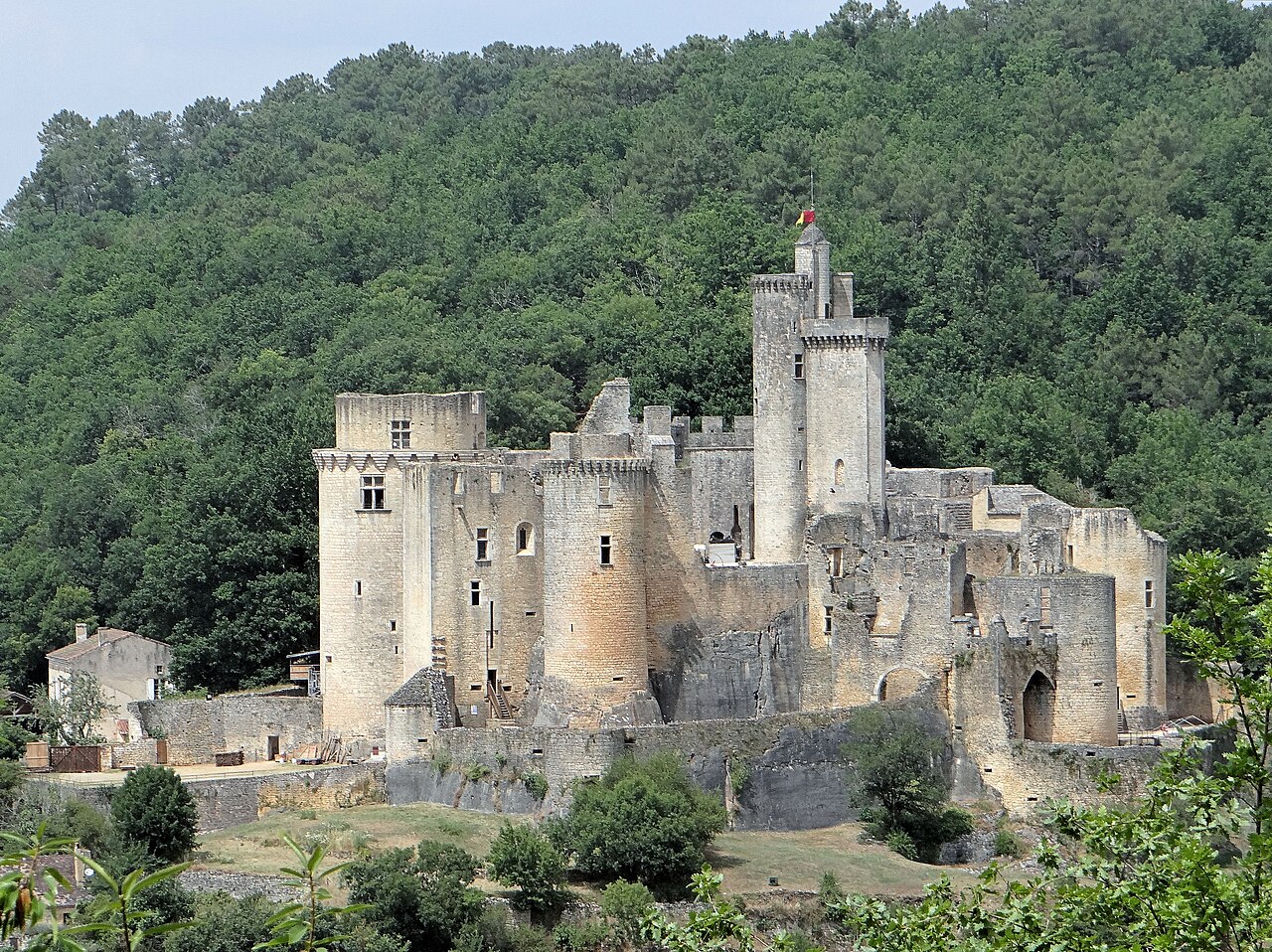
Castle of Bonaguil
The Castle of Bonaguil stands as a remarkable example of late medieval military architecture in France. Known as one of the last fortified castles built during the Middle Ages, it embodies the pinnacle of defensive design against the emerging threat of artillery. Located in Saint-Front-sur-Lemance, the castle occupies a strategic rocky spur, commanding views over the surrounding provinces in southwest France. Its imposing ruins today attract visitors eager to explore a fortress that was both a military marvel and a symbol of feudal power.
Early history and strategic importance
The origins of the Castle of Bonaguil date back to the 13th century when the original stone keep was constructed by Arnaud de la Tour of Fumel, a knight who became the Lord of Bonaguil. The castle's location was carefully chosen for its natural defensive advantages and its position at the crossroads of several important territories. During the Hundred Years War, the Lords of Bonaguil aligned with the English crown, resulting in the fortress changing hands multiple times. It was subjected to sieges, captures, and burnings, reflecting the turbulent political landscape of medieval France. Despite these conflicts, the castle remained under the ownership of the Fumel family, highlighting its significance as a hereditary stronghold.
Renaissance transformation under berenger de roquefeuil
At the close of the 15th century, the castle underwent a profound transformation under Berenger de Roquefeuil, who inherited the property through his mother, Jeanne Catherine of Roquefeuil. Berenger embarked on an ambitious project to modernize the castle's defenses in response to the advent of gunpowder artillery. Over a span of more than 40 years, he expanded and fortified the castle, creating a complex defensive system that integrated the latest military innovations of the late medieval period.
Outer defenses designed to counter artillery
The outer fortifications of Bonaguil were engineered to keep enemy artillery at bay and delay any assault on the main castle. This included a formidable 350-meter long curtain wall reinforced with numerous small towers and over 100 embrasures for firing. These embrasures allowed defenders to use hand-held firearms and crossbows effectively. Large caliber cannons were mounted atop the towers, enabling long-range bombardment of approaching forces.
A deep rock-cut ditch in front of the curtain wall added an extra layer of defense, making any direct attack costly and difficult. Beyond the ditch, a barbican was constructed, defended by several guard towers that provided overlapping fields of fire. The barbican was connected to the main castle by two drawbridges, allowing controlled access and rapid reinforcement.
Additional earthwork fortifications inside the ditch enabled defenders to launch counterattacks and maintain pressure on besiegers. The entire outer defensive circuit was linked by boulevards, facilitating swift movement of troops and supplies throughout the fortress.
Inner defenses and artillery platforms
The inner defensive system focused on protecting the castle's residential and administrative core. Six tall towers were erected, four at the corners and two along the curtain walls. While five of these towers were round, providing better deflection against projectiles, the western middle tower was square, a traditional design element. The height and robust construction of these towers prevented scaling and allowed defenders to observe and repel attackers effectively.
A key innovation was the construction of reinforced artillery platforms atop the towers. These platforms could support the weight and recoil of heavy cannons, marking a significant advancement in fortress design. This adaptation demonstrated the castle's role as a transitional structure between medieval fortifications and early modern artillery forts.
Decline and restoration from the 17th century onwards
Despite its formidable defenses, the Castle of Bonaguil was never subjected to a major artillery siege after its completion. By the mid-17th century, the castle's military importance waned, and it gradually fell into disuse and disrepair. The shift in warfare, favoring more comfortable and less fortified residences, rendered such castles obsolete.
In the 18th century, Marguerite de Fumel acquired the property and undertook restoration efforts. She added new apartments outside the inner walls and maintained the castle as a residence until her death in 1788. However, during the French Revolution, the castle was plundered, and parts of it suffered damage.
In 1862, the municipality purchased the castle and successfully secured its classification as a Historic Monument. This designation initiated a series of restoration projects aimed at preserving the castle's architectural and historical integrity. The most recent significant restoration occurred in 1985, ensuring the castle remains a well-preserved example of medieval military architecture.
Architectural highlights and visitor experience today
The Castle of Bonaguil is celebrated for its comprehensive and innovative defensive features, including its multiple towers, extensive curtain walls, rock-cut ditch, and barbican. The integration of artillery platforms and embrasures illustrates the adaptation of medieval castles to the gunpowder age. Its state of preservation allows visitors to appreciate the complexity of late medieval fortifications.
Today, the castle is open to the public and offers guided tours that explore its history, architecture, and military significance. During summer months, nocturnal tours with lighting and sound effects enhance the visitor experience, bringing the castle's dramatic past to life. The Castle of Bonaguil remains a testament to the ingenuity and resilience of medieval fortification design, making it a must-visit site for enthusiasts of history and architecture.
Frequently asked questions (FAQ)
- How do I get to the Castle of Bonaguil?
- The Castle of Bonaguil is located in Saint-Front-sur-Lemance, accessible by car via local roads from nearby towns such as Villeneuve-sur-Lot. Parking is available near the site for visitors.
- What is the best time to visit the castle?
- The castle is open daily from April to October, with the best visiting conditions in late spring and summer when guided tours and special events are offered.
- Can I explore the castle on my own or only with guided tours?
- Visitors can explore the castle grounds independently, but guided tours are recommended to fully understand the historical and architectural significance of the fortress.
- Are there any special events held at the castle?
- Yes, during summer months, the castle hosts nocturnal tours featuring lighting and sound effects that provide a unique immersive experience.
- Is the castle accessible for visitors with limited mobility?
- Due to the castle's rugged terrain and historic structure, accessibility is limited. Visitors with mobility challenges should inquire in advance about available accommodations.
Information
Opening hours
10:00-18:00, daily from April to October
Ticket prices
€7 adult, €4 child
Current owner
Municipality
Website
Visit websiteSources & official resources
Verify the information above using these authoritative references.
Loading map...
Visitor reviews
No reviews yet. Been here? Write the first review and help other travelers!
Write the first reviewVisited this castle? Share your experience
Your review helps other travelers and adds first-hand knowledge to our encyclopedia.