
Castle of Blandy-les-Tours
The Castle of Blandy-les-Tours is an iconic medieval fortress located in the heart of the village of Blandy-les-Tours, in the Seine-et-Marne department of France. Situated approximately 5 km from the renowned Château de Vaux-le-Vicomte and 10 km from Melun, this castle is a remarkable example of 13th-century feudal architecture that evolved significantly through the High and Late Medieval periods. Its extensive restoration began in 1992, returning the castle to much of its former grandeur and allowing visitors to explore its rich historical layers.
The castle's origins trace back to the early 13th century, first documented in 1216 as a simple manor owned by Adam II de Chailly, Viscount of Melun. Originally, the manor included a stone chapel, the sole stone structure amid timber buildings. Over the centuries, especially during the turbulent times of the Hundred Years' War, the castle underwent major fortifications and expansions that transformed it into a formidable stronghold.
Medieval origins and early development
The initial construction phase of the Castle of Blandy-les-Tours reflects the typical features of a feudal manor in the early Capetian era. The site itself is historically significant, as archaeological evidence reveals a Merovingian necropolis beneath the castle grounds, indicating the location's long-standing importance.
By the 13th century, the manor had a modest stone chapel, while the rest of the buildings were likely wooden. The castle was strategically positioned on a hill, classifying it as a hill castle, which provided natural defensive advantages. This early phase set the foundation for later military enhancements.
Fortifications and transformations during the hundred years' war
The 14th century marked a pivotal era for the castle, as it was extensively fortified to meet the demands of ongoing conflicts. Under the ownership of the counts of Tancarville, notably Jean II and his grandson Guillaume IV, and with financial backing from kings Charles V and Charles VI, the castle was transformed into a robust fortress.
Key defensive features were added during this period, including a wide moat, a new gate-tower equipped with a drawbridge, and the construction of multiple round towers integrated into a polygonal curtain wall. The castle's keep, standing approximately 35 meters tall, was built as part of a hexagonal enclosure around the chapel. This keep is notable for having three separate entrances, an unusual feature in medieval military architecture.
The curtain walls were reinforced with six main towers: the square tower (former gatehouse), the moral tower, the tower of justice, the tower of archives, the keep, and the tower of the guards. The bases of the three latter towers were constructed from durable Fontainebleau sandstone after 1370, while the upper portions were finished around 1390 using more economical gritstone.
These fortifications reflect the castle's strategic importance during the Hundred Years' War, providing defense against sieges and raids. The addition of a chemin de ronde (wall walk) allowed defenders to patrol and defend the walls effectively.
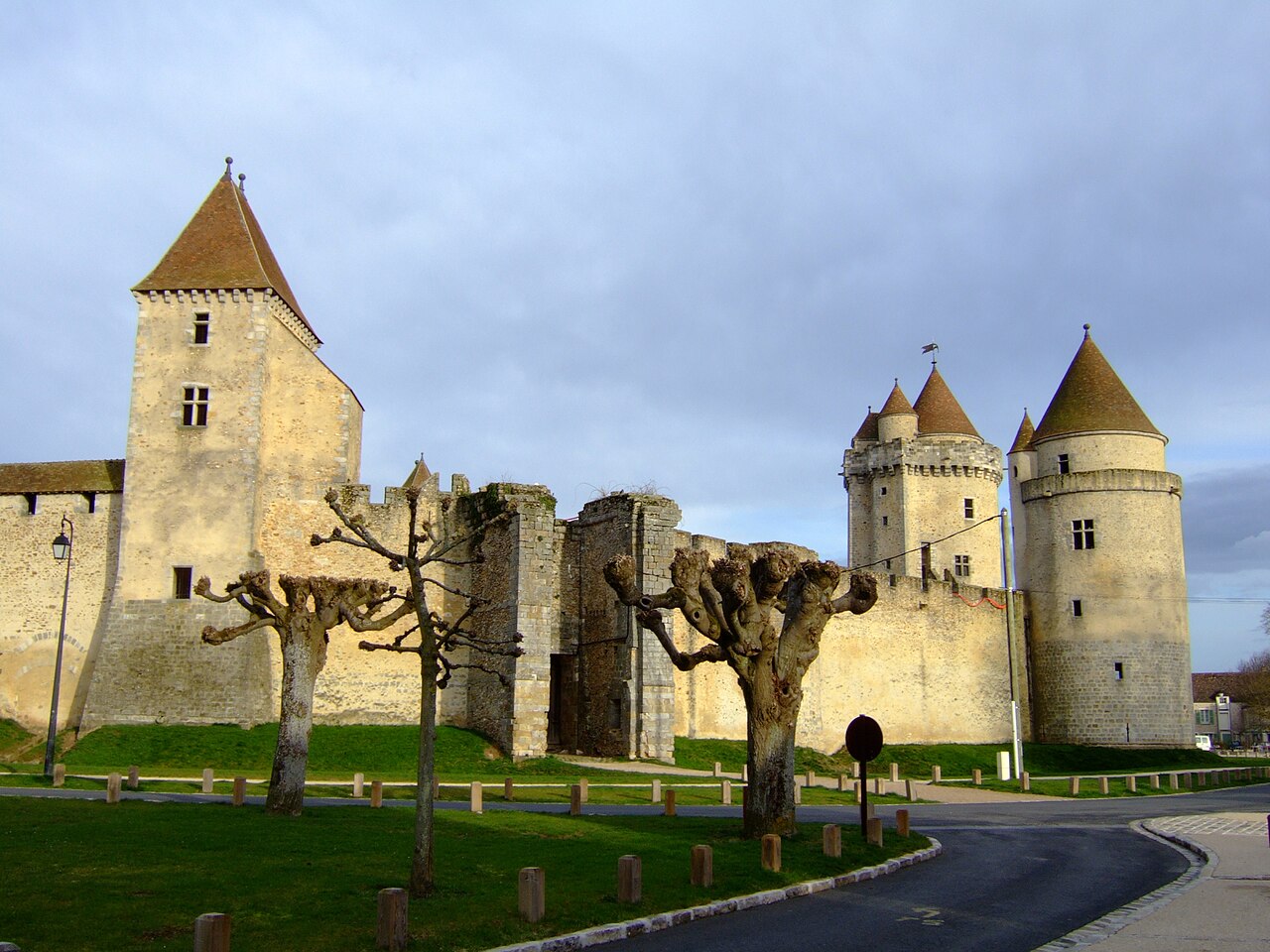
Photo by Lundeux. • CC BY-SA 2.5
Renaissance modifications and noble residence
In the 16th century, the castle transitioned from a strictly military fortress to a more comfortable noble residence. François II of Orleans undertook significant rebuilding efforts to adapt the castle for residential use, adding galleries and gardens that reflected Renaissance tastes.
The castle also gained religious significance as a Protestant refuge connected to the Orléans-Longueville and Rohan families. Jacqueline de Rohan, a prominent Huguenot figure, embraced the Reformed faith and hosted important Protestant leaders like John Calvin and William Farel at Blandy-les-Tours. The castle was a gathering place for Huguenot nobility, including Admiral Gaspard de Coligny and the future King Henry IV. A notable event was the 1572 marriage of Marie de Clèves and Henri I de Bourbon, attended by Henry IV.
Decline, dismantling, and preservation efforts
By the late 17th century, the castle had fallen into disrepair. In 1707, Marshal Claude Louis Hector de Villars, owner of the nearby Château de Vaux-le-Vicomte, acquired Blandy-les-Tours and repurposed it as a farm. This involved removing roofs from the towers, destroying parapets, dismantling the large gatehouse, and filling in the moat, effectively stripping the castle of its defensive features.
These changes inadvertently protected the castle from destruction during the French Revolution, as it no longer symbolized feudal power. The castle continued to deteriorate throughout the 18th and 19th centuries, with the medieval residential buildings eventually demolished in the 1880s due to structural instability.
In 1888, Pierre-Charles Tuot, the mayor of Blandy-les-Tours, purchased the castle and donated it to the municipality. It was officially designated a Monument historique in 1889, recognizing its cultural and historical significance. Volunteer associations began restoration efforts in the 1970s, and the castle was acquired by the Seine-et-Marne departmental council in 1992.
Under the guidance of architect Jacques Moulin, comprehensive excavations and restorations were carried out, culminating in the castle's reopening in 2007 as a cultural venue that blends heritage preservation with contemporary art exhibitions.
Archaeological discoveries and castle features
Excavations in the 1990s uncovered well-preserved latrine pits near the square tower, constructed from local limestone and sandstone. These facilities provide rare insights into medieval sanitation and daily life. Artifacts recovered include ceramics, metal objects related to clothing and household use, high-quality drinking glasses, and colored window glass fragments with geometric and vegetal motifs, reflecting the castle's noble status.
The castle's courtyard contains remains of a Merovingian crypt, underscoring the site's long history of occupation. A 16th-century residential gallery once ran along the east wall, featuring arcades, stables, and a jeu de paume court on the ground floor, with a long gallery above. Though largely vanished, this structure illustrates the castle's adaptation to Renaissance noble life.
Defensive elements such as the protective moat and gate-tower with a drawbridge have been partially restored to their late 16th-century appearance. The combination of large round towers and strong curtain walls exemplifies the castle's evolution from a fortified manor to a military fortress and then to a noble residence.
Architectural significance and heritage value
The Castle of Blandy-les-Tours is a quintessential example of a 13th-century feudal fortress that was transformed into a grand lordly residence in the late 14th century. Its hexagonal plan and polygonal curtain walls with six towers demonstrate the architectural innovations of medieval military design. The unusual feature of the keep having three entrances highlights the complexity and uniqueness of the structure.
The castle's restoration has preserved key elements of its Gothic architectural style, particularly in the fortifications, while also showcasing Renaissance modifications that reflect changing tastes and functions over centuries. Today, the castle serves as both a historical monument and a cultural hub, attracting visitors interested in medieval architecture, history, and archaeology.
Frequently asked questions (FAQ)
- How do I get to the Castle of Blandy-les-Tours?
- The Castle of Blandy-les-Tours is located in the village of Blandy-les-Tours, approximately 50 kilometers east of Paris. You can reach it by car via the A4 motorway or by public transport with a train to the nearby town of Melun, followed by a short bus ride. Parking is available near the castle for visitors traveling by car.
- What is the historical significance of the Castle of Blandy-les-Tours?
- The Castle of Blandy-les-Tours dates back to the 14th century and served as a strategic fortification during the Hundred Years' War. Its well-preserved structure highlights the military architecture of the time and offers insights into the feudal life of the Middle Ages in France. The castle is also a testament to the historical conflicts that shaped the region.
- When was the Castle of Blandy-les-Tours built?
- Construction of the Castle of Blandy-les-Tours began in the late 14th century, with significant modifications made in the following centuries. The castle's architecture reflects various styles and influences, showcasing the evolution of medieval fortifications. Today, it stands as a remarkable example of medieval military architecture.
- Can I visit the Castle of Blandy-les-Tours year-round?
- Yes, the Castle of Blandy-les-Tours is open to visitors throughout the year, but hours may vary by season. It's advisable to check the official website for the most up-to-date information on opening hours and any seasonal events. Guided tours are often available, providing a deeper understanding of the castle's history.
- Why is the Castle of Blandy-les-Tours often recommended as a tourist destination?
- The Castle of Blandy-les-Tours combines stunning architecture with rich historical significance, making it an excellent destination for history enthusiasts. Visitors can explore the castle's towers, walls, and beautiful grounds, while also enjoying breathtaking views of the surrounding countryside. Its proximity to Paris makes it a convenient day trip for tourists.
- Is it possible to take guided tours of the Castle of Blandy-les-Tours?
- Yes, guided tours are available at the Castle of Blandy-les-Tours, offering visitors a comprehensive overview of its history and architecture. Tours are typically conducted by knowledgeable guides who can provide fascinating insights and stories about the castle's past. It's recommended to book in advance, especially during peak tourist seasons.
- What are the ticket prices for the Castle of Blandy-les-Tours?
- Ticket prices for the Castle of Blandy-les-Tours are generally affordable, with discounts available for students, seniors, and groups. Children under a certain age may enter for free. For the most accurate pricing information, including any special promotions, please refer to the official website before your visit.
- What is the best time to visit the Castle of Blandy-les-Tours?
- The best time to visit the Castle of Blandy-les-Tours is during the spring and early autumn months when the weather is mild and pleasant. Additionally, these seasons often feature fewer crowds, allowing for a more enjoyable experience. Special events and exhibitions may also be held during these times, enhancing your visit.
- Are there any nearby attractions to explore after visiting the Castle of Blandy-les-Tours?
- Yes, there are several nearby attractions worth exploring, including the picturesque village of Blandy-les-Tours itself and the scenic landscapes of the Brie region. Additionally, the nearby city of Melun offers historical sites, shops, and restaurants. Combining your castle visit with these local highlights can make for a delightful day out.
Photo gallery

Information
Website
Visit websiteSources & official resources
Verify the information above using these authoritative references.
Loading map...
Visitor reviews
No reviews yet. Been here? Write the first review and help other travelers!
Write the first reviewVisited this castle? Share your experience
Your review helps other travelers and adds first-hand knowledge to our encyclopedia.