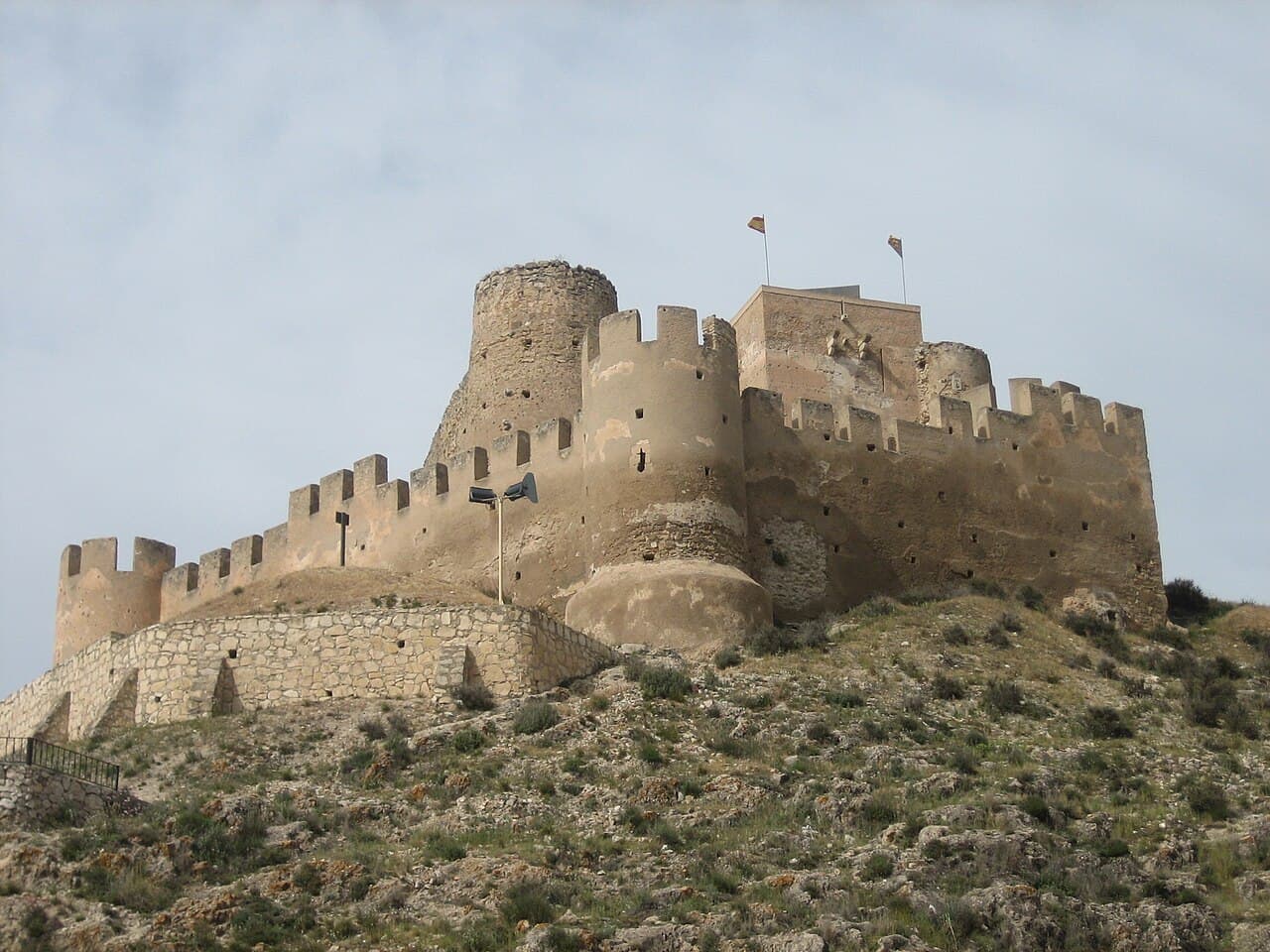
Castle of Biar
The Castle of Biar stands prominently on a hill overlooking the historic town of Biar in the province of Alicante, southeastern Spain. This hill castle is a remarkable example of Almohad military architecture dating back to the 12th century, a period when Muslim rule shaped much of the Iberian Peninsula's defensive structures. The castle's strategic location allowed it to serve as a vital stronghold during the turbulent times of the Reconquista, particularly under the reign of King James I of Aragon, when it functioned as a crucial border fortress between Christian and Muslim territories.
Historical background and significance
The Castle of Biar was originally constructed in the 12th century by the Almohad dynasty, a powerful Muslim dynasty that controlled large parts of Spain and North Africa. Its name, "Biar," derives from the Arabic word for "well," reflecting the importance of water sources in the region and possibly the settlement that existed nearby. The fortress played a pivotal role during the late Reconquista, marking the frontier between the Christian kingdoms of Castile and Aragon and the Muslim territory of Murcia, part of Al-Andalus.
In 1245, the castle was captured by King Jaime I of Aragon, who initially allowed the Muslim inhabitants to remain temporarily. However, the castle's control fluctuated, with a brief Muslim rebellion in 1265 restoring it to Muslim hands before Christian forces reasserted control. Following these conflicts, Arnau de Monzó was granted the castle and undertook significant reconstruction and fortification efforts. Further enhancements were ordered by King Jaime II of Aragon in 1293, including the addition of barracks and utility buildings to strengthen its defensive capabilities.
The castle's military importance continued into the 14th century, notably resisting a siege by King Pedro I of Castile in 1375 during the conflicts between Castile and Aragon. After the dynastic union of these kingdoms, the castle gradually lost its strategic military role and began to decline, though it remained inhabited for some time. In 1931, the Castle of Biar was declared a national historic-artistic monument of Spain, recognizing its cultural and historical value. It is currently owned by the local municipality and forms part of the renowned Route of the Castles of Vinalopó.
Architectural features and layout
The Castle of Biar is a classic example of a concentric fortress, characterized by multiple layers of defensive walls designed to provide successive lines of protection. The centerpiece is a main square keep or donjon that rises approximately 19 meters high. This imposing tower consists of three floors topped by a large observation platform, offering commanding views of the surrounding landscape.
A particularly notable architectural feature is the presence of Almohad ribbed vaults on the upper levels of the keep. These vaults are among the oldest surviving examples in both Spain and North Africa, highlighting the castle's importance as a repository of Islamic architectural innovation. The fortress walls are primarily constructed from stone masonry combined with rammed earth (tapial), a traditional technique used extensively during the period. The keep itself incorporates this earth construction method, which provided both strength and insulation.
Originally, the castle was protected by two concentric defensive walls descending the mountain slopes, with a third wall encircling the town of Biar. Today, only fragments of the second wall remain, while the third wall has largely disappeared. The southern side of the castle faces a steep slope and is naturally defended, thus lacking extensive walls. In contrast, the northern side contains two terraced courtyards that historically served economic and service functions.
The castle's main entrance is situated on the eastern side, leading into a central courtyard around which the interior buildings are arranged. Historical records from the 15th century describe a variety of rooms within the castle complex, including a guardroom, hayloft, a newly constructed palace for the governor's family, pantry, kitchen equipped with a fireplace and oven, stable, dining hall, and a church dedicated to Santa María Magdalena and Santa Quiteria.
Unique architectural elements
One of the castle's most distinctive features is a 12th-century Almohad dome located in the palace area, a rare example of Islamic architectural influence in military buildings. The roofs throughout the castle are covered with curved tiles designed to collect rainwater efficiently. This water was directed into a large cistern carved into the rock beneath the castle, which remains intact today and underscores the importance of sustainable water management in medieval fortifications.
Preservation and current use
The Castle of Biar has undergone various restoration efforts since the late 20th century, aimed at preserving its structural integrity and historical authenticity. Despite centuries of wear and partial ruin, the castle is in well-preserved condition, allowing visitors to appreciate its original defensive features and architectural details.
Today, the castle houses an ethnographic museum that showcases the local history and cultural heritage of the Biar region. Additionally, the former municipal government building is located within the castle grounds, reflecting the site's continued civic importance beyond its military origins. The castle is a key attraction on the Route of the Castles of Vinalopó, drawing tourists interested in medieval history, Islamic architecture, and Spanish heritage.
Visitor information and cultural significance
Visitors to the Castle of Biar can explore its robust defensive walls, the towering keep, and the atmospheric courtyards that reveal layers of history spanning over eight centuries. The castle's blend of Islamic and Christian architectural influences offers a unique insight into the cultural transformations that shaped medieval Spain.
Its designation as a national monument and inclusion in regional heritage routes highlight its importance as a symbol of historical resilience and architectural ingenuity. The castle's preservation efforts ensure that it remains a vital educational resource and a captivating destination for scholars, history enthusiasts, and travelers alike.
Frequently asked questions (FAQ)
- What is the historical significance of the Castle of Biar?
- The Castle of Biar, a prominent example of medieval military architecture, dates back to the 13th century. It played a critical role in the defense of the region during the Reconquista and symbolizes the historical struggle for territory in Spain.
- When was the Castle of Biar built?
- The construction of the Castle of Biar began in 1270 under the orders of the Christian king, James I of Aragon. Over the centuries, it underwent several modifications, reflecting the architectural styles of different eras.
- What are the opening hours for visiting the Castle of Biar?
- The Castle of Biar is typically open to visitors from 10 AM to 6 PM, with extended hours during the summer months. It is advisable to check the official website or local resources for any changes in the schedule.
- Can I access the Castle of Biar with limited mobility?
- While the Castle of Biar has some accessible paths, the uneven terrain and stairs may pose challenges for visitors with limited mobility. It's recommended to contact the site in advance to inquire about specific accessibility options.
- Is it possible to take guided tours of the Castle of Biar?
- Yes, guided tours are available at the Castle of Biar, providing visitors with in-depth insights into its history and architecture. These tours are a fantastic way to enhance your understanding of the castle's significance and the surrounding area.
- What is the best time to visit the Castle of Biar?
- The best time to visit the Castle of Biar is during the spring and fall when the weather is mild and comfortable. Visiting during these seasons also allows you to enjoy fewer crowds, making for a more pleasant experience.
- Are there any nearby attractions to visit along with the Castle of Biar?
- Yes, nearby attractions include the charming village of Biar, known for its traditional architecture, and the beautiful countryside perfect for hiking. Additionally, the historic town of Villena is just a short drive away and offers its own set of attractions.
- What are the ticket prices for the Castle of Biar?
- Ticket prices for the Castle of Biar are generally affordable, with discounts available for students and seniors. It's best to check the official website for the most current pricing and any special offers that may be available during your visit.
Photo gallery

Public domain
Information
Website
Visit websiteSources & official resources
Verify the information above using these authoritative references.
Loading map...
Visitor reviews
No reviews yet. Been here? Write the first review and help other travelers!
Write the first reviewVisited this castle? Share your experience
Your review helps other travelers and adds first-hand knowledge to our encyclopedia.


