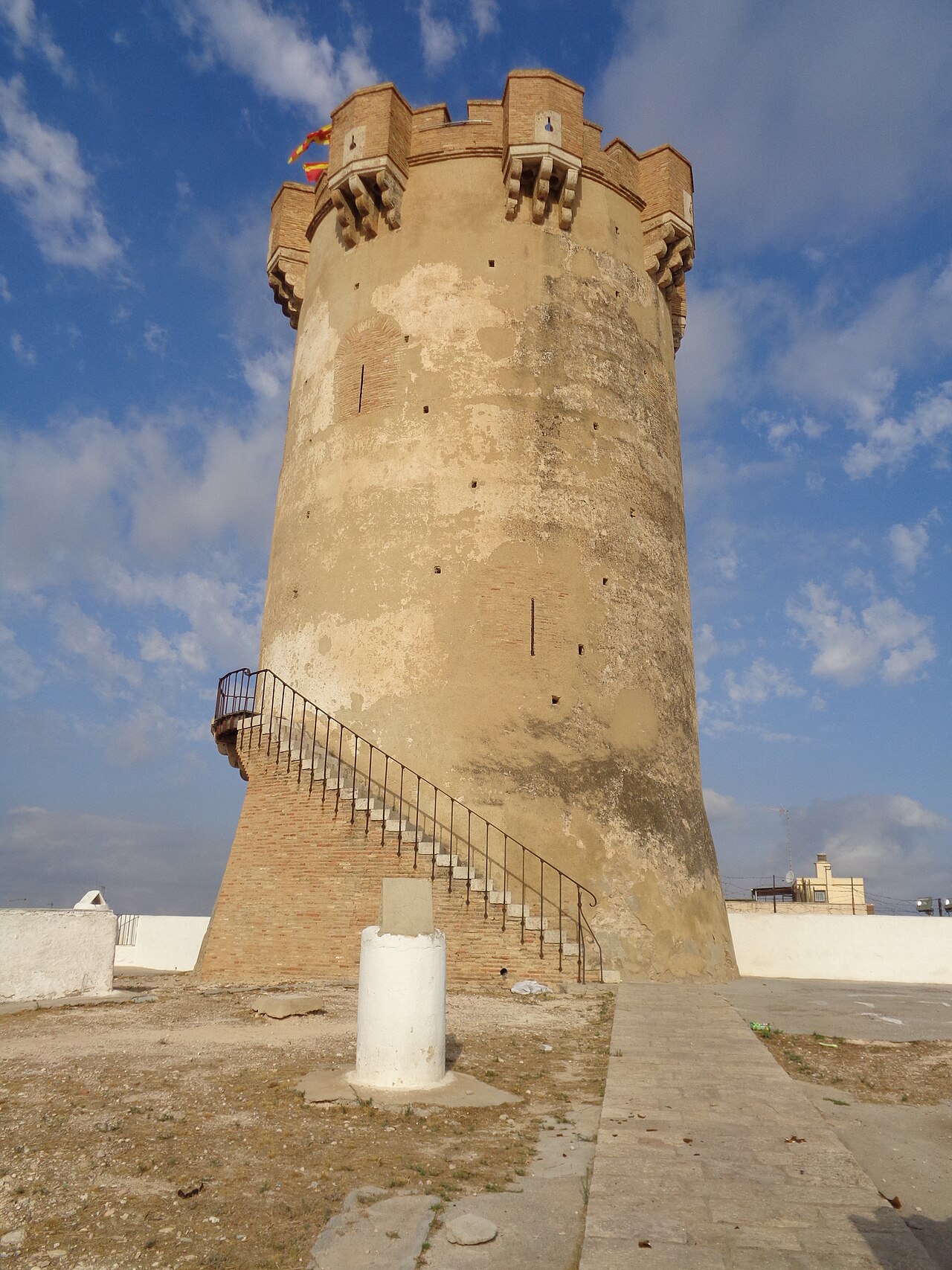
Castle of Benissanó
The Castle of Benissanó stands as a remarkable example of medieval fortification and noble residence in the municipality of Benissanó, Spain. Its origins are deeply rooted in the region's complex history, beginning with an earlier Islamic agricultural settlement known as Benixanut. This reflects the area's Arab heritage prior to the Christian reconquest, a period marked by significant cultural and political shifts that shaped the castle's eventual construction and purpose.
In the latter half of the 15th century, the castle was built by the influential Cavanilles and Villarrasa families, who held lordship over the territory. The structure was designed to fulfill dual roles as a fortified stronghold and a noble residence, combining defensive architecture with domestic comfort. This duality is evident in the castle's layout and surviving features, which include robust walls, towers, and elaborately decorated interiors.
Historical significance and notable events
The castle played a pivotal role during the turbulent political landscape of early modern Spain. Most notably, it served as a place of imprisonment for King Francis I of France, who was held captive here for eighteen days under the orders of Emperor Charles I of Spain. This event highlights the castle's strategic importance and its involvement in the broader European conflicts of the time. Within the chamber where Francis I was confined, a frieze adorns the ceiling, featuring alternating coats of arms of the Cavanilles and Villarrasa families alongside a cryptic inscription linked to a local legend about the king's captivity, intertwining the castle's architecture with its historical narrative.
Architectural features and defensive systems
The Castle of Benissanó is distinguished by its sophisticated defensive system, comprising three concentric walls that once enclosed the entire complex. Each wall is reinforced by four evenly spaced towers, enhancing the castle's defensive capabilities and providing vantage points for surveillance and protection. These walls and towers exemplify the military architectural principles of the late medieval period, designed to withstand sieges and control access.
The castle originally featured three main gates named Bétera, Llíria, and València, all of which survive largely intact. These gates served as critical points of controlled entry and exit, reflecting the castle's role as both a military fortress and a seat of local governance. The removal of features such as the original drawbridge, moat, and a central tower with a triangular point occurred over time, indicating adaptations to changing defensive needs and architectural trends.
Interior spaces and decorative arts
Inside the castle, the central courtyard, known as the patio de armas, remains a focal point around which various rooms are arranged. A vestibule leads to underground chambers that have been repurposed as wine cellars, illustrating the continuity of use and adaptation of the castle's spaces over centuries.
The noble hall is particularly notable for its rich decorative elements, which were added during a late 19th-century restoration. This includes heraldic doors bearing the coats of arms of the founding families, an ornate chimney, stained glass windows, and historic tiles that collectively enhance the hall's historic ambiance and reflect the castle's noble heritage.
Throughout the castle, tile work of significant historical value can be found. Some tiles date back to the late 14th century from the Cárcer factory, while others are from the late 15th-century Manises blue ceramics tradition. Additionally, select ceilings feature traditional "socarrats" or "cremats", types of decorated terracotta tiles originating from Paterna. These elements showcase regional craftsmanship and contribute to the castle's unique interior ornamentation.
Ownership history and modern use
Over the centuries, the castle has seen various modifications and changes in ownership. In the late 20th century, the property changed hands multiple times, reflecting shifts in its intended use. In 1987, it was acquired by Vidal Valle, who planned to establish a contemporary art museum, although this project was never realized. Financial difficulties led to the castle's seizure by Caja Madrid in 1994, followed by its auction in 1996.
Eventually, the castle was jointly purchased by the Generalitat Valenciana and the Benissanó town council. Since becoming public municipal property, the castle has been repurposed as a cultural venue. Notably, it has hosted the International Music Festival "Castell de Benissanó" since 2016, demonstrating its ongoing relevance as a site of cultural heritage and community engagement.
Preservation and cultural importance
The Castle of Benissanó preserves essential features of its original defensive and residential design, with many architectural elements restored or maintained to retain historical authenticity. The survival of its three concentric walls, four towers, and the three main gates provides valuable insight into medieval military architecture in the Valencian region.
Its interiors, including the noble hall and the chamber of King Francis I, offer a glimpse into the artistic and cultural expressions of the families who ruled there. The castle's tile work and decorative arts are significant for understanding regional craftsmanship traditions, particularly the use of Manises ceramics and Paterna terracotta tiles.
Today, the castle stands as a monument to the layered history of the area, from its Islamic roots through the Christian reconquest to its role in European political history. It remains an important cultural and historical landmark, attracting visitors interested in medieval architecture, Spanish history, and heritage conservation.
Frequently asked questions (FAQ)
- How do I visit the Castle of Benissanó?
- The Castle of Benissanó is open to the public as a cultural venue. Visitors can check local tourism websites or contact the Benissanó town council for current opening hours and guided tour availability.
- What is the historical significance of the Castle of Benissanó?
- The castle is historically significant for its role as a fortified noble residence and for imprisoning King Francis I of France in the 16th century, reflecting its importance in regional and European history.
- Can I attend events at the Castle of Benissanó?
- Yes, the castle hosts cultural events such as the International Music Festival "Castell de Benissanó," held annually since 2016, offering visitors a unique experience combining history and the arts.
- What architectural features are notable at the Castle of Benissanó?
- Notable features include its three concentric defensive walls, four towers, three preserved gates, a noble hall with heraldic decorations, and historically significant tile work from regional ceramic traditions.
- Is the castle wheelchair accessible?
- Due to its medieval structure and partial restoration, accessibility may be limited. Visitors with mobility concerns should inquire in advance about accommodations and accessible areas within the castle.
Information
Sources & official resources
Verify the information above using these authoritative references.
Loading map...
Visitor reviews
No reviews yet. Been here? Write the first review and help other travelers!
Write the first reviewVisited this castle? Share your experience
Your review helps other travelers and adds first-hand knowledge to our encyclopedia.