Castle of Agia Mavra
The Castle of Agia Mavra, also known as Santa Maura, is a historic bastioned fortress located on the Greek island of Lefkada. Overlooking the strategic Drepanos Channel, this castle has witnessed centuries of military, political, and cultural transformations since its initial construction around 1300. Its imposing ruins stand as a testament to the island's complex history, marked by a succession of rulers including the Orsini family, Venetians, Ottomans, and later European powers.
Early history and construction
Following the Fourth Crusade in 1204, the Byzantine Empire fragmented, leading to the establishment of the Despotate of Epirus, which controlled much of western Greece, including Lefkada. In 1294, the island was gifted to the Lombard Count of Orsini, who sought to fortify the island against frequent pirate raids and invasions. The Count initiated the construction of a large fortification beginning in 1300, completing it by 1302. This early castle covered approximately 25,000 square meters and was surrounded by a moat, a defensive feature typical of medieval fortresses.
Within its walls, the castle housed about 200 stone houses, two baths, a seminary, and two schools, reflecting its role as a fortified town rather than just a military installation. Equipped with an impressive arsenal of 126 cannons, the fortress was named in honor of Saint Maura, which also lent its name to the entire island for a period.
Medieval and renaissance transformations
Throughout the 14th and 15th centuries, the castle changed hands multiple times. The Orsini family lost control in 1331 to Walter VI of Brienne, followed by Venetian acquisition under Graziano Giorgio in 1343. By the mid-14th century, the fortress was seized by Leonardo I Tocco, whose successors, especially Carlo I Tocco, expanded the castle into a walled town and administrative center. This period marked the castle's zenith as a fortified capital.
The Ottoman Empire captured the fortress in 1479, briefly lost it to Venice from 1502 to 1503, before regaining control through a peace treaty. Under Ottoman rule, the castle town, known as Aya Mavra, served as Lefkada's capital, housing around 1,000 Greek Christian residents and a garrison of over 100 soldiers in the early 16th century.
A significant Ottoman engineering achievement was the construction of a three-kilometer aqueduct in 1564, which supplied fresh water from the island's interior to the fortress and its inhabitants. This aqueduct also functioned as the only land access route to the island besides sea passage, underscoring the castle's strategic importance.
The 16th and 17th century rebuilding and military significance
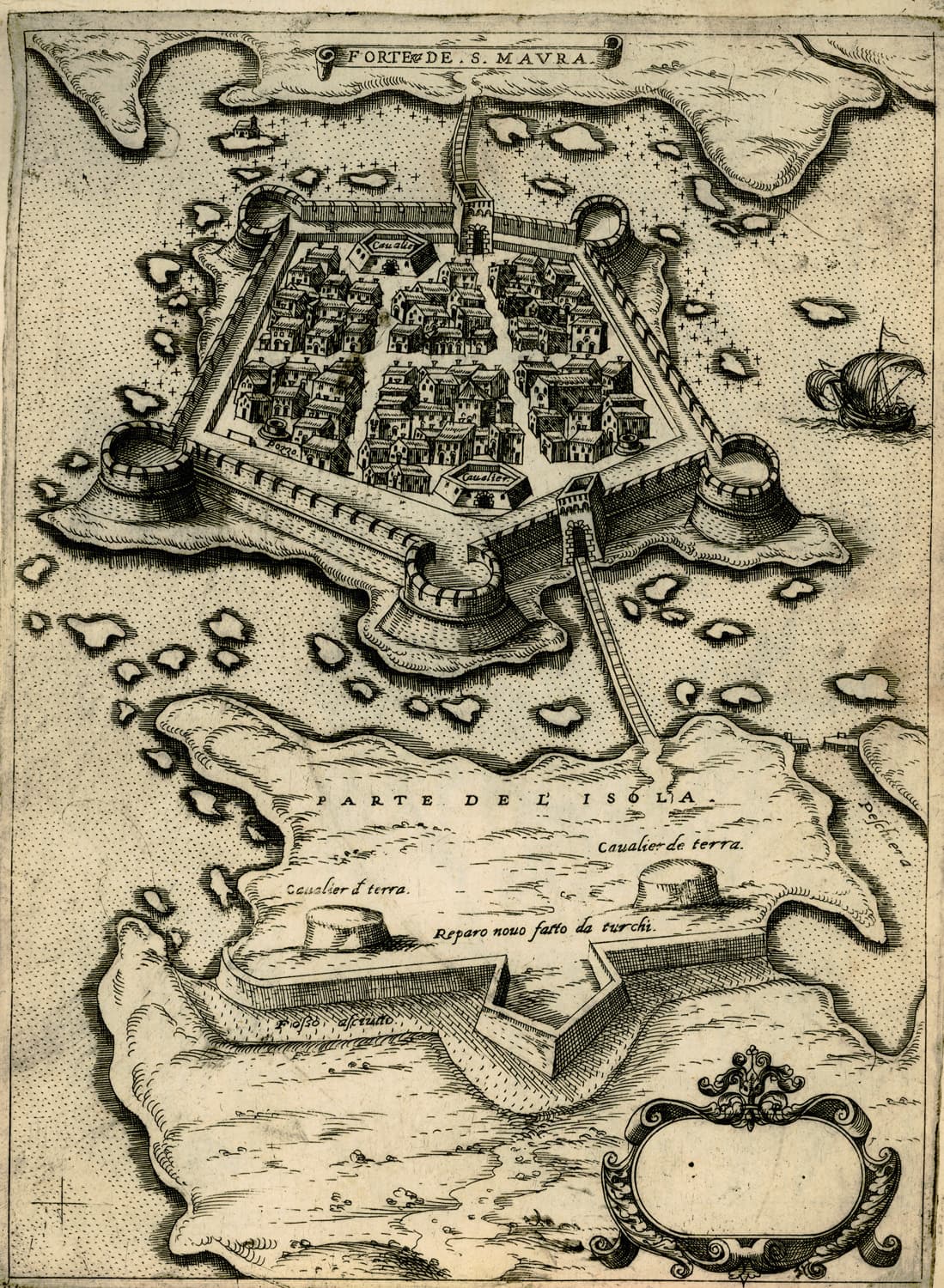
Following the Battle of Lepanto in 1571, the Ottoman admiral Kapudan Pasha Kılıç Ali Pasha ordered extensive rebuilding and enlargement of the castle from 1572 to 1574. This reconstruction gave the fortress its present largely preserved form, characterized by an irregular hexagonal layout fortified with nine large rounded bastions designed for artillery defense.
By the late 17th century, the population within the fortress was exclusively Muslim, while the Christian population lived in wooden suburbs outside the walls. These suburbs were later removed during Venetian occupation to improve defensive capabilities.
The Republic of Venice recaptured the fortress in 1684 after a brief siege during the Morean War. Venetian authorities demolished the medieval town and suburbs to clear a glacis, an open field in front of the walls to expose attackers. They also modernized the fortifications by removing the medieval citadel, reinforcing eastern ramparts with new bastions, and adding outworks such as a ravelin and couvreface, enhancing the castle's defensive strength.
Later history and decline
During the Seventh Ottoman–Venetian War (1715–1716), the castle was briefly abandoned and partially demolished but quickly restored after Venetian victories. Control of the Ionian Islands shifted multiple times between France, Russia, the Septinsular Republic, and again France between 1797 and 1810. The British captured the fortress in 1810 and maintained a garrison during their protectorate, implementing some modernization.
After the union of the Ionian Islands with Greece in 1864, the Greek army used the castle until 1922, when it was repurposed as a refugee shelter. Most internal buildings were demolished in 1938, leaving the castle largely in ruins.
Architectural features and remains
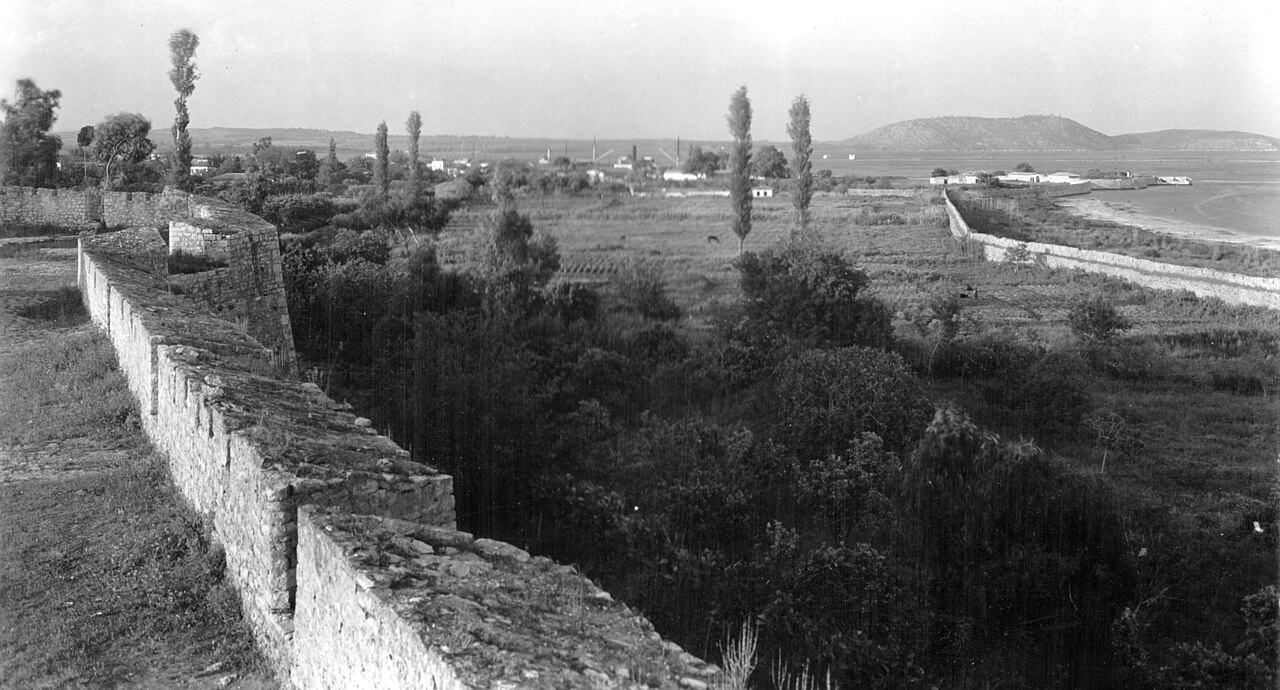
The castle occupies a strategic sandy peninsula projecting toward Epirus, guarding maritime access to Lefkada. Its irregular hexagonal shape measures approximately 220 meters long and 150 meters wide. The fortress walls, primarily from the Ottoman reconstruction, are reinforced with nine large rounded bastions designed for overlapping artillery coverage.
The northeastern corner preserves a section of the original medieval fortress, acting as a citadel within the larger fortification. This area provides insight into the castle's earlier phases before the extensive Ottoman rebuilding.
The 1564 aqueduct remains a notable engineering feat, supplying water and serving as a critical land route. Venetian modifications introduced a glacis and removed medieval structures to optimize defense, while British-era updates added minor modernizations.
Today, the castle stands as a significant archaeological site and a symbol of Lefkada's layered history, attracting visitors interested in medieval and early modern military architecture.
Visitor information and cultural significance
The Castle of Agia Mavra is accessible to visitors who can explore its extensive ruins and appreciate its strategic location overlooking the Drepanos Channel. Its layered history reflects the complex interactions of Western European and Ottoman powers in the Ionian Sea region.
As a bastioned fortress, it exemplifies the evolution of military architecture from medieval fortifications to early modern artillery defenses. The site offers valuable insights into the historical shifts in control, cultural influences, and architectural advancements over several centuries.
Frequently asked questions (FAQ)
- When was the Castle of Agia Mavra originally built?
- Construction of the Castle of Agia Mavra began in 1300 and was completed by 1302 under the Lombard Count of Orsini.
- What architectural style characterizes the castle?
- The castle primarily reflects late medieval military architecture with significant Ottoman-era bastioned fortifications added in the 16th century.
- How did the castle's role evolve over time?
- Initially a fortified town and administrative center, the castle evolved into a bastioned fortress with advanced artillery defenses under Ottoman and Venetian rule.
- Is the castle accessible to visitors today?
- Yes, the ruins of the Castle of Agia Mavra are open to visitors who can explore the extensive remains and enjoy views of the Drepanos Channel.
- What are some notable features of the castle?
- Notable features include its irregular hexagonal layout, nine large rounded bastions, a medieval citadel section, and a 16th-century aqueduct supplying fresh water.
Photo gallery

Photo by Giovanni Francesco Camocio•Public domain
Information
Website
Visit websiteSources & official resources
Verify the information above using these authoritative references.
Loading map...
Visitor reviews
No reviews yet. Been here? Write the first review and help other travelers!
Write the first reviewVisited this castle? Share your experience
Your review helps other travelers and adds first-hand knowledge to our encyclopedia.