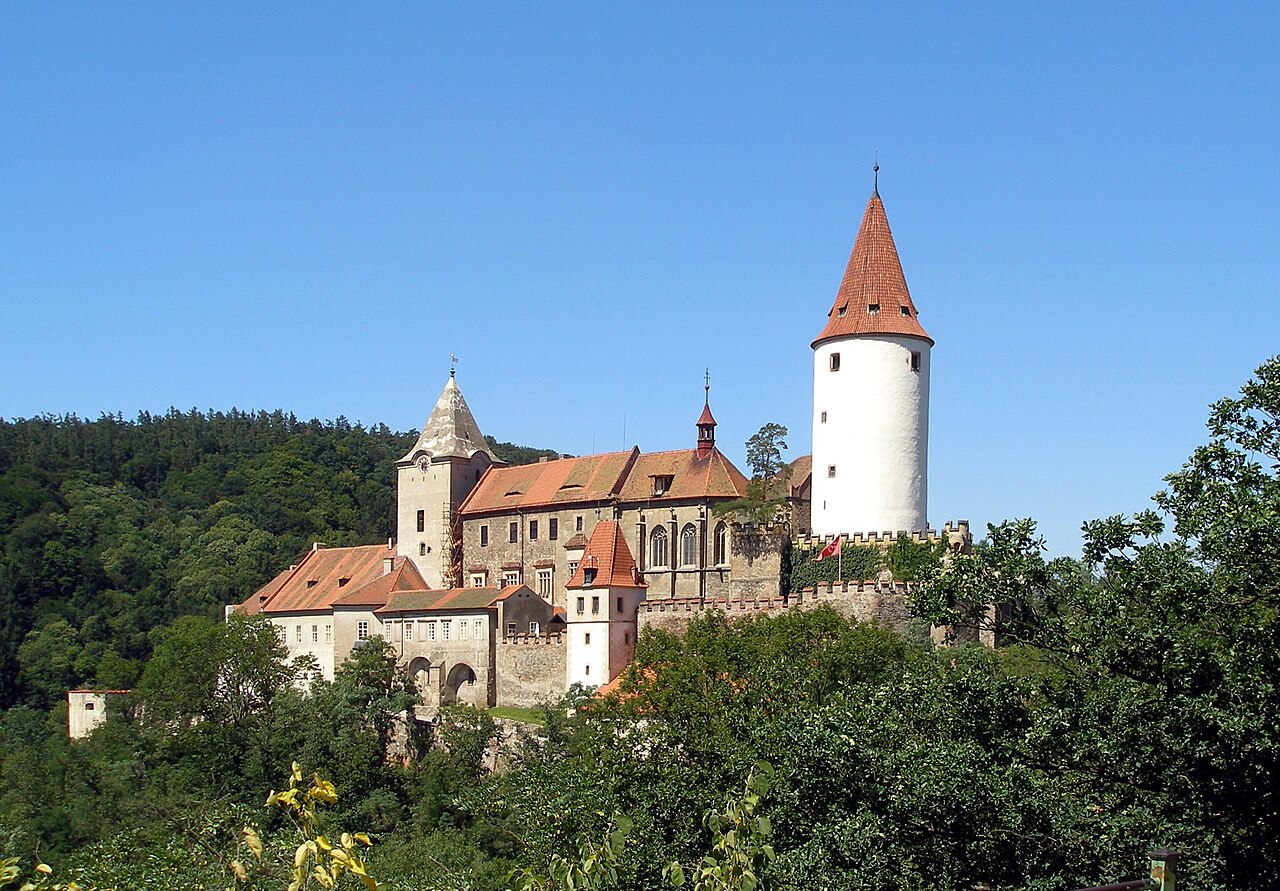
Castle Nižbor
Castle Nižbor stands as a significant hill castle in the municipality of Nižbor, Czechia, with origins tracing back to the 13th century. Founded by the Bohemian king Přemysl Otakar II, it was originally named Miesenburg after the nearby river Mže, now known as the Berounka. This castle played a crucial role as a royal fortress and administrative center during the High medieval period, reflecting the strategic importance of its location overlooking the confluence of the Berounka River and Habrový Creek.
The castle's early history is closely tied to the reign of Přemysl Otakar II, who in 1265 issued a charter at Nižbor permitting the foundation of the town of Polička and established the Podbrdy district office there. Although some sources attribute the founding to his predecessor Václav I, the castle's documented prominence begins under Přemysl Otakar II's rule. Throughout the late 13th and early 14th centuries, Nižbor was managed by appointed burgraves, with notable figures such as Dětřich Špaček z Kostelce overseeing it between 1278 and 1283.
Medieval significance and ownership changes
King Václav II favored the castle and undertook extensive efforts to expand and strengthen its defenses from 1284 to 1301. The castle's ownership shifted multiple times during this period. In 1307, it was taken by the noble Vilém Zajíc z Valdeka before returning to royal control in 1319. Subsequently, it was pledged to various nobles, including the Janovic brothers and Duke Rudolf I of Saxony. After 1341, it became the residence of Moravian Margrave Jan Jindřich.
In 1384, King Václav IV pledged the castle to Konrád ze Zlosiny and later to his cupbearer Jan Kunat. The fortress was captured by Hussite forces in 1425 during the Hussite wars but was soon retaken. Repairs were carried out by Mikuláš Kapoun ze Smiřic and his son Petr. The castle changed hands again in 1510 when Jan Otto z Losu acquired it, and his son reinforced its fortifications in 1538.
Renaissance and baroque transformations
At the start of the 17th century, Emperor Rudolf II granted Nižbor free estate status to Konrád Šanovec ze Šanova in 1601, who began Renaissance-style renovations. However, financial difficulties led to the castle's sale in 1613 to Fridrich Mičan z Klinštejna. The Mičan family later took part in the Bohemian Revolt. Ownership passed through marriage to Mandaléna Polyxena z Ladronu, who sold it to Pavel Morzin in 1664.
In 1679, Prince Jan Adolf I of Schwarzenberg acquired Nižbor, integrating it with his Křivoklát estate. The castle was sold again in 1685 to Arnošt Josef z Valdštejna, whose son Jan Josef Valdštejn transformed the Renaissance castle into a Baroque chateau. The Fürstenberg family owned the castle from 1731 until 1929, during which time Princess Leontýna established a notable library with approximately 5,000 volumes.
Modern era and restoration
Following World War II, the castle was divided into apartments and underwent roof reconstruction in 1971. By 1997, the local municipality took ownership of the dilapidated structure and initiated restoration efforts in the early 2000s. Since 2004, Castle Nižbor has hosted a multimedia exhibition and information center dedicated to Celtic culture, showcasing daily life, crafts, deities, and warfare of the Celts.
Architectural features and castle remains
Castle Nižbor is a two-part fortress built on a sloping promontory, offering commanding views of the Berounka River and Habrový Creek junction. Its original design included multiple towers, although these provided only limited flanking defense, making it an unusual example of a castellated fortress with a misunderstood historical design.
Historical depictions show a tower at the corner of the gatehouse facing the river. Present-day remains include fragments of the northern perimeter wall and a latrine tower on the northern side. The castle’s interior housed two main palace buildings: the northern palace, partially preserved, features a large hall illuminated by grand traceried windows, typical of medieval architecture. This palace includes a round tower at its northwest corner and a preserved round flank tower on the east side, attached to a polygonal chapel originally dedicated to Saint Catherine.
While some have speculated about a fortified enclosure or parkán around the chapel, archaeological investigations have not confirmed this. One of the massive buttresses supporting the northern palace originally served as an additional latrine tower.
The southern palace, opposite the northern one, tapered toward the chapel and was divided into at least three rooms in its eastern section. It likely collapsed in the 14th century due to unstable ground but its outer wall was repaired and reused as a defensive barrier.
Archaeological work has revealed varied terrain levels within the castle’s second courtyard, with the western section lying two to three meters below the medieval ground level. A neck ditch protecting the castle’s approach and the main gatehouse location with a tower at the northwest corner of the front castle section have also been confirmed. During Baroque renovations, part of this ditch was adapted to create cellar spaces beneath later constructions.
Courtyard sundials and meridian line
Two sundials remain visible in the castle courtyard. The left sundial shows true local solar time with the Latin inscription "Sine sole nequid sum", meaning "Without the sun I am nothing." The right sundial indicates the old Bohemian time system, counting hours from the previous sunset, with the inscription "Sol cognovit occasum suum", meaning "The sun has counted its setting." A meridian line marked in the courtyard paving traces the path of the 14th eastern meridian relative to Greenwich, noted by a simple plaque.
Church of the exaltation of the holy cross
Adjacent to the eastern side of the chateau stands the Church of the Exaltation of the Holy Cross, rebuilt in the Baroque style in 1724 by architect František Maxmilián Kaňka. This church is positioned on a cliff edge directly above an earlier Gothic chapel dating from the 13th century, reflecting the site's long-standing religious significance.
Frequently asked questions (FAQ)
- How do I visit Castle Nižbor and what can I expect?
- Castle Nižbor is open to visitors who can explore its partially restored medieval fortress remains and a multimedia exhibition on Celtic culture. Check with the Municipality of Nižbor for current opening hours and any guided tours available.
- What is the historical significance of Castle Nižbor?
- Castle Nižbor was founded in the 13th century by King Přemysl Otakar II and served as a royal fortress and administrative center. It played a key role in regional defense and governance through the medieval and Renaissance periods.
- What architectural styles are represented at Castle Nižbor?
- Castle Nižbor features a mix of architectural styles, including medieval Gothic elements in the palace and chapel, Renaissance renovations, and Baroque transformations, especially in the chateau and the adjacent church.
- Is Castle Nižbor accessible for people with mobility issues?
- Due to its medieval hilltop location and partially restored condition, some areas of Castle Nižbor may be challenging for visitors with mobility issues. It is advisable to contact the local municipality for detailed accessibility information.
- When is the best time to visit Castle Nižbor?
- The best time to visit Castle Nižbor is during the late spring to early autumn months when weather conditions are favorable for exploring the outdoor fortress remains and enjoying the exhibitions.
- Are there any nearby attractions to combine with a visit to Castle Nižbor?
- Visitors can explore the nearby Berounka River valley and the historic town of Nižbor itself. The region offers hiking opportunities and other cultural sites, making it a worthwhile day trip.
Information
Architect
František Maxmilián Kaňka
Current owner
Municipality of Nižbor
Website
Visit websiteSources & official resources
Verify the information above using these authoritative references.
Loading map...
Visitor reviews
No reviews yet. Been here? Write the first review and help other travelers!
Write the first reviewVisited this castle? Share your experience
Your review helps other travelers and adds first-hand knowledge to our encyclopedia.