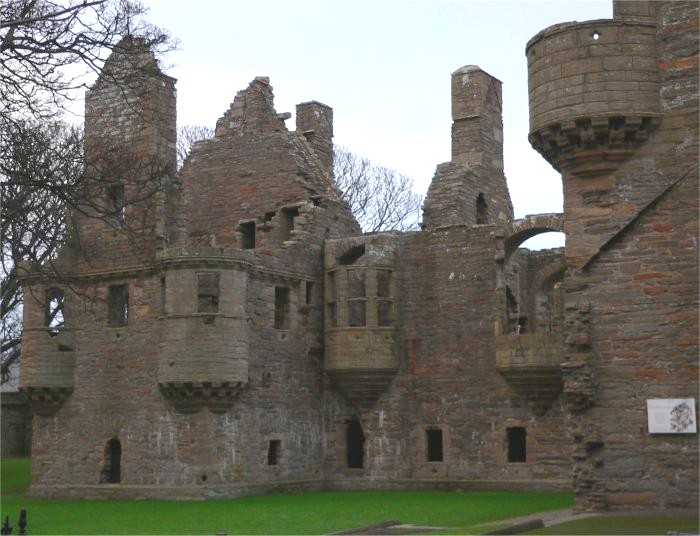
Castle Bloody
Castle Bloody is a prehistoric archaeological site located on the island of Shapinsay in the Orkney archipelago of Scotland. Despite its name, Castle Bloody is not a medieval castle but rather a prehistoric souterrain, also known as an earth house. This subterranean structure dates back to around 3000 BC, placing it firmly in the Neolithic period. It is one of the notable prehistoric features in Orkney, a region renowned for its rich archaeological heritage.
The site is often misidentified as a chambered mound on official maps such as the UK Ordnance Survey, but detailed studies have clarified that it is more accurately classified as a souterrain. These underground constructions were typically used for storage, shelter, or ritual purposes by ancient communities. The structure consists of carefully built stone walls forming a roofed underground chamber, which would have been covered by earth or turf.
Architectural characteristics of castle bloody
The architecture of Castle Bloody exemplifies the ingenuity of prehistoric builders in Orkney. The souterrain features dry-stone construction techniques common in Neolithic Scotland, where stones were stacked without mortar to create stable walls and roofing slabs. The underground chamber was designed to be concealed and insulated, providing protection from the harsh northern climate.
The entrance to the souterrain is narrow and low, emphasizing its function as a hidden or secure space. Inside, the chamber would have been dark and cool, suitable for storing perishable goods or possibly serving as a refuge. The exact layout and dimensions of Castle Bloody are characteristic of similar earth houses found in Orkney, which often include a main chamber and smaller side cells.
Historical and cultural context
Castle Bloody is part of the broader prehistoric landscape of Orkney, which includes famous sites such as the Ring of Brodgar, Maeshowe, and Skara Brae. These sites collectively demonstrate the advanced social and architectural development of Neolithic communities in this region.
The souterrain likely played a role in the daily life and spiritual practices of its builders. While the precise purpose of earth houses remains debated among archaeologists, they are generally seen as multifunctional structures. The proximity of Castle Bloody to the ruined historic Linton Chapel indicates the continuity of sacred or significant sites in this area over millennia.
Preservation and current condition
Today, Castle Bloody is classified as an archaeological site rather than a castle in the traditional sense. Its preservation state reflects its ancient origins and the effects of millennia of weathering. The site is partially visible above ground, with stone remains accessible to visitors interested in prehistoric archaeology.
As a protected heritage site, Castle Bloody offers insights into early human settlement and architectural practices in Orkney. Visitors to Shapinsay can explore this unique structure alongside other historical landmarks, gaining a deeper appreciation for Scotland's prehistoric past.
Visiting castle bloody
Access to Castle Bloody is generally open to the public, though facilities are minimal due to its remote and ancient nature. Visitors are encouraged to respect the site, as it is fragile and of significant archaeological importance. The nearby village on Shapinsay provides amenities and information for tourists.
Castle Bloody is best visited during the warmer months when weather conditions are more favorable for exploring outdoor archaeological sites in Orkney. Its location near other notable prehistoric and historic sites makes it a valuable stop for those interested in Scotland's ancient heritage.
Frequently asked questions (FAQ)
- What is Castle Bloody and why is it significant?
- Castle Bloody is a prehistoric souterrain on Shapinsay, Orkney, dating from around 3000 BC. It is significant as an example of Neolithic underground architecture used for storage or shelter.
- How do I visit Castle Bloody?
- Castle Bloody is accessible to the public on Shapinsay island. Visitors should be prepared for minimal facilities and respect the fragile archaeological site during their visit.
- When was Castle Bloody built?
- Castle Bloody was constructed around 3000 BC during the Neolithic period, making it one of the oldest known prehistoric structures in Orkney.
- What architectural features define Castle Bloody?
- Castle Bloody features dry-stone construction with a narrow entrance and underground chambers typical of souterrains, designed for concealment and protection.
- Is Castle Bloody related to any other historical sites nearby?
- Yes, Castle Bloody is near the ruined Linton Chapel and is part of the rich prehistoric landscape of Orkney, including sites like the Ring of Brodgar and Skara Brae.
Information
Loading map...
Visitor reviews
No reviews yet. Been here? Write the first review and help other travelers!
Write the first reviewVisited this castle? Share your experience
Your review helps other travelers and adds first-hand knowledge to our encyclopedia.