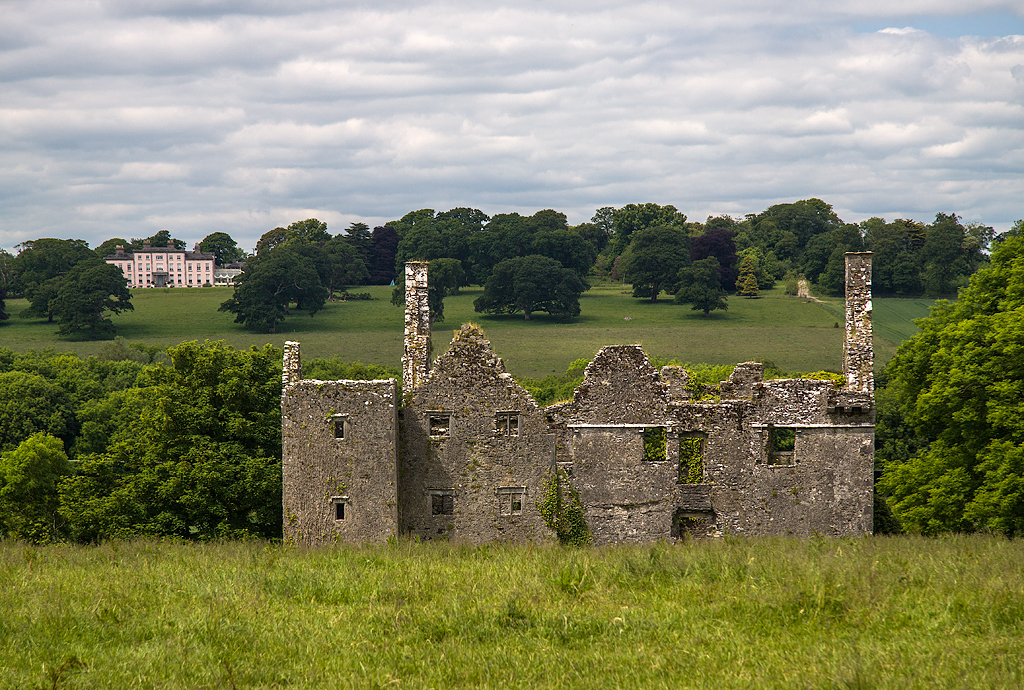
Castle Barrett
Castle Barrett, also historically known as Castle More or Castlemore, is a notable medieval castle ruin located in the townland of Castlebarrett, County Cork, Ireland. Perched on a hill overlooking the Clyda River valley, the castle's strategic position offered commanding views and defensive advantages in its time. The site is freely accessible to visitors, offering a glimpse into Ireland's layered medieval and early modern history.
The origins and early history of Castle Barrett
The earliest recorded mention of Castle Barrett dates back to 1252, when it was referred to as Castle More. It was during this time that the Anglo-Irish knight John de Cogan was granted permission to hold a weekly market and an annual fair beside the castle, indicating its significance as a local center of power and commerce. The castle was likely constructed earlier in the 13th century, serving as a fortified residence and stronghold overseeing the surrounding lands.
Between 1276 and 1281, the castle underwent repairs while under royal control, reflecting its ongoing strategic importance. By the mid-15th century, specifically in 1439, the castle came into the possession of the powerful Earl of Desmond, a prominent noble family in Munster with substantial influence in the region.
Transition to the Barrett family and Renaissance-era changes
In the early 17th century, the castle passed into the hands of the Barrett family, a notable Anglo-Norman lineage in Ireland. This period corresponds with the Renaissance era in Ireland, during which many castles saw modifications to adapt to changing military technologies and domestic needs. While Castle Barrett retained much of its medieval character, some alterations may have been made to accommodate more comfortable living quarters and updated defensive features.
Conflict, destruction, and decline
The castle's fortunes waned during the turbulent 17th century. In 1645, it suffered damage inflicted by the forces of Oliver Cromwell during his military campaigns in Ireland. Later, following the Battle of the Boyne in 1690, John Barrett, a supporter of the Jacobite cause, was dispossessed of his lands. Subsequently, Castle Barrett was destroyed, marking the end of its active use as a fortified residence.
Architectural features and current condition
Today, Castle Barrett remains as a ruined castle that offers visitors a tangible connection to Ireland's medieval past. The surviving structures include remnants of defensive walls and portions of the main tower, which reflect typical features of a 13th-century hill castle. Its location on elevated ground overlooking the valley remains a key aspect of its original defensive design.
The castle is classified as a hill castle, constructed primarily for defense and control of the surrounding territory. Despite its ruinous state, it retains enough architectural interest to attract historians and tourists alike.
Visiting Castle Barrett
Castle Barrett is freely accessible to the public, situated in a rural field setting. Visitors can explore the ruins at their leisure and enjoy the scenic views of the Clyda River valley. The site offers an intimate experience of Ireland's medieval heritage without the crowds often found at more famous castles.
While facilities are limited due to its status as a ruin, the castle's historical significance and picturesque location make it a worthwhile destination for enthusiasts of Irish history and castle architecture.
Frequently asked questions (FAQ)
- When was Castle Barrett originally built?
- Castle Barrett was likely constructed in the 13th century, with the first recorded mention in 1252.
- What historical events affected Castle Barrett?
- The castle was repaired under royal control between 1276 and 1281, damaged by Oliver Cromwell's forces in 1645, and destroyed after the Battle of the Boyne in 1690.
- Can visitors freely access Castle Barrett?
- Yes, Castle Barrett is freely accessible to the public, allowing visitors to explore the ruins and surrounding landscape.
- What type of castle is Castle Barrett?
- Castle Barrett is classified as a hill castle, built on elevated ground for defensive purposes.
- Who were the notable owners of Castle Barrett?
- Notable owners include the Anglo-Irish knight John de Cogan, the Earl of Desmond, and the Barrett family in the 17th century.
Information
Loading map...
Visitor reviews
No reviews yet. Been here? Write the first review and help other travelers!
Write the first reviewVisited this castle? Share your experience
Your review helps other travelers and adds first-hand knowledge to our encyclopedia.