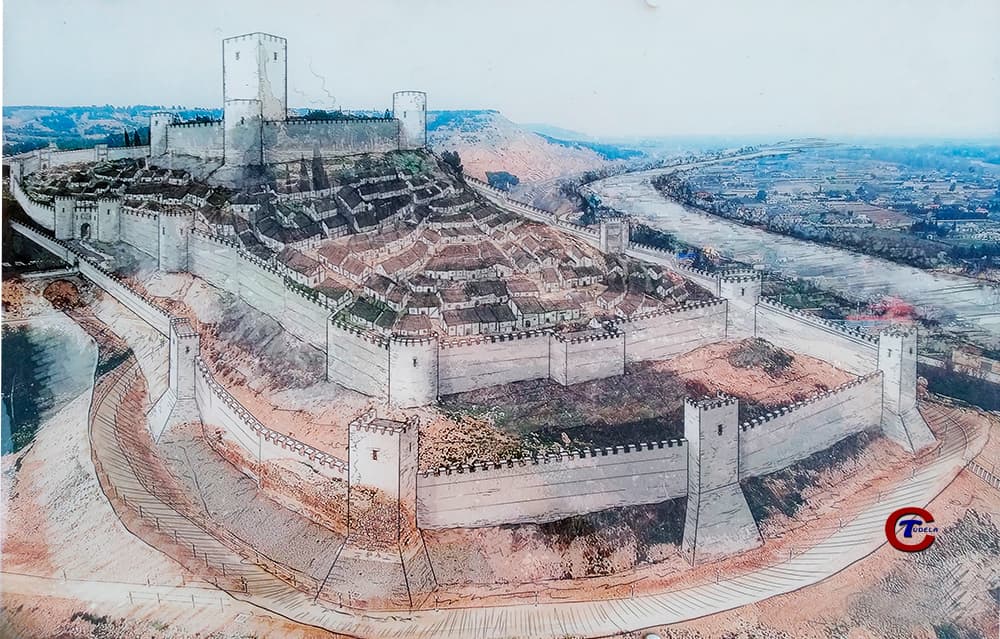
Castle and Mount of Santa Bárbara, Tudela
The Castle and Mount of Santa Bárbara in Tudela, Spain, stands as a testament to centuries of military architecture and shifting political dominion in the Ebro River valley. Originally established in the early 9th century by Muslim builders, the fortress occupies a commanding hilltop known as the Mount of Santa Bárbara, offering strategic oversight of the surrounding plains and the river below. Its location on steep natural cliffs provided formidable natural defenses, augmented by extensive man-made fortifications that evolved through the Early Medieval and High Medieval periods.
Constructed between 803 and 804 under the direction of Amrùs ben Yusuf, a general of the Emir of Córdoba Al-Hakam I, the castle originally functioned as an alcazaba, a fortified Muslim military enclosure. It was a critical stronghold within the frontier zone of Al-Andalus, reflecting the military and administrative needs of the time. The fortress was initially controlled by the Banu Qasi, a powerful local Muslim dynasty that made Tudela the capital of their territories. Later, it came under the authority of the Tuyibíes dynasty as part of the Taifa of Zaragoza, before becoming the seat of the independent Taifa of Tudela. These phases underscore the castle’s significance as a center of governance and defense in a fractious medieval Iberian landscape.
Muslim origins and fortification features
The original Muslim fortress was designed to exploit the natural topography, with steep cliffs on several sides and the Ebro River providing a natural moat on one flank. The fortification included a double wall system: an outer wall encircling the lower slopes of the mount, serving as the city’s external defense line, and an inner wall enclosing the summit area. This inner enclosure was the heart of the alcazaba, featuring a heavily fortified main tower that dominated the landscape and controlled access routes.
Along the lower outer wall, strategically placed towers provided surveillance and defense. Archaeological excavations have revealed remains of nine towers facing the Ebro River and an additional six towers extending toward the historic Calahorra Gate. These towers were integral to the fortress’s layered defense system, enabling defenders to monitor and repel attackers effectively.
Construction techniques included the use of ashlar masonry and rammed earth (tapial), demonstrating the blend of durable stonework and earth construction typical of Islamic military architecture in Iberia. Wells and storage pits uncovered within the site indicate the fortress was designed to sustain a garrison and civilian population during sieges, emphasizing its role as a self-sufficient stronghold.
Christian conquest and medieval transformation
The castle’s strategic importance continued into the Christian Reconquista. In 1119, Alfonso I the Battler captured the fortress, integrating it into the expanding Crown of Navarre-Aragon. Under Christian rule, the castle underwent significant modifications to adapt to new military and administrative requirements. The original Muslim alcazaba was transformed into a medieval castle, with enhancements attributed to Sancho VII the Strong, who fortified the structure further.
During the reign of García V Ramírez, known as "the Restorer," the castle was definitively incorporated into the Kingdom of Navarre, consolidating its role as a royal stronghold. Between 1388 and 1393, King Carlos III the Noble undertook a major redesign, converting the fortress into a royal palace. His renovations introduced new wings, expansive halls, galleries with chimneys, and stained glass windows, alongside heraldic decorations that reflected its elevated status. A spacious plaza before the main gate and the "Porch," a building used for royal justice administration, were notable additions from this period.
Despite these improvements, the castle suffered from periods of neglect and deterioration, with repairs documented in the early 14th century. The Navarrese civil war in the 15th century prompted the deepening of the moat to enhance defenses. However, the castle’s military relevance declined in the early 16th century when Cardinal Cisneros ordered the demolition of its towers and the filling of its moats in 1516, initiating structural decline.
Decline, dismantling, and archaeological rediscovery
After remaining standing through the early 16th century, the castle was gradually dismantled by Tudela’s inhabitants, who repurposed its stones for local construction. This reuse was officially sanctioned by Charles I in 1522. Some parts, such as the central tower known as the "Tower of Don Mejón," were partially preserved and incorporated into the 17th-century Hermitage of Santa Bárbara, which no longer exists today.
The ruins persisted over the centuries and saw intermittent fortification efforts during the 19th century, particularly during periods of conflict. Stone from the castle was integrated into local infrastructure, including the vault supporting the Plaza Nueva over the Queiles River. In the 20th century, the site gained renewed cultural significance with the erection of the Monument to the Sacred Heart of Jesus in 1942.
Systematic archaeological excavations began in 1985, led by archaeologist Juan José Bienes. These investigations uncovered Islamic terraces, walls, wells, and artifacts, revealing the complex stratigraphy of the site. The excavations have been crucial in understanding the castle’s evolution from a Muslim military enclave to a medieval royal palace and its subsequent decline.
Architectural remains and visitor experience
Today, the ruins of the Castle and Mount of Santa Bárbara are preserved within a public park that offers panoramic views over Tudela, the Ebro River, and the surrounding Mejana plains. Visitors can observe remnants of the outer and inner walls, fragments of defensive towers, cisterns (aljibes), and underground passageways that hint at the fortress’s former complexity.
The site’s natural and artificial defenses, including the steep cliffs and moats, remain evident, providing insight into medieval military architecture. The archaeological remains and the landscape together tell a story of cultural layering, from Islamic fortifications to Christian modifications and later adaptations.
While much of the original structure has been lost, the site’s historical significance and commanding location make it a valuable destination for those interested in the military and political history of medieval Spain. The park setting also allows for educational and cultural activities, enhancing public appreciation of this layered heritage site.
Frequently asked questions (FAQ)
- When was the castle originally built and by whom?
- The castle was originally built between 803 and 804 by Amrùs ben Yusuf, a general of the Emir of Córdoba Al-Hakam I, during the early 9th century Muslim period.
- What architectural features remain visible at the site?
- Visitors can see remnants of the outer and inner walls, defensive towers, cisterns (aljibes), underground passageways, and the natural steep cliffs that formed part of the castle's defenses.
- How did the castle change after the Christian conquest?
- After Alfonso I the Battler captured it in 1119, the castle was transformed from a Muslim alcazaba into a medieval fortress and later into a royal palace under King Carlos III the Noble, with added wings, halls, and decorative elements.
- Why was the castle dismantled in the 16th century?
- The castle was dismantled after 1521 when the inhabitants of Tudela reused its stones for other buildings, a process officially authorized by Charles I in 1522, leading to its decline as a military structure.
- Are there ongoing archaeological studies at the site?
- Yes, archaeological excavations began in 1985 and continue to uncover Islamic terraces, walls, and artifacts, providing insight into the castle's layered history.
Photo gallery

Information
Website
Visit websiteSources & official resources
Verify the information above using these authoritative references.
Loading map...
Visitor reviews
No reviews yet. Been here? Write the first review and help other travelers!
Write the first reviewVisited this castle? Share your experience
Your review helps other travelers and adds first-hand knowledge to our encyclopedia.



