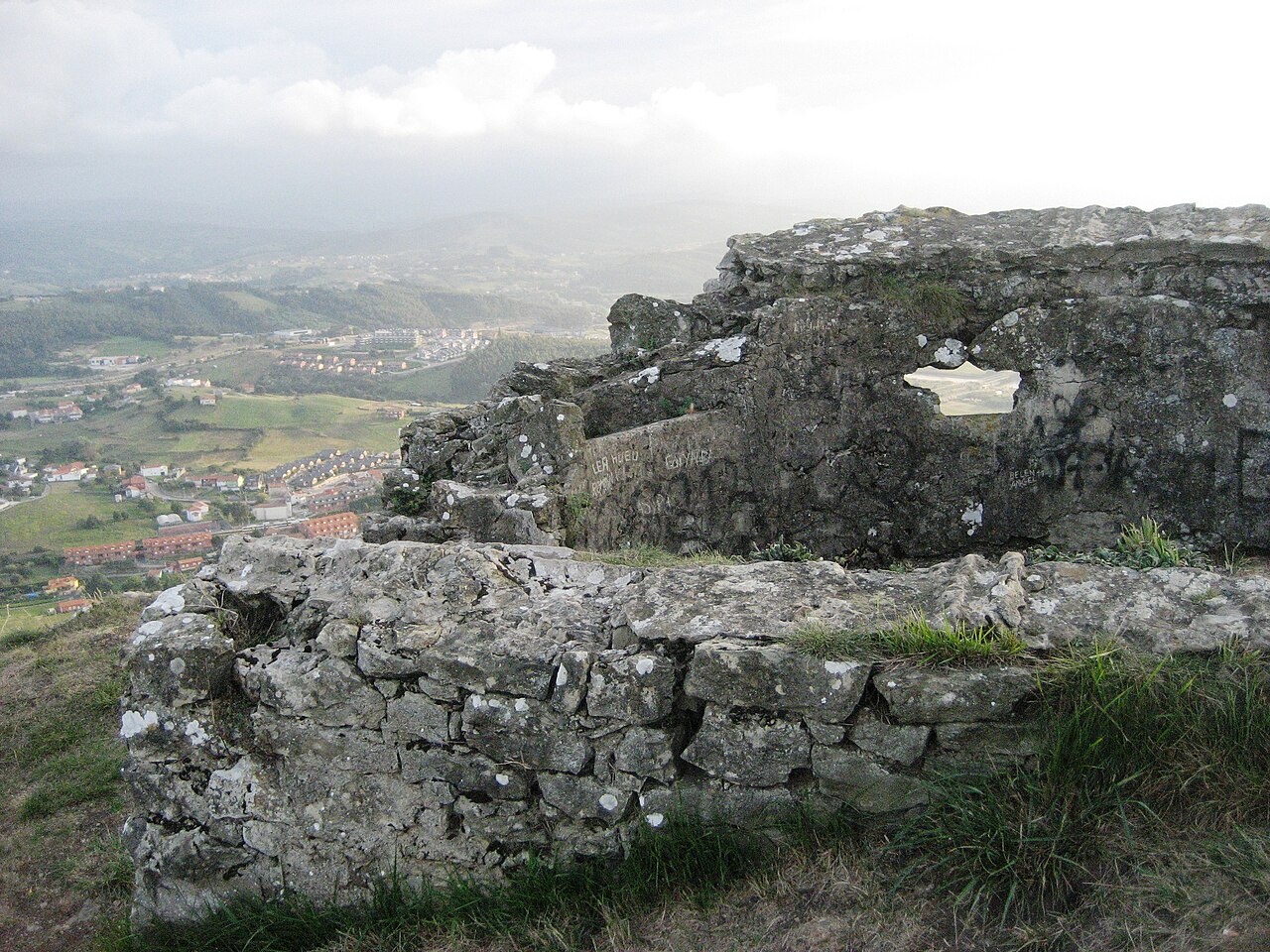
Castillo del Collao
Castillo del Collao is a significant early medieval fortress located in the municipality of Camargo, within the historic region of Cantabria, Spain. This hill castle was constructed during a turbulent period following the decline of Roman influence, roughly between 760 and 1020 AD, as evidenced by radiocarbon dating. Its establishment reflects the broader regional pattern of fortifying strategic hilltops to defend local communities amid shifting political and military landscapes in the early Middle Ages.
The fortress occupies a commanding position at an elevation of 96 meters above sea level, overlooking the Bay of Santander and the valleys of Pas and Camargo. This vantage point provided critical surveillance capabilities, essential for early warning against potential invaders. The site, covering approximately 512 square meters, was the largest among some thirty similar fortifications identified in Cantabria, indicating its prominence in regional defense networks.
Architectural features and construction
The design of Castillo del Collao centers on a robust defensive stone wall exceeding 2.5 meters in thickness. This wall was ingeniously constructed using two parallel faces of carefully cut limestone blocks, with the cavity between filled with rubble, a technique providing considerable stability and strength. The wall encloses a rectangular courtyard, locally known as the patio de armas, which served as the central open space within the fortress.
Within the enclosure, archaeological excavations revealed the foundations of several rooms, distinct from the fortress’s main keep tower. This tower is notable for its rectangular shape and construction from finely dressed limestone ashlar blocks, resting on a substantial base of large, roughly hewn limestone blocks arranged in a cyclopean masonry style. Positioned near the entrance, the tower was integrated into the defensive wall, likely reinforcing the gateway and functioning as a lookout and defensive strongpoint.
Today, the remains consist primarily of foundations and lower wall sections, with surviving heights reaching up to 2.5 meters. Despite its ruined state, Castillo del Collao is recognized as one of the best-preserved early medieval castles in the Cantabrian region, offering valuable insights into the military architecture of the period.
Historical context and significance
The fortress was constructed and actively used during a period of considerable political fragmentation and local autonomy in northern Spain. Following the decline of Roman control, local communities in Cantabria fortified hilltops to protect themselves from incursions by rival groups and to assert territorial control. Although no specific historical records identify the rulers or garrisons of Castillo del Collao, its scale and construction quality suggest it was a key defensive site.
Its active use appears to have ceased in the early 11th century, after which the site was abandoned. There are no documented events detailing its later history or any attempts at reoccupation or reconstruction. The fortress's abandonment corresponds with broader regional changes as political power consolidated elsewhere.
Archaeological discoveries and artifacts
Excavations conducted around the year 2000 uncovered a range of artifacts that illuminate the daily life and military functions of the fortress. These include numerous ceramic vessels varying from undecorated pots to striated and painted jars, indicating domestic activities within the fortress walls.
A collection of iron arrowheads found on site points to the presence of armed defense and possible conflict. Additional finds include everyday tools such as knives and bone flutes, suggesting cultural and recreational aspects of the inhabitants' lives. A terracotta figurine depicting a man in a tunic adds a symbolic or artistic dimension to the site’s material culture.
One remarkable artifact is a gilded bronze applique decorated with monstrous head motifs, which may have served a decorative or emblematic purpose, possibly signifying status or identity within the fortress.
Strategic location and landscape
The fortress’s hilltop location provided extensive views over the surrounding landscape, including the Bay of Santander and the valleys of Pas and Camargo. This strategic positioning was crucial for early detection of threats and communication across the region.
Part of the site includes a designated lookout area (mirador), highlighting the importance of surveillance in its defensive strategy. The natural topography combined with man-made fortifications made Castillo del Collao a formidable stronghold in its time.
Preservation and cultural heritage status
Recognized for its archaeological and historical importance, Castillo del Collao was declared a Cultural Heritage Site (Bien de Interés Cultural) in 2003. Its state of preservation, though primarily ruins consisting of foundations and partial walls, is considered excellent for an early medieval fortress.
Ongoing conservation efforts aim to protect the site and facilitate public access, allowing visitors to explore this important monument of Cantabria's medieval past. Interpretive signage and guided tours help contextualize the fortress within the broader history of the region.
Frequently asked questions (FAQ)
- When was Castillo del Collao built and used?
- Castillo del Collao was constructed and actively used between approximately 760 and 1020 AD, during the early Middle Ages in the Cantabrian region of Spain.
- What architectural features define Castillo del Collao?
- The fortress features a thick defensive stone wall over 2.5 meters thick, a rectangular courtyard, and a prominent rectangular keep tower built with finely cut limestone ashlar blocks on a cyclopean limestone base.
- What artifacts have been found at Castillo del Collao?
- Excavations uncovered ceramic vessels, iron arrowheads, knives, bone flutes, a terracotta figurine of a man in a tunic, and a gilded bronze applique with monstrous head motifs.
- Is Castillo del Collao accessible to visitors?
- While specific visiting hours are not widely published, Castillo del Collao is recognized as a Cultural Heritage Site and is accessible for educational and touristic visits in the municipality of Camargo, Cantabria.
- Why is the location of Castillo del Collao strategic?
- Its hilltop position at 96 meters above sea level offers commanding views over the Bay of Santander and the Pas and Camargo valleys, crucial for surveillance and defense in the early medieval period.
Information
Loading map...
Visitor reviews
No reviews yet. Been here? Write the first review and help other travelers!
Write the first reviewVisited this castle? Share your experience
Your review helps other travelers and adds first-hand knowledge to our encyclopedia.