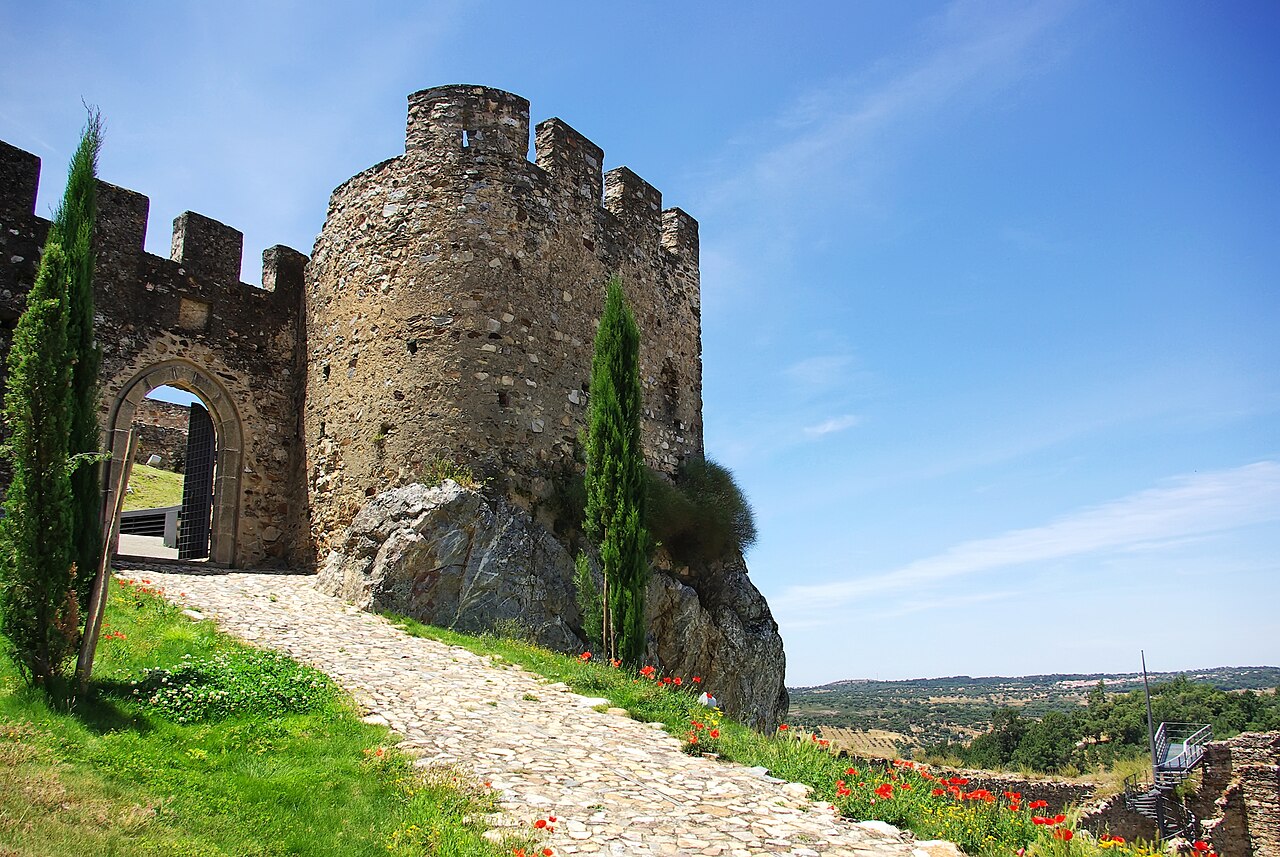
Castillo de Mayorga
The Castillo de Mayorga stands as a significant example of medieval military architecture in Spain, constructed during the 13th century in the municipality of San Vicente de Alcántara. This hill castle played a crucial role in the Christian reconquest period, strategically positioned along the volatile border between Spain and Portugal. Its location was part of a broader defensive network that included nearby fortresses such as Azagala and Piedrabuena, designed to repel invasions and assert territorial control.
Built on irregular terrain, the castle's design demonstrates a keen adaptation to the natural landscape, with its enclosure walls following the contours of the hill to maximize defensive advantage. The walls, notably thick—exceeding three meters in places—reflect the military engineering knowledge of the period, emphasizing durability and resistance against siege weaponry.
Architectural features and layout
The Castillo de Mayorga originally featured a complex internal arrangement centered around a central courtyard. Surrounding this courtyard were residential and service buildings, including a distinctive two-story gallery with a portico, which provided sheltered walkways supported by columns. This architectural element not only enhanced the domestic functionality of the castle but also added an aesthetic quality uncommon in purely military fortifications.
A key defensive structure was the torre del homenaje or keep, located on the western side of the fortress. This tower served as both the last refuge during attacks and a symbol of the lordly authority that governed the castle. The keep's robust construction and strategic placement underscored its importance within the castle's defensive scheme.
The castle also contained multiple named towers and facilities, as recorded in historical documents. These included the Mazmorra (dungeon), Aljibe (water cistern), Horno (oven), Homenaje (main tower), and Las Cabras. Each served specific functions, illustrating the castle's role not only as a military bastion but also as a self-sustaining residence and administrative center.
Historical context and military significance
During the 16th century, the castle remained an active military site, undergoing several phases of modification. These included the demolition and restoration of the barbican, an outer defensive wall designed to protect the main gate. Such changes reflect the evolving military technologies and shifting strategic priorities of the period.
The castle's strategic importance was highlighted during the mid-17th century conflicts between Spain and Portugal. In these turbulent times, Portuguese forces captured the Castillo de Mayorga and deliberately destroyed it before withdrawing. This act of demolition marked the beginning of the castle's decline and eventual ruin.
Current condition and archaeological remains
Today, the Castillo de Mayorga exists as a ruined fortress, with its most intact remains found on the southern side of the site. The surviving rectangular tower and the thick enclosure walls provide valuable insights into the castle's original defensive capabilities. The vaulted passage with a barrel vault ceiling, leading directly into the courtyard, remains a notable architectural feature.
Despite its ruined state, the castle's layout and construction techniques are well documented through both archaeological evidence and historical records. These resources have allowed historians and architects to reconstruct the castle's appearance and understand its role in the border defense system during the medieval and early modern periods.
The barbican and defensive adaptations
The barbican of Castillo de Mayorga underwent multiple demolitions and reconstructions throughout the 16th century. This outer fortification was critical for protecting the main entrance against enemy assaults. Its repeated rebuilding indicates the castle's ongoing military relevance and the need to adapt to new siege tactics and artillery advancements.
Cultural and heritage significance
As a medieval hill castle with a documented history of military engagement and architectural evolution, the Castillo de Mayorga holds significant cultural value. It exemplifies the border fortresses that shaped the historical relations between Spain and Portugal and offers a tangible connection to the region's tumultuous past.
Visitors to the site can explore the ruins and appreciate the strategic ingenuity of medieval fortifications while reflecting on the castle's role in the broader context of Iberian history.
Frequently asked questions (FAQ)
- When was Castillo de Mayorga built and what was its primary purpose?
- Castillo de Mayorga was built in the 13th century during the Christian reconquest to serve as a defensive fortress along the border with Portugal.
- What architectural features are notable at Castillo de Mayorga?
- Notable features include thick enclosure walls following the terrain, a rectangular tower, the torre del homenaje (keep), a vaulted barrel passage, and a two-story gallery with a portico.
- What happened to the castle during the 17th century conflicts?
- In the mid-17th century, Portuguese forces captured and deliberately destroyed Castillo de Mayorga, leading to its decline and ruin.
- Is Castillo de Mayorga accessible to visitors today?
- Yes, visitors can explore the ruins of Castillo de Mayorga, which provide insights into medieval fortification techniques and regional history.
Information
Loading map...
Visitor reviews
No reviews yet. Been here? Write the first review and help other travelers!
Write the first reviewVisited this castle? Share your experience
Your review helps other travelers and adds first-hand knowledge to our encyclopedia.